Jan 27, 2020

Rogue Trader: Holidays of the Acheron sector

I wanted to add a little bit of verisimilitude to our Rogue Trader tabletop role-playing game campaign by figuring out what holidays people celebrate in the Acheron sector. We actually don't seem to know a whole lot about the Imperial year. There's a pretty good summary of what we do know at Bell of Lost Souls, and I've taken it as my point of departure. All dates are, of course, in the Imperial Dating System.

So what we learn from BoLS is that the main holidays of the Imperial calendar are Emperor's Day, which marks the new year, the Feast of the Emperor's Ascension, whose date is not given, and Candlemas at the end of the year. In general, holidays attached to religious figures don't necessarily have anything to do with their actual lives, if they even lived at all; for example, the date of Christmas was fairly obviously selected to coincide with the winter solstice, not least because it was already a popular Roman holiday. The fact that the first "Christmas" was celebrated centuries after Jesus's alleged birth quite conclusively demonstrates that it has no relation to any actual events. Using the same logic, I've decided to assign the Feast of the Emperor's Ascension to Midsummer, or year fraction 500.

This leaves the spring and autumn equinoxes, and since the Imperial calendar is based on ours, I thought it would be appropriate for them to also be important holidays that somehow carry on the spirit of ours. For autumn, it feels very Imperial to celebrate martyrs, so I've named the autumn equinox holiday the Martyrion. Spring is more difficult, since something celebrating new life and fertility verges on Slaanesh (although I still maintain that the Imperium is probably much more sex-positive than our 21st century society!), but I came up with a holiday called Vigilia, or Vigil in English: a coming-of-age feast day themed around the changing of the guard. A new generation takes up the watch and so on.

Apart from these major holidays, I've come up with a bunch of minor ones, with some assistance from my players, for which I'm grateful. As a final note, all the official year fraction dates are just that; in practice, I'd expect worlds would have to decide whether to celebrate a solstice holiday on the actual solstice, or on the exact official Imperial date. With ships each having their own time, some fairly bizarre feast-day coincidences will undoubtedly happen (if they get too bizarre, get in touch with the Ordo Chronos. Be vigilant!)

**

Major imperial holidays

Emperor's Day

Official date: year fraction 1

The most sacred holiday in the Imperial calendar celebrates, well, the Emperor. Not commemorating this holiday is surely a heresy. Unfortunately, we know very little about how it's celebrated! As it opens the new year, I'd like to think it's a time to celebrate new beginnings and undertakings.

Vigilia

Official date: year fraction 250

The Festival of the Watch celebrates coming of age, and the changing of the guard as new generations take up the cause of the Imperium of Man. Vigilia is celebrated in many different ways across the Imperium, from solemn religious ceremonies to blood sports. Space Marine chapters often choose recruits on Vigilia, and it is a traditional time for promotions and retirements.

Ascension

Official date: year fraction 500

Lexicanum tells us that the Feast of the Emperor's Ascension is a week-long festival that's considered an especially auspicious time for marriages and other undertakings, and is generally the most important festivity of the year.

Martyrion

Official date: year fraction 750

As the autumn darkens, Imperial citizens come together to remember the dead at Martyrion. The form of the festivities varies from planet to planet, from somber processions to raucous parties, but all are focused on the honored dead, especially those who gave their lives in the service of the Emperor.

Candlemas

Official date: year fraction 997

A solemn holiday that marks the end of the year, and usually the darkest time of winter. Candlemas is a celebration of the light of the Emperor shining throughout the galaxy. On some worlds, Candlemas is celebrated as Sanguinala, in memory of the sacrifice of the Primarch Sanguinius.

**

Minor Imperial holidays

Day of Light

Official date: year fraction 200

An important ecclesiastical holiday, the Day of Light commemorates the overthrow of the tyrant Vandire by Sebastian Thor, and the founding of the Adepta Sororitas.

Knights' Day

Official date: year fraction 225

The main festival of the year on knight worlds, on other planets of the Imperium Knights' Day is celebrated as a martial holiday and the start of Vigilia festivities.

Feast-day of the Imperial Guard

Official date: year fraction 300

Soon after the great feast of Vigilia comes the feast-day of the Imperial Guard. On worlds with extensive Vigilia celebrations, this can be a solemn holiday of remembrance and return to duty; regiments often ship out after the feast-day. Years of service in the Guard are traditionally calculated by this date.

Day of Mercy

Official date: year fraction 400

A holy day of many saints across the Imperium, the Day of Mercy is the feast-day of the Imperial courts and Judges, and an important day for the Ecclesiarchy. If prisoners are to be pardoned or other indulgences announced, they are traditionally done on this day. The Day of Mercy is also considered an auspicious day to appeal to authorities or sponsors.

The Olympiad

Official date: year fraction 600

The Olympiad celebrates the Treaty of Olympus between the Imperium and the Machine Cult. For reasons that have been long since forgotten, the Olympiad is a time of athletic contests between teams and individuals.

Orphans' Day

Official date: year fraction 650

The feast-day of the Schola Progenum, Orphans' Day is a festival dedicated to children.

Tank Day

Official date: year fraction 700

The mailed fist of the Imperial Guard is celebrated on a day of motor-races and noisy festivities. On some worlds famous for their armored regiments, Tank Day is a highlight of the year and can involve an entire week of feasting, and even contests of skill involving actual tanks.

Masquerade

Official date: year fraction 775

A festival of masks and and revelry, rumored to be the feast-day of the Officio Assassinorum.

Artillery Day

Official date: year fraction 885

A feast-day that celebrates the Imperial Guard's massive indirect fire support, and also the factories and Forge Worlds that produce it. This is a festival of both firepower and labor.

Fleet Day

Official date: year fraction 900

Reckoning

Official date: year fraction 925

The first of the end-of-the year festivals, Reckoning heralds the coming of the Emperor's day and the last labors of the year. It is the feast-day of the Adeptus Arbites and of Imperial justice in general.

Feast-day of the Administratum

Official date: year fraction 950

In the Segmentum Obscurus, Candlemas season traditionally starts in 950 with the Feast-day of the Administratum, signifying another year in the record-books. There is great pressure on the scribes and adepts of the Administratum to conclude their work by the feast-day, though this rarely succeeds. By tradition, Administratum business stops on the feast-day and recommences after Emperor's Day. Filling and submitting forms on the feast-day is considered to bring good luck to the endeavour.

**

Acheron sector holidays

Martyrion of St. Valeria

Official date: year fraction 400

Consort of Saint Anastasia and scourge of the xenos, the Martyrion of St. Valeria the Light-bringer closes out the spring festivities in the Acheron sector, and is celebrated as the feast-day of Navigators.

Martyrion of St. Isabella

Official date: year fraction 700

Revered Saint Isabella the Just purged the Charon fringe of heretics and founded the Acheron sector, where her saint's day opens the Martyrion festivities.

Martyrion of St. Anastasia

Official date: year fraction 800

The last day of Martyrion in Acheron is in memory of revered Saint Anastasia, who opened the way to the rimward reaches of the sector and is especially commemorated in Ultra Pars.

**

Other local holidays

Confederation Day

Official date: year fraction 150

This day commemorates the founding of the Confederation, and is celebrated there as a joyous festival.

**

Anyway there's a bit of fluff that was fun to write. Next up, I think I'm going to talk a little more about the Confederation.

Jan 13, 2020

LotR LCG: The Haradrim cycle

I have crossed many mountains and many rivers, and trodden many plains, even into the far countries of Rhûn and Harad where the stars are strange.
- Aragorn, in the Lord of the Rings, book II, chapter II


Times were weird around Gencon 2016: we'd only just heard about Sands of Harad and gotten our hands on the Flame of the West when the first Haradrim adventure pack was announced, and promised for Q4 that year! Of course, none of us believed it, and as it happened, we got our copy of the Mûmakil in February 2017. February was also when the last pack in the cycle was announced; it officially came out a year later, in February 2018, but we didn't get our hands on it until the very end of April. At this release rate, the Ered Mithrin cycle should still be going!


John Howe: Haradrim, 2002

**

The Mûmakil - DL 4


The first quest in the cycle picks up right where Sands of Harad left off: our heroes have met up with Kahliel and his tribesmen, and are going to make their way back to Gondor. To do this, we're going to need to catch some Mûmakil, or Oliphaunts, to carry us across the Harad desert.


In practice, the quest is pretty heavy on locations until you get to the final phase, where you have to take on the Mûmaks and do damage to them in order to catch them. Out first three-handed attempt with the hobbits ended in location lock, so bring location control! There's also a treachery that turns into a condition attachment, Terrible Fever, and even an enemy that does the same, so bring something to get rid of them as well.


Next time, we brought a bear. This time, we survived the initial flood of locations and got our questing going. The enemies aren't very tough, but when the Mûmaks showed up, we got into a proper fight. Beorn died defending a Mûmak attack, but was brought back by Landroval, and eventually (pre-errata) Boromir secured some Support of the Eagles and memorably defended three Mûmakil in a turn! Soon enough, a Northern Tracker cleared out the locations, and when the last Mûmak fell into one of our traps, we won!


I still think that condition attachments are one of the worst-thought-out ideas in an otherwise excellently designed game; most quests don't have them, so something like Power of Orthanc will be a dead card most of the time. It feels a bit silly to have a list of the quests where I need to remember to add them to my deck. I like condition attachments as such - they work well in this quest - but I wish they were better integrated with the rest of the game.

Having said that, though, we enjoyed this quest. It's a bit heavy on the locations, but the mechanic where you first have to find and then catch the Mûmakil feels really thematic and a little different than anything we've done before. My only real complaints are that the locations all feel a bit too similar, and the encounter deck is really thin; in a reasonably succesful three-player game where we weren't particularly taking our time, we reshuffled at least twice. But like I said, it was fun and thematic, and I feel that this is a necessary part of the Harad experience.

Card spotlight: Wait No Longer


There were lots of useful player cards in the Mûmakil: we got Leadership Feint, Lore Feint, and, of course, Kahliel and the other objective allies from the Long Arm of Mordor as player cards. But the most interesting card here is the one that gives Tactics some encounter deck manipulation. In most quests, swapping an encounter card in staging for an engaged enemy is simply a great deal, especially for someone like Core Legolas, or a Dúnedain deck. Obviously this is an amazing card in solo, where it lets you skip staging entirely, but even with more players, everything is just that much easier with less encounter cards. Especially brilliant for a last-ditch questing push, where the extra engaged enemy just won't matter.

**

Race Across Harad - DL 6


Now that our heroes have captured Mûmaks to ride, they take off across the desert for the river Harnen, which marks the boundary between Harad and Gondor. Pursuing them are orcs on wargs, so not only do we have to survive the desert, but also outrace the orcs.


In practice, the quest setup is identical to Flight of the Stormcaller: there's the usual quest deck and staging area, and the orcs have their own area, as well as a quest deck they're advancing on. There are orc and warg enqemies, and the wargs will sometimes attach to the orcs as mounts, which is clever and works with the concept of the quest. Other than that, however, there isn't a whole lot of new stuff here. We took a swing at this back when it came out, but misplayed the orcs' questing at first, so although we won, I'm afraid we have to forfeit the result. We did have a fairly epic time of it, though, using a Boromir bomb to survive one last onslaught of enemies until a last questing push, aided greatly by Wait No Longer, got us to the river.


This is by no means an easy quest: quite a lot of threat can pile up in the staging area, and quite a few orcs in their staging area. I have to say, though, that as much fun as riding Oliphaunts across Harad is as an idea, in practice this is kind of a forgettable quest. It doesn't help that it really is exactly like Flight of the Stormcaller, but whereas that quest did a really good job of creating the feeling of an intense chase on the high seas, this is just, well, a slightly humdrum quest with like a desert, and some orcs. Decent but unimpressive.

Card spotlight: Steward of Orthanc


Two willpower and two hit points for three neutral resources? Spirit is the only sphere in which this isn't a great deal, and it's amazing for Tactics. The ability is a pure bonus. Also, it was a real pleasure to see an Orthanc ally again; it's a long time since the Ring-maker cycle, and we weren't expecting to see any more of these guys. It was kinda weird to see a whole archetype like Doomed introduced and then almost abandoned, so not only is this a really good card, but also a pleasant surprise.

**

Beneath the Sands - DL 5


In the comedy of errors that is our heroes' trek across Harad, they've now stumbled across desert spiders, and have to go rescue their companions from a spider cave in the desert.

We gave it a shot, and while the quest itself isn't too difficult, we eventually lost to location lock because several copies of Blocked Passage showed up, completely negating all of my deck's location control abilities. So that was annoying. Other than that, it's not a bad quest, but the on track - off track mechanism is a bit fiddly, and basically the quest consists of clearing uninteresting locations and fighting weakish enemies. Not exactly memorable.

Card spotlight: Keep Watch


An interesting side quest for several reasons: not a battle quest like the previous Tactics side quest, and a potentially very useful effect. Side quests are very situational, and since they're limited to one copy each, rarely show up, but this is one I really wouldn't mind seeing in, say, Moria.

**

The Black Serpent - DL 8


With the spiders behind us, our heroes come across the Black Serpent's forces. This quest is a pleasant surprise, as we're the ones doing the raiding for a change: you advance the quest both by placing progress and capturing objectives, which earns you the increasing attention of your enemies. Also, we're finally fighting the Haradrim again, in this adventure pack cycle called the jungle creatures southern orcs desert spiders Haradrim!


We took a stab at this quest three-handed with our visiting hobbit player, and pretty comprehensively threated out after losing several heroes to a combination of nasty shadow effects and the Black Serpent himself. Like the quests in the Harad deluxe expansion, this one was difficult (even if DL 8 feels a bit high), but it didn't steamroll us with massive enemies or giant piles of threat. Instead, this is another intelligently designed quest where the different pieces interact with each other to produce an escalating threat that you feel like you have several ways to fight. So a good quest, then; if you don't mind a little difficulty, I might even recommend it.

Card spotlight: Southron Refugee


An inadvertently topical card in terms of contemporary politics, the Southron Refugee is also the first faction reducer character like the ones we're used to seeing in the Game of Thrones LCG. She's certainly well suited to the expensive unique Harad allies, and the second hit point means she's not entirely useless on her own either. I also wanted to highlight this card because it reminds us of a feature of Tolkien's works that so often gets overlooked: his humanity towards the enemies of the Free Peoples. Sam gets a moment of empathy with the dead Southron warrior; Gandalf tells us he even pities the orcs. Similarly, the suffering and destruction of war isn't elided in the Lord of the Rings, but is part of the overall tragedy. So as a Tolkien fan, I'm very happy that Southron Refugee is part of our card collection.

**

The Dungeons of Cirith Gurat - DL 7


I guess the raiding of the southron caravan didn't go all that well, because the next quest is a jailbreak. This one focuses on capturing allies, but I have to be honest and say that we didn't really get anywhere with this quest, so this is a bit of a non-review. We found the combination of pure difficulty right off the bat and the sheer amount of text and special mechanics so offputting that we gave up on this one. Maybe there's a good quest hidden under all that stuff, but honestly, I doubt it.

Card spotlight: Heirs of Eärendil


Not only is this an excellent location control card, but I love the way it takes the Haradrim cycle mechanic of playing off heroes' traits and executes it in a very Tolkienian way. I used this with Arwen and Idraen, which I find adorably cute in so many ways.

**

The Crossings of Poros - DL 5


The last phase of our heroes' journey takes them to the Poros, the river that marks the boundary between Gondor and the lands of the Haradrim. Continuing the trend of really fiddly quests right to the end of the cycle, here you get an encounter deck and four different set-aside encounter decks. The occasional treachery will make you reveal a random card from a set-aside deck, and which randomly selected quest stage you end up on also removes some decks. This is another one of those things where on the one hand, I see how this is good for replay value and it's kind of interesting in itself, but again, it's fiddly, overly complicated and distracts from the actual gameplay. Because you can also draw just about anything, on our first try we found ourselves facing both the Uruk Chieftain and a Southron Champion - in addition to The Black Serpent, obviously - on our second turn! So the difficulty level can be, shall we say, variable. Still, at least it's an interesting quest, although again we didn't get very far.

Card spotlight: Wind from the Sea

Magic Ring is also in this adventure pack, and it's a really cool card because it's about time we got an artifact that represents both the potential and the danger of Rings of Power! But I like Flight to the Sea more, because it's also intensely Tolkien, and it lets you screw around with the encounter deck, and that's always fun. Specifically, for the measly price of two Spirit resources, you get to shuffle this beauty into the encounter deck:


It doesn't even have surge! I love the art, and the card itself is such a delight to see in staging. When it turns up as a shadow card, it can sometimes feel a bit wasted - but in that case it goes back into the discards, so if you're lucky you'll draw it again. An excellent card, very cheap and I think definitely worth bringing in any Spirit deck that can afford it.

**

On the whole, then, the Haradrim cycle was a bit of a mixed bag. None of the quests really stand out; Black Serpent was pretty good, Dungeons of Cirith Gurat wasn't; Crossings of Poros was kind of interesting, most of the rest of them weren't. I think Poros is the only one we'd be interested in revisiting at all. So I might actually go as far as to say - with the considerable caveat that we've barely played the Angmar adventure packs at all - that unfortunately the Haradrim cycle is the blandest adventure pack cycle in the game.

**

As for my deck, it remains unchanged.

57 cards; 33 Spirit, 20 Lore, 4 neutral; 25 allies, 13 attachments, 16 events, 3 side quests. Starting threat 27.

Lanwyn (TTitD)
Idraen (TTT)
Rossiel (EfMG)

Allies: 25 (19/6)
Elfhelm (TDM)
Northern Tracker ×2
Bofur (TRG)
Elrohir (TMoF)
Greyflood Wanderer (TTT) ×2
Rhovanion Outrider (TotD) ×2
Arwen Undómiel (TWitW) ×2
Bilbo Baggins (TRD)
Curious Brandybuck (TWoE)
Galadriel's Handmaiden (CS) ×3
West Road Traveler (RtM) ×3
Elladan (TMoF)
Mablung (TLoS)
Warden of Healing (TLD) ×3
Henamarth Riversong

Attachments: 13 (7/5/1)
Unexpected Courage ×2
Light of Valinor (FoS) ×2
Mithril Shirt (TFoW)
Song of Eärendil (RtR)
Warden of Arnor (TTT)
A Burning Brand (CatC) ×2
Cloak of Lórien (CS)
Dúnedain Pipe (TBS)
Map of Rhovanion (TWoR)
Magic Ring (TCoP)

Events: 16 (5/8/3)
Flight to the Sea (TCoP) ×2
A Test of Will ×3
Leave No Trace (EfMG) ×2
None Return (AtE) ×3
Daeron's Runes (FoS) ×3
Keen as Lances (EfMG) ×3

Side quests: 3 (2/1)
Rally the West (TBS)
Double Back (EfMG)
Scout Ahead (TWoE)

Sideboard:
Dwarven Tomb ×2
Power of Orthanc (VoI) ×3
Deep Knowledge (VoI) ×3

Lord of the Rings saga expansions with Fellowship Frodo when the hobbit deck isn't around sideboard:
Sam Gamgee (TTitD) x1

Jan 6, 2020

Let's Read Tolkien 64: The Passing of the Grey Company

Gandalf was gone, and the thudding hoofs of Shadowfax were lost in the night, when Merry came back to Aragorn.

Meanwhile, back at the other ranch: Gandalf speeds off with Pippin, leaving Merry with Aragorn, Gimli, Legolas and the Riders of Rohan. Soon after they've set off back to Helm's Deep, they're overtaken by a group of riders who turn out to be Aragorn's kinsmen from the North, and Elrond's twin sons. I don't think we ever find out if they're as racist as their dad. Anyway they bring Aragorn a flag and some lore reminders.

Fortified with these, Aragorn withdraws while the others eat at the Hornburg. For his own reasons, Merry has taken a shine to Théoden, and offers his service to the king. It's accepted, and he rides off to Edoras with the king's household while Aragorn dramatically announces that he will be taking the Paths of the Dead.

After Théoden's party leaves, Aragorn explains that he looked into the palantír. He not only introduced himself to Sauron, but as Isildur's heir and therefore the rightful owner of the stone, used it to look around a bit as well. Apparently he saw a threat from the south which he has to intercept, and he will do this by passing the White Mountains through the Paths of the Dead, and recruiting a bunch of dead guys while he's there. Dead Men of Dunharrow is a hell of a card to have at the right time in War of the Ring, so it's a good strategy. The ghosts will do what he says because - you guessed it - he's Isildur's heir.

The way to the Paths is through Dunharrow, where Éowyn is in charge. Because the Rohirrim apparently believe that if you go to the Paths you get eaten by ghosts or something, she is very skeptical about Aragorn's plans. However, because she has a crush on him and is extremely frustrated that she can't go to war with her king, she begs Aragorn to take her with him. He refuses and gives her a homily on how she needs to stay behind, and how she may yet get to fight to defend her home if the men fail. Her reply:

And she answered: "All your words are but to say: you are a woman, and your part is in the house. But when the men have died in battle and honour, you have leave to be burned in the house, for the men will need it no more."

This is such a searingly, amazingly brutal takedown of Aragorn's patriarchal condescension that I'm still not over it. Aragorn then rides off and they go through a scary ghost place to meet the ghosts, but never mind because this is the key part of the chapter right here. Éowyn is directly putting into words how the system of male honor and warfare works: only men are allowed to go and fight, and if they win, women must praise and worship them; if they lose, it doesn't matter what happens to the women because the men will no longer need them. Whatever her abilities, a woman's place in this scheme is only ever as a spectator or a victim. Aragorn has no counter-argument to this, and only gets out of the situation on the technicality that he can't countermand Théoden's orders.

"I can ride and wield blade, and I do not fear either pain or death."
"What do you fear, lady?" he asked.
"A cage."

This is genuinely powerful stuff. This is Éowyn's chapter; Aragorn just happens to ride through it.

**

So, the return of the king is underway, with Aragorn openly declaring himself Isildur's heir to various ghosts and Saurons. His claiming of the palantír and confrontation with the Enemy is good stuff. For all that he carps on about his royal heritage, though, it's worth remembering that the actual hero of the story, Frodo, is the heir of Bilbo, but neither of them ever got anywhere by declaring their illustrious heritage. Because they don't have one. Heritage and heroism were current themes as I was writing this, and there's still a strange obsession with bloodlines and descent in our entertainment, from space wizard daddy issues to orphan wizards who grow up to be cops. Tolkien and his waning bloodlines certainly plays his part, but let's not forget that the fate of Middle-earth is not ultimately decided by any scion of a legendary family tree.

Tolkien takes a moment here to underline the connection between the Rohirrim and the Anglo-Saxons by referring to the "weapontake" at Edoras; in the Danelaw, a wapentake was a subdivision of a shire, and here Tolkien uses the word in a far more literal meaning that may well be where it originally comes from.

Edoras, by the way, is where we already met Éowyn. How Tolkien goes from an entire novel that fails to feature one single named woman character to Éowyn basically indicting the patriarchy, I will never fully understand. Her biting commentary on gender inequality could have been written today.

In his letters, Tolkien talks briefly about the "theme of mistaken love" (Letters, 131) with Éowyn and Aragorn; the idea is that Aragorn represented a way out of her predicament, rather than someone she actually loved. Her despair at being left behind due to sexism is palpable.

My personal opinion is that in the end, the absence of women in Tolkien's writing is not necessarily so much due to any particular misogyny, but rather that it's a product of his almost exclusively masculine upbringing. While it's far too rarely remarked upon that Tolkien was introduced to this whole business of inventing languages by two of his female cousins, most of his childhood and youth after the death of his mother seem to have been spent in exclusively masculine company. His only sibling was a brother; they were raised by a Catholic priest and went to boys-only schools; Tolkien's friends at university seem to all have been men, and he served in the army with men. With a background like this, is it really surprising that women are either distant and ethereal objects of worship, matronly older relatives or, far more often, simply completely absent? It seems like it would have been quite natural for Tolkien to have conceived of his stories as quite literally "Boys' Own" adventures.

The great exception, of course, is Éowyn, who comes straight out of the Scandinavian sagas. In a sense, she's another victory of Tolkien's faithfulness to his "Northern" ideas: even though women barely appear in the story at all, if the Lord of the Rings is a saga, then it must have a shield-maiden, and Éowyn is her. As I said earlier, Éowyn also echoes the strong historical role of women in Mercia, which Éowyn's Rohan is based on. Ultimately it's a tragedy that Tolkien was so incurably phallocentric in his writing, since I think Éowyn and Lobelia Sackville-Baggins are some of his best characters. He could "write women"; he could even potray a woman as equal to men; it's just that he could not actually seem to conceive of women as equal participants in his stories. Their absence is one of the most enduring, fundamental flaws of his work.

**

Next time: more horses.

Dec 30, 2019

End-of-year thoughts: Getting back into Warhammer

As a byproduct of our by now largely moribund Rogue Trader tabletop role-playing campaign, I've gotten back into Warhammer, kind of. At least to the extent that I have opinions on it again.

**

Rules bloat is getting completely out of control in Warhammer 40,000. Let's take my Chaos army as an example. Back when we decided to get (re)started with Warhammer 40,000, my players were going to have an Imperial army, so the obvious thing to do, both fluffwise and based on the models I had at hand, was to build a Chaos army for them to fight. Since I have a theology degree, clearly my legion choice was Word Bearers. We got through the first and second games just fine with the Imperial Guard and Chaos Space Marine codexes.

For our third game, we wanted to use my old Space Marine vehicles and some Imperial Knights, which meant more codexes, but I'm fine with that; especially since at the time, the Renegade Knights codex was a free download.

However, since I'm playing Word Bearers, I was interested in the new Dark Apostle rules in the Vigilus Ablaze campaign book, and I bought it so we could use the new prayers in our game. I had also planned to field some Obliterators, but the Shadowspear boxed set came out around that time, with new rules and points costs for them. I was completely perplexed by the idea that a boxed set could suddenly change the matched play rules for a unit, and ended up not using them.

The next thing that happens is that a new Chaos Marine codex comes out. I was a bit annoyed by this, to be honest! I felt like I'd shelled out over 60€ on two books, only to have them immediately superseded. I was around for 3rd edition, when they also released two codexes for some armies - but it was explicitly done because a new edition was coming, and the new codexes would be "forward-compatible". This time they've said no such thing.

Then it turns out that the new codex actually doesn't include the specialist detachment rules in Vigilus Ablaze, so I guess I didn't completely waste my money. Should I still buy the new codex, though? Absolutely not, because right on the heels of the new codex they announce the next line of campaign books, the first of which, Faith and Fury, will include new legion rules for the Word Bearers! So do I get Faith and Fury, or do I wait for a third codex that maybe incorporates the legion rules in Faith and Fury, or maybe doesn't? I'm also delighted I didn't buy the new loyalist Marine codex, because guess what? They're also getting a pile of new rules in Faith and Fury!

Back in third edition times, we got quite a few rules updates in White Dwarf, and they also came up with Chapter Approved books, so if you wanted to do something clever, it was quite possible you'd have to lug around some WDs and a Chapter Approved book in addition to your codex. People did complain! But what makes eighth edition potentially much stranger is that now rules are popping up in all kinds of places, from 40k boxed sets to expansions for other games, like Kill Team and Blackstone Fortress. You can make a whole battalion with Blackstone Fortress rules, although I think you'd be better off with Renegades and Heretics from the Imperial Armour book. This can be a bit confusing.

By the way, in the middle of all this, Chapter Approved comes out once a year and they keep tinkering with the points values. I had some success with Chaos Cultists in our first games, but when they went up to 5 points each and lost access to legion traits I started looking at Renegade Militia instead - only for Chaos Cultists to drop back to 4 points in CA 2019.

But really, the worst thing is the new codexes. I like codexes! I own most of the 3rd edition ones, I think, and at least the CSM 3.5 codex. But the fact that the current ones might be superseded within the same edition has just completely put me off buying any. I know I want some Machine Cult units for my Imperial army, and now that we've been playing Munchkin 40,000 and enjoying some Necron-based humor, I might even like to look into Necrons - but why buy a codex when for all I know, a newer version is coming out next month? And why buy a campaign book if the rules in it are going to be reprinted in a more convenient book later that year?

To take another example, I really like the Adeptus Mechanicus Archaeopter that was shown off at the Warhammer 40,000 Open Day, and I'd like to make an AdMech detachment for my Imperial army. But again, what's the point of getting a Codex if a new one might appear at any time and make it obsolete?

The lesson seems to be to only buy new books if I'm going to be using the rules in them imminently. Saves money, I guess. I can't imagine this is the outcome GW had in mind.

**

Then there's Age of Sigmar. Apparently when I wasn't keeping up with things, they decided to blow up the Warhammer Fantasy world, the chief objectives seeming to be to make Sigmar into Fantasy Emperor, introduce his tremendously boring Fantasy Space Marines and change all the names into something easier to trademark. So instead of orcs you now have Orruks, dwarves are Duardin, and so on. It all feels more than a little silly, like calling the Imperial Guard "Astra Militarum" (which means "stars of the soldiers" but never mind), but all over the place. The fluff is also kind of weird, because they've kept so many of the old Warhammer Fantasy units but changed the backgrounds. For example, you still get Black Ark Corsairs, but now Black Arks are just ships, rather than magically floating elven castles. And so on.

On the other hand, they're doing a bunch of interesting things with it, like flying sharks and steampunk dwarves with flying ships, so I'm actually kinda on board with it. Also, with the Cities of Sigmar army book, I can have an army with elves, dwarves, humans and flying sharks, which sounds like a fun thing to collect. It's just that I'm not one bit interested in any of the new fluff.

On top of all this, though, last month GW announced they're bringing the Old World back. To be honest, I don't really care. I'm getting bored with nostalgia.

**

Finally, though, there was this blog post, published after the author died of cancer. In a moving post in general, what really stuck with me was his admonishment to stick to projects and finish them, both as a way to control your spending and, well, to get things done. With more modelling projects underway that I can count, I felt that. So I think that's going to be my new year's resolution for 2020 and indeed the decade in general: I will finish modelling projects before starting new ones.

So in practice, that means building up tournament-sized Imperial and Chaos armies for next summer, and actually finishing all the damn models! Once they're done, I'm going to see about turning my very eclectic Warhammer Fantasy collection into something Age of Sigmar-ish. Luckily, Cities of Sigmar makes that look surprisingly likely. Even though I very rarely play and am mostly a collector, I still prefer collecting an army that would make at least some sense on the tabletop, in some more-or-less current edition of the game. And I do enjoy playing when I get the chance!

Especially when working on abstract things like lecture courses or academic articles, I've found it thoroughly relaxing to be able to work with my hands and concentrate on building or painting something. I'm going to try adding the additional dimension of actually finishing projects. We'll see how it goes.

Dec 23, 2019

CKII: The House of Solomon

And Sulaiman was Dawood's heir, and he said: O men! we have been taught the language of birds, and we have been given all things; most surely this is manifest grace.

- the Qurʼān, 27:16


Like I said in my previous Crusader Kings II post, there have been so many changes to the game since I last played that I need to figure it all out again. When I finished my teaching last fall, it felt like a good time to do just that. One of my lecture courses was on the Cold War, and I talked about the last emperor of Ethiopia, Haile Selassie. He reckoned himself part of a dynasty reaching all the way back to the Biblical King Solomon. How am I supposed to not think about Crusader Kings? I tried playing as a tribal ruler in Africa before, and it didn't go great. Maybe I should try being a successor of King Solomon?

I set the start date to 769, found the Solomonid King of Abyssinia, and got started. The goal in this game is going to be very simple: survive. In reality, the Solomonids made it to 1975, when Emperor Haile Selassie was murdered by communists. In Crusader Kings, this isn't very easy to do; the defensive advantages of the Ethiopian Highlands aren't that great in the game, and the Prophet's alleged command to his followers to leave the Abyssinians in peace is nowhere to be found. Allegedly, the Prophet sent his daughter Ruqayyah and her husband ʿUthmān, the future Rāšidūn caliph, to safety in Abyssinia when the Quraysh were still opposed to Islam, and in gratitude commanded his followers to respect the Abyssinians' Christian faith. In Crusader Kings at least, the Abbasid caliphate is already firmly established and not particularly well-disposed toward Abyssinia, and I'm not sure if there's a lot I can do to stop being swallowed up by them. I'm just going to have to hope they have better things to do - and that the Catholics invent crusades soon.

In the game, the Solomonids are miaphysites, which may well have been the case if they actually ruled as far back as then. I'm planning a series of lectures on the Crusades, and I think much of, if not all of the first one is going to have to be dedicated to Christology, because it's very difficult to understand the Middle East before the Crusades without understanding the Christological debates that split Christianity into so many different sects long before the east-west divide.

To make a long and complicated story very short, the issue is the physis (φύσις) or nature of Jesus. Early theologians believed that Jesus was both divine and human, but how did that work in practice? By the time the Gospel of John came to be written, Christianity was already being expressed in the language of Greek philosophy: in the beginning, there was the logos (λόγος). While this made Christianity a lot easier to sell in the Hellenic world, it also gave rise to several intractable theological problems. By associating Jesus's divinity with the Platonic ideal of the logos, it creates an issue with Jesus's actions and experiences because the logos resides in the perfect and unchanging realm of ideas. If he is the logos, then he must be perfect, and implicit in the Platonic definition of perfect is that a perfect thing cannot change. If Jesus cannot experience change, can he be said to have actually suffered on the cross? And if he didn't suffer, did he really redeem mankind?

The official opinion of the Catholic, Eastern Orthodox, and indeed Anglican and most Protestant churches is duophysitism, as defined as the Council of Chalcedon in 451: Christ is fully human and fully divine, having two natures (hence duophysitism) which cannot be separated from each other. An opposing view was championed by Cyril of Alexandria, a complete villain and vicious antisemite, whose thugs murdered the philosopher Hypatia: Cyril maintained that Christ had only one nature, which united the divine and human. This position came to be called miaphysitism, and became the creed of the Oriental Orthodox churches, including the Coptic church of Egypt and the church of Ethiopia. Hence Crusader Kings II models miaphysitism as a branch of Christianity with a Coptic pope resident in Alexandria but mostly practiced in Abyssinia.

A more extreme formulation of the same idea is monophysitism, a doctrine that maintains Christ had only one nature, in which the divine and human were not united, but the divine nature of Christ effectively replaced some parts of the human nature. Apollinarism, named after Apollinaris of Laodicea, maintained that Jesus had a human nature, but his soul had been effectively replaced by his divinity. I've always thought of it as saying that Jesus was, in a sense, a man possessed by god. The even more extreme doctrine of Eutychianism maintains that Jesus's human nature was dissolved into his divinity, and therefore Jesus really only had a divine nature. Monophysitism is condemned as a heresy, and is modelled as a heresy of miaphysitism in Crusader Kings II.

In the first century or so of my campaign, monophysitism is key. It's apparently a popular heresy along the upper Nile, and we used this to our advantage early on: an independent province or duchy would experience a monophysite revolt, convert, and we'd declare holy war and conquer the heretics. After some heresy-driven consolidation, we ended up at a rough strategic balance at the uppermost reaches of the Nile on the game map: the miaphysite realms of Abyssinia, Makuria and Alodia, all miaphysite and all approximately as strong. We and the Makurians were under pressure from the Muslims to the north and east, the Alodians from the pagans to the west.


The first dramatic change to this balance was when Alodia converted to monophysitism, which led to several serious wars over the exact nature of the divine person of Christ. The second was when the Abbasids swallowed up almost half of Makuria and all of Alodia.


The Abbasid expansion made life a little bit more complicated for us. Luckily, the caliph's attention was elsewhere, but we still had to fight off several holy wars from minor Abbasid rulers. We defeated an invasion from Yemen, but the sultan of Egypt then invaded with a far superior force. Our only chance was to defeat his two armies separately, and we were rewarded with a tremendous stroke of luck.


Soon thereafter, King Rema Armah was succeeded by his son, but we don't talk about him.


King Rema Armah's grandson Kifle Solomonid died at the young age of 34; the stress of defending the kingdom and trying to keep Makuria standing got to him. He was succeeded by his son, King Benaim (859-921), and that's when things really started to get interesting.


In 879, the Abbasids exploded.


Muslim dynasties in Crusader Kings II can suffer from decadence. If their decadence gets high enough, they can get Howardianly invaded by a more virile nomad tribe, which usurps the dynasty and shatters their realm. In our case, the Abbasids were overthrown by the Muhallabids, and all of a sudden the map looks very different!


In the year 900, appropriately enough while we were still in the middle of a holy war, the Catholics invented crusading. Apparently the Umayyads of al-Andalus expanded far enough into France to trigger the crusades, which works for us.


Now that crusades are a thing, in 903 King Benaim founded the Miaphysite holy order, the Order of Saint Anthony. Apparently there was never any such chivalric order in Ethiopia, but many westerners thought it existed and it was in fact created by the Ethiopian monarchy in exile in the 1980s, so hey, why not. In the game, they provide a tremendously useful force of heavy cavalry that's available for free when defending against a holy war. This is an excellent investment for us, and I for one am delighted that the Umayyads were so interested in France.


Eventually, the Abbasids recovered the caliphate, but not their territories in Persia and beyond. King Benaim was able to take advantage of the chaos to conquer the Horn of Africa and even grab Socotra, where we founded a vassal merchant republic of our own.


With that additional income in the royal pockets, it was time to start construction on my first ever great work: the Great Library of Aksum. One of the (frankly ahistorical) downsides of starting in Abyssinia is the abysmally low technology level, and I feel like we need to do everything we can to change that. A Great University would be even better, but we don't have the tech for it, and anyway the Great Library was always my favorite wonder in Civilization.

**

As the story has it, the historical empire of Aksum was destroyed by Queen Judith of the Jewish kingdom of Semien. My Abyssinian kingdom was spared a Judith, but that's not to say they didn't try. Semien had tried to stab us in the back several times, launching a holy war when we were distracted somewhere else, but we'd managed to hold them off. After King Benaim's death, they made another attempt.

Instead of a Judith, they had a King Pirkoi, who was pretty much a military genius. When my idiot vassals decided to start a rebellion for more council power, Pirkoi launched a holy war and managed to conquer Aksum. The morons and their council cost us the heart of the kingdom. I had the ringleader executed, and damn near quit the whole game there and then.

Things looked great for King Pirkoi. He'd conquered Aksum, humiliated the dynasty of Solomon, and was now the proud owner of the Great Library of Aksum. Empires have been started with less, by lesser men. It would be a real shame if something happened to him.


A key part of the success of our plot was the enthusiastic participation of his wife. Pirkoi was succeeded by his son, who was still a child when we retook Aksum in a holy war. The second holy war saw an invasion of Semien itself, the capture of the young king, and the extinguishing of his kingdom.

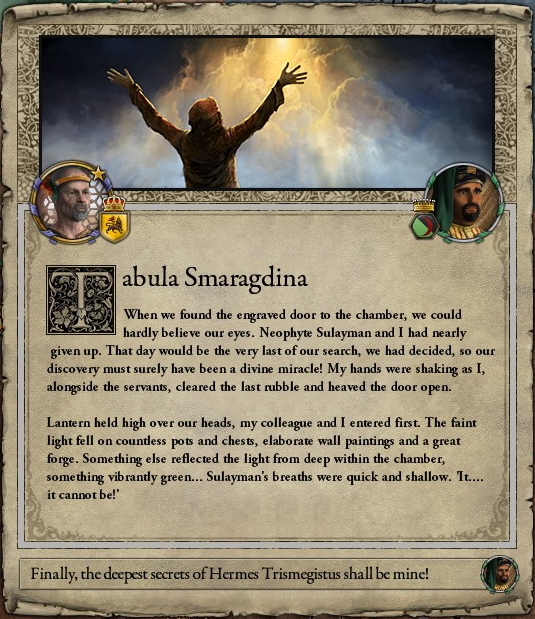
While all this was going on, we also made an unusual addition to the royal treasury.


Ever since the Hermetic Order was founded, I've tried to get my kings to be members. The Learning boosts really help with developing technology, and I've also started a collection of magnum opuses. The stat bonuses they offer are simply too good to pass up.

Meanwhile, we've also worked to develop tolerance so we can advance the status of women in Abyssinia. While I like that you can work to change the gender laws in Crusader Kings II, I'm also disappointed that the default "traditional" model everywhere is maximum misogyny, when we don't actually know that was necessarily the case at all. Still, at least the game makes the most basic argument for gender equality: full status of women doubles the amount of available commanders.


In 974 we got a whole new kind of challenge: the plague. The royal family survived in seclusion, with food threatening to run out when the pandemic moved on, but the destruction was almost complete.


By the millenium, the Muhallabids had returned to the throne again, and their empire stretched from Spain to Afghanistan. In 1008, they won a jihad against Byzantium for the kingdom of Anatolia.


This is how things stood in 1024. Eastern Europe was dominated by the pagan realms of Serbia and Novgorod; Catholic Sweden had risen to a surprising stature with lands all the way down to the Adriatic; and a Nenets noble had founded the Holy Roman Empire in Italy. Dominating the Middle East and Africa is the Muhallabid empire.


Facing this massive Abbasid/Muhallabid blob, there's not a lot I can do except strengthen my realm, hope they stay busy elsewhere and bide my time. In other words, try to survive. We've almost made it to the starting date of the vanilla game, after all, with a strong kingdom, a flourishing dynasty and several great works to our name.

**

Finally, some thoughts.

In the past, I've tried to get my realm to primogeniture succession as fast as possible, but over this campaign I've actually become very fond of feudal elective succession. Of course, you need the right circumstances for it, but if you can manage to have at least most of the significant electors be from your dynasty, the risk of game over is very low, and I think the benefits far outweigh the costs. You can pick the person best suited to be king, instead of being saddled with potentially useless children, and since the electors will rarely pick minors, inconvenient regencies are very rare. When you can avoid the risk of the title passing to another dynasty, I feel like feudal elective is a really good system. Best of all, it has no technology requirements, so you can move straight from gavelkind to feudal elective.

It does come with some surprises, though. For instance, one duke who was elected king turned out to have founded a mercenary company, which is not something I'd have done in our current situation. I couldn't figure out how much money I was making out of it, and I wanted my troops back, and had a hell of a time catching the company between jobs so I could disband it. Seeing as how that seemed to make next to no difference to my economy, it didn't seem like a great deal. Although I did get the achievement!

Also, in these post-Monks and Mystics days, you're guaranteed at least one surprise Satanist per dynasty, and maybe more with feudal elective. Still, I think it's worth the occasional werewolf.

**

Next time: a new millenium.

Dec 16, 2019

Let's Play Marvel Champions: the Card Game

In August, Fantasy Flight announced the upcoming Marvel Champions: the Card Game, a Marvel-themed co-operative living card game. Frankly, it sounds exactly like the Lord of the Rings LCG that we've spent quite some time with, except with only one hero. Clearly we had to try it.

**

To get the obvious part out of the way: yes, it is very much like the Lord of the Rings LCG, and will be immediately recognizable to anyone who's played the current crop of living card games, or indeed Magic: the Gathering, where all the basic mechanics are from. Each player controls a hero, who has a thwart (willpower in LotR), attack and defense stats, as well as hit points (a lot of them!).


There are some clever bits, though. Each hero has an alter ego, who has no combat stats, but instead has a different ability and a recovery stat, which they can use to restore hit points. What the villain in the scenario does depends on which form your hero is in: if you're a hero, the villain attacks you; if you're your alter ego, the villain advances their scheme. It's quite clever and gives the players a lot of control over how the game proceeds.


Each player also has a deck of 40-50 cards, which includes 15 hero-specific cards. In time-honored card game fashion, these basically consist of allies, attachments and events. Each deck can only include cards from one aspect (color/sphere) and basic (colorless/neutral) cards, so with just the core set, deckbuilding consists of choosing a hero and an aspect.


The only real twist is that you pay for cards by discarding other cards for resources. Each card has one or more resource icons in the bottom left corner, showing what kind of resources it produces, and there are resource cards specifically meant to be discarded for resources. Because you replenish your hand at the end of every turn, there's a real incentive to do as much as you can every turn, which suits the theme of the game very well.


Another fun thing is something FFG did in Arkham Horror, which is that each hero comes with their own unique weakness: both an obligation card that's shuffled into the encounter deck, and an individual nemesis and associated encounter cards that can be summoned into play by the encounter deck.


I love that one of the core set heroes is She-Hulk, by the way. As you can see, the cards are nice to look at and quite functional. The visuals throughout are in the contemporary Marvel comics style, with surprisingly few nods to the cinematic universe. It's interesting, for instance, that even though the Captain Marvel movie was a big deal, Yon-Rogg is definitely not Jude Law!

**

We got stuck in with the recommended tutorial decks, i.e. Spider-Man Justice and Captain Marvel Aggression facing Rhino. Another key difference to the other LCGs is that instead of us trying to accumulate progress on a quest, we're trying to stop the villain from accomplishing his aims. I suppose this speaks to how superheroes are generally reactionary, but maybe that's a topic for another day. In this case, Rhino is trying to break out of prison, and we're trying to stop him.


In this case, it's mostly a simple enough matter of beating up on Rhino until we reduce him to 0 hit points, while stopping him from gathering too much threat on the main scheme (quest). We focused on the beating up part; when some minions turned up, I got to play a card with a picture of a raccoon on it.


There are four different kinds of resources in the game, but you don't need a resource match to play your cards. However, as the raccoon card shows, sometimes you get benefits from using a specific kind of resource for a certain card.

Finally, after some surprisingly devastating Swinging Web Kicks, Captain Marvel took Rhino out with an Energy Channel, and we were victorious.

A second attempt with the Captain Marvel Leadership and Iron Man Aggression ended up with my Captain Marvel eliminated from play, but she bought enough time for Iron Man to gather his gazillion tech upgrades and beat the crap out of Rhino.


Back in the Lord of the Rings card game, my partner plays a mono-Tactics deck with a heavy emphasis on attachments, based on Boromir and Legolas beating everyone up. Oddly enough, it's apparently a very short step from that to an Aggression deck with a heavy emphasis on attachments, based on Iron Man beating everyone up. Who knew?


I also tried my Captain Marvel deck solo, and enjoyed the experience. Solo play in the Lord of the Rings card game is quite different to multiplayer, because it's so much easier to control the pace of the game. Here, that's so much easier overall that the difference doesn't feel nearly as big, but I found solo Marvel to also be quite good fun. It was very rewarding to finally knock out Rhino with a maxed-out Energy Channel!

After the first scenario, we tried the second one, where instead of a straight-up fight to beat up Rhino, you get... a straight-up fight to beat up Klaw.


I'll be honest: the first two scenarios play out exactly the same way, and that was a bit disappointing.

**

With potentially the entire Marvel universe to play with, it's not like this game is ever going to run out of material. As a household of Marvel aficionados, naturally we have lots of opinions on who needs to be included in the game as it expands. I mean seeing as how there's already a raccoon card, they're clearly going to do the Guardians of the Galaxy at some point, so I very much want Nebula and Valkyrie heroes. And obviously Nikki. Ally cards we need include Jessica Biel's character from Blade: Trinity. In fact, I'm holding out for a Blade-themed deluxe expansion or whatever they're going to call the box sets.

My list of heroes we absolutely need to see in the game:

Dazzler
Karma
Domino
Moondragon
Wildstreak
Vendetta
Death's Head
Misha from the Warheads

Although to be fair I guess I might have to accept Misha as an ally. And finally, of course, my favorite Marvel character of all time: Motormouth. I will be very disappointed if we don't get a Motormouth hero pack!

**

So we've had fun with the core set! There's a couple of things I'm a bit leery about, though, in comparison to Fantasy Flight's earlier LCGs. We've been told we're getting hero packs, villain packs and story boxes; the first will include a new hero and a ready-to-play deck, the second has a new villain and some scenarios, and the story boxes will presumably have some of everything. So whereas with the Lord of the Rings you'd buy an adventure pack and get a hero, a pile of player cards and a quest to play, now we have to pay double (on top of a considerably more expensive core set!). Okay, we get more cards, but that leads to my other question: how is deckbuilding going to work?

While it's definitely a good thing that the core set comes with four playable decks (unlike, say, the Arkham one), restricting each deck to a single aspect means there's no deckbuilding to be done with the core set. In the announcement of the Captain America hero pack, we were told that that hero pack will come with 15 Captain America cards, 17 Leadership cards and eight basic cards, plus a new card for each other aspect. That's not exactly a lot in terms of deckbuilding. If the Cap deck is playable right out of the box, I guess some of the basic cards have to be at least functional reprints? The resource cards, for instance. So for a Leadership player, there's the 17 new cards and maybe something new in neutral; everybody else is getting three copies of one new card. This isn't exactly going to be a fast-growing cardpool.

I get that not everyone likes deckbuilding, but hell, I do. I'm fondly recalling the Lord of the Rings core set, with which you could build all kinds of decks by mixing two or even three spheres. I'm kinda bummed that it looks like it's going to be quite a while until I get to do any proper Marvel deckbuilding.

The other thing that feels a little bit disappointing is that so far, the core set scenarios have felt very similar. We have to stop the villain from gathering enough threat to win, and do enough damage to them to beat them up. And that's it. If all the quests are going to be like this, then I'm afraid this is going to get kinda old pretty fast.

**

So, a verdict. Marvel Champions feels promising, and we've enjoyed playing it. Would we recommend dropping 70€ on a copy? Frankly, not really. At this point so much depends on where the game goes. Hero and villain packs will apparently be dropping throughout next year, and for me at least, whether the game is worth playing or not is really going to depend on whether they take both deckbuilding and the villain decks in new and interesting directions or not. Overall, we feel cautiously positive - but let's see.