Showing posts with label board games. Show all posts

Aug 11, 2025

Let's Play Cuba Libre

Mmm... organized crime.

 - Homer Simpson, Last Exit to Springfield, the Simpsons, season 4

I remember seeing a copy of Colonial Twilight: The French-Algerian War, 1954-62 at our friendly local gaming store and thinking to myself that anyone who makes a board game out of the Algerian war has got to be mad. Of course, I now know more about GMT Games and can testify that they are, indeed, quite mad. Still, I was intrigued by the idea of an entire series of counterinsurgency games, and since the publishers themselves suggest starting with Cuba Libre, that's what we're going to do.


**

The first impression I got was sheer delight at how small the game board was! We're used to games taking up the entire table, so it was a delight to have some actual elbow room. Despite its tiny size, the board is very functional, and the cards and wooden pieces are excellent.


We're playing as four factions fighting over Cuba: the government, Fidel's rebels, the Revolutionary Directorate of 13 March, and the US Mafia. While the government is trying to hold on to power and suppress the rebels, the rebels are trying to control enough territories to overthrow the government, while the mob is trying to keep its casinos open and make money. While all factions have different win conditions, I was very interested in the asymmetrical nature of the Mafia faction, so that was who I played as.

Cuba Libre is a card-driven game, but in a very clever way: players don't hold cards in their hands, but a card is revealed from the deck, and then the top card of the deck is turned face up. So there's always one card in play, and you can see what the next card will be as well.


The icons at the top of the cards determine the order in which the factions act that turn. In that order, they can decide to pass, play the event, or conduct operations on the map. Once two factions have played, play moves on to the next card, and the factions that took an action last turn have to sit the next one out. In some cards, like Herbert Matthews above, you pick one out of two possible event outcomes.

It's a very clever system, which forces you to think quite hard about your decisions every turn. Furthermore, victory points are scored whenever a Propaganda card comes up; they're distributed throughout the deck, one per quarter.


We started as we went on: I was trying to open casinos and amass wealth, the Directorio massed in the central highlands and Fidel's gang founded bases in the east. Santiago de Cuba attracted huge amounts of police, military and guerrillas throughout, and somehow none of them got much done. The most miserable people on the island must have been the unfortunates who lived in Las Villas, which was constantly being shaken down for resources by the Directory's guerrillas.

When the game ends is determined by when the last Propaganda card comes out. If the deck is prepared properly, it should be in the final quarter of cards: one of cards 40-52. In our case it was card number 49. So with the third Propaganda card showing up surprisingly early, the last campaign turned into a bit of a slog. However, in the end, the Directory won a surprisingly tight game.


We all enjoyed the game and found it quite simple to pick up and play on a weekend day. The asymmetry between the factions and the card-driven system are excellent. I've put in a P500 order for Pendragon, the COIN game set in Roman Britain. Before it shows up, I'm pretty sure we'll bust out Cuba Libre again.

Jul 14, 2025

Let's Play Chaos in the Old World

Back before the pandemic, when I was looking for board games for our little group to try, I kept coming across the out-of-print Chaos in the Old World, and finally, I cracked and bought a second-hand copy.

**

Chaos in the Old World is a four-player game where each player controls a Chaos God and tries to corrupt and destroy the Old World.


The board and components are excellent, but I do have one complaint: the miniatures. I like the design, but it's the War of the Ring problem again: they're made of soft plastic, so quite a few of them are bent out of shape, and some of the cultist models have lost their Chaos icons entirely.


Everyone gets three kinds of models: cultists, daemons and a single greater daemon. Cultists generate corruption tokens, and daemons can fight peasants and each other. Each turn, each player gets a set of power points they can use to summon models onto the board and play chaos cards.

There are three ways to win the game, and one way to lose it. First, each chaos god has a threat dial. If they do certain thematically appropriate things, they get to advance the dial; for example, if Khorne kills other gods' models, they get a dial token. If a player manages to advance their dial all the way, they win.

You can also gather victory points by dominating areas, that is, having enough models in them to exceed their conquest value. If a player gathers 50 victory points and no-one's maxed out their dial, they win.

You also get victory points from ruining areas. If an area has twelve corruption tokens on it, it becomes ruined, and everyone who chipped in corruption tokens gets victory points. If five areas get ruined, the game ends and the player with the most victory points wins.

Finally, there's a deck of Old World cards that represent random events in the world; when the deck runs out, the game ends, and if no-one has achieved any of the victory conditions, everyone loses! I like it.

**

We decided the only thing to do was to try playing! We divided up the Chaos gods, and I shamelessly picked my personal favorite, Slaanesh.


At the beginning of the game, the map gets randomized a bit with various tokens scattered in the different areas. As Slaanesh, I was particularly interested in the Noble and Hero tokens, as I get to move my dial if I can place corruption tokens in areas with them. Luckily, one of the early Old World cards had a hero arise in the Troll Country.


I staked out a presence in Norsca to corrupt their nobility, and Tzeentch homed in on the warpstone in Kislev, where we had the first, inconclusive, battle of the game.


Over the first turn, we all homed in on where we thought our strengths would be. I started corrupting the north, and Tzeentch infiltrated Kislev and the Empire. Nurgle favors populous areas and focused on Bretonnia, while the Khorne player mistakenly thought he'd get to advance his dial by killing peasant tokens and carved a bloody swathe through the south.


I realized I was slightly hemmed in in the north, and made a play for Tilea in the south. Nurgle wanted it as well, and we got into a fairly epic fight, with both sides summoning their greater daemons.


Unfortunately for me, Nurgle was victorious, but some of my cultists survived to land a corruption token with the Tilean nobility.


Nurgle switched their attention to Estalia, Tzeentch invaded Norsca, and Khorne started making inroads into the Empire. Nurgle also continued to pile up corruption tokens in Bretonnia at an impressive pace.


Soon enough, we were ready for total destruction. The mechanics for ruination are interesting: everyone who's placed corruption tokens in the ruined area that turn gets victory points, and then the players with the most and second-most tokens in the area get a bigger points haul. It leads to some good scrambles as everyone tries to get in on the action. Nurgle's efforts bore fruit in Bretonnia, and Tzeentch led the way in blowing up Kislev.


The game was now definitely nearing its end. We only had one turn left, and it looked like a pretty foregone conclusion that I would be able to advance my dial to win. Meanwhile, several players were closing in on the 50-VP win condition, but if we somehow failed all of these, we'd actually all lose! So we decided to work together to blow up as much of the Old World as possible.


In the end, we ruined not only Bretonnia and Kislev, but also Norsca, Estalia and the Empire. I maxed out my dial and took the overall win, but all of the other players also exceeded 50 victory points, and we ruined five regions, which means that we fulfilled all of the victory conditions on the last turn of the game. So I feel like in that sense, we all won.


**

I decided I'd do the same with Chaos in the Old World as I have with some other games, and paint the winning models. It took me such ages to finish writing this post that I painted all the Slaanesh models before it was done.


Since they are board game pieces, I wanted to make it very obvious which Chaos god they belong to, so pink and purple were the order of the day.

**

We had a great time playing Chaos in the Old World. The mechanics are surprisingly smooth, and I really enjoyed the theme and the gameplay. Your choice of Chaos god does constrain your options somewhat, so I don't know, maybe this'll get repetitive after some point. I'd love to get the Horned Rat expansion, but it's only available second-hand for absolutely outrageous prices. But the base game itself is just an excellent time, and I highly recommend trying it.

Apr 14, 2025

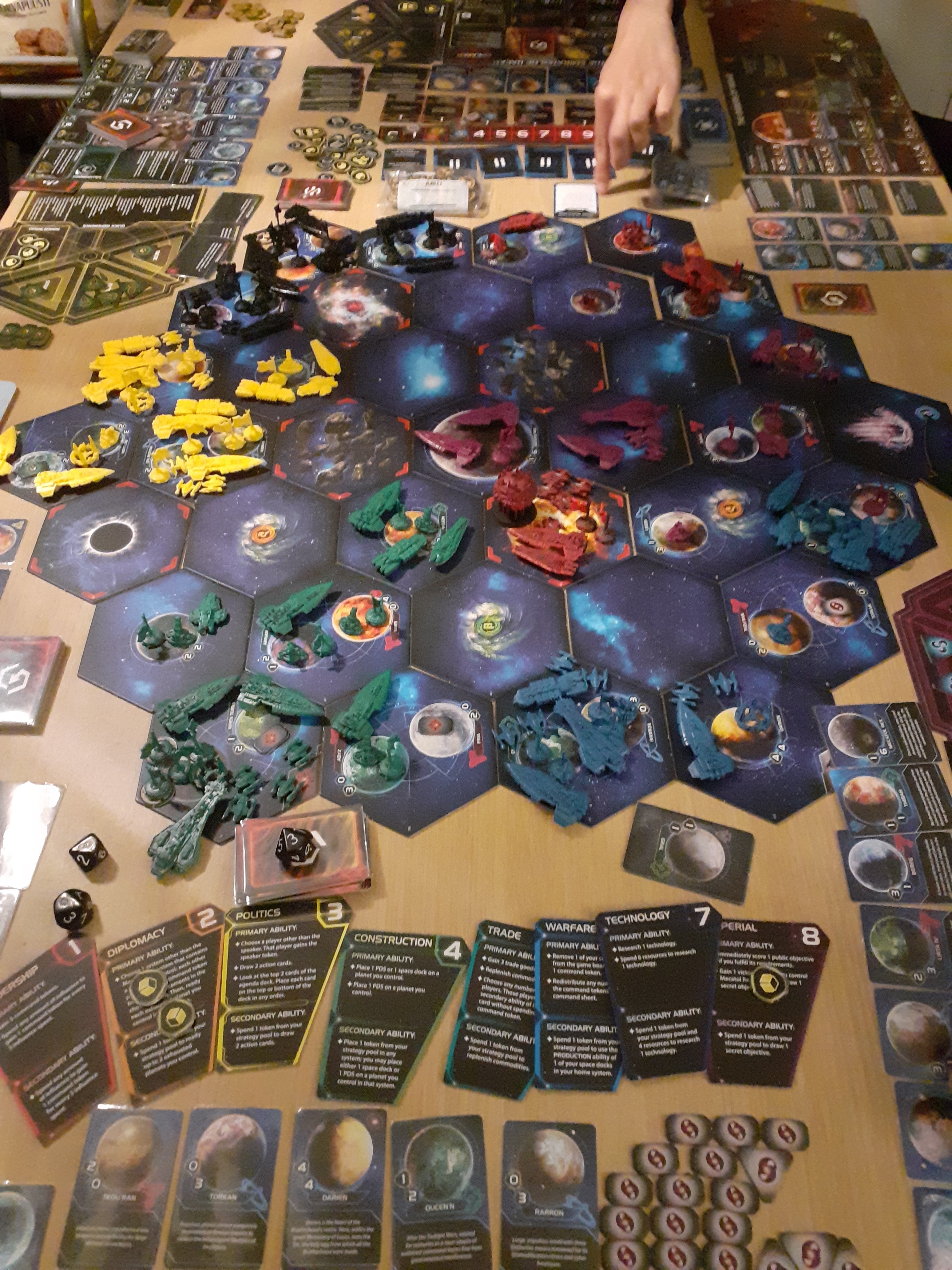
Twilight Imperium 3: Are You Threatening Me?

No longer mere earthbeings and planetbeings are we, but bright children of the stars! And together we shall dance in and out of ten billion years, celebrating the gift of consciousness until the stars themselves grow cold and weary, and our thoughts turn again to the beginning.

 - Lady Deirdre Skye, "Conversations With Planet", Epilogue

A little over a year ago, the Yin Brotherhood was victorious in our second game of Twilight Imperium. Now it's time for game 3.

**

After our previous game, it was suggested that last time's winner should play with one of the higher complexity factions next time. I agreed, and picked the Arborec, who I decided were basically Alpha Centauri's Planet after a transcendence victory. On my left was the Nekro Virus, and on my right the Ghosts of Creuss; opposite me were the Mentak Coalition (space pirates) and the Tyranids.


Everyone got started expanding out of their home systems.


The first hostilities of the game were between the Nekro Virus and the space pirates, when the Nekro Virus invaded Sakulag. Their faction specialty is that they don't develop technology, but rather acquire it by consuming other factions' units and betting on the outcomes of agenda votes. So they got things started by eating some space pirates.


Apparently this was by mutual agreement, although I don't think anyone asked the pirates whose part in the deal was to get eaten. While all this was going on, I built the Arborec flagship and seized the Cornholio system right next door to Mecatol Rex, and the Ghosts of Creuss spread their influence far and wide.


On the opposite side of the board, the pirates tried to grab Tar'mann, but their invasion force was wiped out by the Tyranids' upgraded space cannon in the First Cannonade of Tar'mann.


For my part, I cashed in a secret objective by blowing up a Creuss destroyer with my flagship.


The Ghosts of Creuss surprised us by claiming Mecatol Rex, which put them firmly in the lead and ushered in the agenda phase. I was second in victory points, with everyone else more or less sitting tight and building up their fleets. The space pirates sent a larger fleet, which survived the Second Cannonade of Tar'mann, and grabbed the planet.


**

I have to say that the agenda phases in this game were even sillier than usual, and we greatly enjoyed them. The Nekro Virus don't get to vote in the agenda phase, but they can pick one of the agendas to bet on. If they guess right, they get to steal technology from the voting factions. I have no idea what this mechanic is even supposed to represent, but it's damn good fun. With the Nekro Virus bets and various action card riders, it sometimes became a very complicated but entertaining process to figure out who gets what depending on which way a vote goes.

As an example, when we voted on Representative Government, two players attached riders, leaving two of us to actually vote on the outcome. That would then have been changed by Bribery, but the bribe was sabotaged.


By far the silliest vote was when we drew Public Execution, and the first thing that happened was that the Nekro Virus assassinated my representative. The matter then went to a vote, and the Ghosts of Creuss were chosen - only for them to deploy Confusing Legal Text and have me publicly executed instead.

While all this was going on, the Ghosts racked up victory points by spreading their fleet thin and using the extra mobility provided by their wormholes. As the rest of us were trying to co-ordinate an attack on them, the Creuss player picked the Imperial strategy card and won the game outright by scoring a 2-VP objective.


I came in second with 6 VP. It was a deserved win for the Creuss with a well-executed strategy. I shall henceforth refer to them as I Am Wormholio.


**

So, we saw that Creuss victory coming, but we didn't see it coming that quickly. I think some valuable strategic lessons were learned.

As the Ghosts started racking up victory points, their fleets were outnumbered by their neighbors, that is, myself and the Tyranids. However, our actions were severely constrained by our neighbors. For much of the endgame, there was a considerable Nekro Virus fleet right next to me at Thibah, and the space pirates were massing behind the Nids.

This was an excellent example of the strategic concept of the fleet in being: the fleet at Thibah was a serious problem for me, as I didn't know what it was going to do. If I moved decisively against the Creuss, there would be nothing to stop them from grabbing several of my systems. So I'd have to take a serious risk to stop the Ghosts from winning, and make myself vulnerable to the Nekro Virus.

So far, I'd say our games of Twilight Imperium have been characterized by the security dilemma. Each player sees their neighbors building up their fleet, and feels threatened, and therefore builds a larger fleet. Their neighbors see that, feel threatened by it, and build more starships and space cannon. And so it goes, with large sections of the board paralyzed into mutual deterrence.

The overall strategic lesson I'm taking with me from this instance of Twilight Imperium is that if you camp, you lose. I still feel like the pace of the game is slightly faster than I think, but I'm getting a better handle on it. I like that the game rewards aggressive play for victory points, and I hope we get to play it again!

Apr 1, 2024

Twilight Imperium: Let's Paint the Blue Fleet

Now that the Yin Brotherhood won our second game of Twilight Imperium, Enlightenment is a Function of Willpower, it's time to paint the blue fleet.


**

Drawing on my experience with the red miniatures, I decided to start with the infantry and cruisers.


For the infantry, I did the same thing as I had with the reds: Gunmetal Grey and Black Glaze, with the colored parts of the base in Dark Prussian Blue and Dark Blue, and the flag in Dark Blue.


I feel it's a little borderline whether that's too dark a blue, but I like it so much better on the flags than a lighter one. We'll have to see how it goes.

The cruisers got to be the testbed for my starship color scheme again. I liked the basic idea of what I did with the red cruisers, but this time I decided to up the contrast and make Deep Sky Blue the lightest color.


I feel like it works, and it means that my blues are Dark Prussian Blue, Blue, Dark Blue and Deep Sky Blue. Armed with that decision, I tackled the war suns.


Because Deep Sky Blue is also the color I use for the trans pride flag, it was easy to conclude that the war suns are trans. They're quite easy to paint. The fighters, on the other hand, are the fiddliest miniatures and therefore the most annoying. So I got them out of the way.


The space docks are also trans.


**

In our first game, I don't really recall getting much use out of my flagship. Last time, though, it was a key to my success. The Yin Brotherhood flagship, the van Halen, was the perfect counter to the Muaat death star: if the Eddie van Halen is destroyed, it takes every ship in the system with it. This deterrent value both kept me feeling secure against the Muaat juggernaut, and also let me grab Quann off them in the climactic last turn, which ended up stopping them from winning!


For such sterling service in the cause of the Yin, the van Halen deserves to be remembered. I therefore decided to give the blue flagship a paint scheme based on the Frankenstrat.


I'm actually kinda happy with it! Then it was time to finish the cruisers.


I kept the carriers simple.


The destroyers got a similar paint job to the cruisers.


And finally, here are the dreadnoughts.


Here's a badly lit picture of the whole fleet in my display cabinet.


**

So they're done! I still find painting board game miniatures very rewarding. Now, if we could only find the time for another game...

Nov 6, 2023

Twilight Imperium 2: Enlightenment is a Function of Willpower

I maintain nonetheless that yin-yang dualism can be overcome. With sufficient enlightenment we can give substance to any distinction: mind without body, north without south, pleasure without pain. Remember, enlightenment is a function of willpower, not of physical strength.

 - Chairman Sheng-ji Yang, "Essays on Mind and Matter"

We enjoyed our first game of Twilight Imperium, The Assassination of Bug Jesus by the Coward Space Turtles, so much that we wanted to play another one. So, with our newly painted red miniatures, we did.


**

Well before the game, we randomized seating order and factions. I ended up getting the Yin Brotherhood, an all-male faction of clones. Our special abilities are a kamikaze attack with cruisers or destroyers, and for some reason, Indoctrination, which lets us convert opposing infantry. I'm just going to think of them as what happens when the Hive builds Cloning Vats and then wins Alpha Centauri. Because they are so clearly the Hive, I picked the blue miniatures.

Going clockwise, on my left I have the Barony of Letnev (green) who won last time, then also on my left but with a different player. Then it's the Yssaril Tribes, some kind of space goblin spies with the yellow miniatures, and a new player in black with the Emirates of Hacan, the trader space cats.

Next we have the Embers of Muaat, who start with one of the death stars I just painted, and have a special ability, Star Forge, which means they can produce ships in their death star. Given that they also start with the speaker token, they're basically Emperor Palpatine. Finally, on my right, last time's winner with the violet Ghosts of Creuss: the spooky space ghosts live on the other side of a wormhole.

My flatmate was kind enough to build a map for us:


And we were ready to go!

**

We got off to what I'm coming to think is the usual Twilight Imperium start where we expand cautiously into the immediately adjacent systems.


Aided by the menacing presence of the Muaat death star, the trash talk was heaviest at the opposite end of the table. I quickly established friendly relations with what I was informed was called the Baloney of Satnav, and a cautious accord with the creepy wormhole ghosts. Seeing as how the Creuss player won last time, I was definitely most nervous about them!

My suspicions were quickly confirmed when the Ghosts sent a fleet through the alpha wormhole, and grabbed Arinam and Meer from right under the noses of the Satnav. One of the public objectives involved controlling planets with the same planet trait, and Meer is a hazardous planet.


The Baloney was having none of it, and very quickly got them back.


As the second turn drew to a close, everyone was busy building up their fleets, and the first shots had been fired.


**

On the third turn, I decided to make my contribution to the shot total by invading New Albion.


What I wanted was a planet with some decent production. I told the Ghosts quite frankly that I was having New Albion, and either Starpoint or Hodor in the adjacent system. The Ghosts preferred to keep Starpoint, so I let them. It was a hazardous planet, and I figured it would keep them bugging their neighbors for another one.

Right after all this, we were a little bit shocked to find the Muaat war sun materializing out of the beta wormhole!


Because there was a public objective for having two unit improvements, several players had upgraded their PDSes to fire into adjacent systems. The Muaat took a bit of a cannonade, but only ended up losing one fighter and taking some damage on their dreadnought. As the Muaat fleet withdrew into the safety of the adjacent supernova, the Ghosts rode their wormhole slipstream right to Mecatol Rex, and took possession of it.


The Ghosts also made a play for a different hazardous planet, this time at the expense of the Muaat. However, they hadn't counted on the Muaat planetary defense systems, and the Creuss fleet was wiped out in the First Cannonade of Waffle II.


Here's the situation at the end of the fourth turn. We've had an agenda phase; I can't remember which was which, but they always provide opportunities for shenanigans and are an excellent part of the game. The goblins were building a giant fleet and hoarding strategy cards, while the Emirates of Håkan were somewhat hemmed in between them and the Muaat.


Luckily, I had the perfect counter to the Muaat death star: the Yin Brotherhood flagship, the van Halen, is rubbish at combat, but if it's destroyed, it takes every other ship in the system with it. When that war sun showed up on our side of the board, you bet I built the Eddie van Halen right away.

**

The Muaat got the new turn started by moving on Mecatol Rex, where they soon evicted the Creuss with the aid of their upgraded death star.


For my part, I invaded Hodor in pursuit of more production and a public objective for controlling planets.


The Ghosts of Creuss continued their quest for hazardous planets by sending another fleet to Waffle II. This time, some of the ships survived the space cannon, but none of the drop troops made it to the surface. The Second Cannonade of Waffle II ended with the Creuss still frustrated.


Meanwhile, the Muaat had built a second death star. Below is the overall situation at what I think judging from the public objectives should be the beginning of turn seven.


The Muaat tried to reinforce Waffle II with Frontline Deployment, but the Creuss countered with Unstable Planet. Must be all the cannoning.


Meanwhile, the great war of the goblins and the space cats finally started.


A lot of action cards were played in that one. For my part, I sent the Eddie van Halen to drive off a Muaat destroyer hanging around the beta wormhole.


Once again, the Ghosts of Creuss launched a fleet, and this time, both the starships and ground troops got through, and the Third Cannonade of Waffle II ended in the planet falling to the Creuss.


At this point, the Baloney of Satnav sprang into action. First, their flagship defeated some of my fighters for a victory point.


Then they intervened in the goblins wars by blowing up the Håkan flagship, for another victory point!


I sent my fleet through the wormhole to grab Quann off the Muaat, so I too could score the planet trait objective, and also deny a planet to the Muaat.


The Eddie van Halen deterred the Muaat from getting Quann back, so they attacked me at Hodor instead. The Muaat player took a hit on their death star, finally letting me play the Direct Hit action card - which was immediately sabotaged by the Satnav.


The Muaat wiped out my fleet, but chose not to attempt a landing on Hodor. A possibly incomplete list of things that were sabotaged in this game: a skilled retreat, a morale boost, a direct hit on a Muaat death star, and a public disgrace of the Satnav.

**

After some further shenanigans and one last agenda phase, we had to call it a night at the end of the seventh turn.


The final scoring was very, very tight.


The space goblins were last with one victory point. Our new player piloted the Emirates of Håkan to a very respectable 5 VP, just behind the Embers and Ghosts at 6. I ended up tied with the Baloney of Satnav at 8 VP, and I won the tiebreaker by being ahead in initiative order. However, the Embers of Muaat were a few measly influence points away from scoring one of the 2-VP objectives, and they would have won the tiebreaker against me! So this one really went down to the wire.


**

So, what did we learn? First of all, we had a great time. However, we also had to stop the game earlier than we would have liked due to time constraints. We're going to look into running a two-day game at some point next year. Even with the premade map and everything, this is still a lot to get through in one day.

We also focused more on victory points, which led to a tighter game and more surprises, as people went for both public and secret objectives. Another way that Twilight Imperium is like Game of Thrones, or for that matter Scythe, is that if you play it like a wargame, you lose. I like the way the objectives direct play, so you have to both have a strategy of your own and be able to respond to events.

Overall, I think Twilight Imperium is a fantastic game. The theme is on point: it feels like we're playing Master of Orion. The mechanics work, none of the rules feel overly complex or counterintuitive, and the game flows quite nicely. Finally, even though it's a big game that takes a long time to play, it doesn't leave me mentally exhausted like, say, Game of Thrones, let alone totally destroyed like War of the Ring.

So this one's a winner: I strongly recommend Twilight Imperium, and we will be playing it again.