Oct 19, 2015

LotR LCG: The Mirkwood cycle

Ever since we got into the Lord of the Rings living card game over midsummer, we've been collecting the various expansions in some kind of order. The first releases after the core set were the Shadows of Mirkwood adventure packs, so you only need the core set to use them. In fact, our very first LotR LCG purchase included a Shadows of Mirkwood pack, namely The Dead Marshes, because my partner was keen on Boromir. Overall, the Mirkwood packs are tremendous value for money: not only are there some excellent player cards for all spheres, but almost all of the quests are good fun as well. If you're just getting into the game, I can't think of a better way to start collecting beyond the core set than the Mirkwood cycle adventure packs.

For this post, I thought I'd go through the packs one by one, sharing our experiences with the quest and discussing a player card or two.

**

The Hunt for Gollum - DL 4

The overall theme of the Shadows of Mirkwood cycle is Gollum: your heroes have been recruited by Gandalf to find the slimy bastard and bring him to the Elven-king's halls in Mirkwood. The first quest finds us searching for signs of Gollum along the banks of the Great River.


As I mentioned before, the notion that this quest is as difficult as A Journey Along the Anduin is ridiculous. The Hunt for Gollum is a fairly leisurely stroll along the river looking for clues. It's not a complete pushover; if, for instance, the Hunters from Mordor show up when there are several clue cards in play, things can get nasty. I have been defeated by this quest a few times! Most of the time it's fairly easy, but not boring; a basic, fun enough quest that's a nice introduction to further adventures in Middle-Earth, especially for new players devastated by A Journey Along the Anduin.

Card spotlight: Winged Guardian


I think there are some Eagle cards in just about every Mirkwood adventure pack, and my partner's deck is pretty much based on them by now. Winged Guardian is one of the best defenders in the early game, with a defence of 4 that's almost surreally high right after the core set. The cost of 2 is incredibly low, but the only downside is that Winged Guardian leaves play after defending, unless you spend a resource. Still, though, it's a brilliant card, and I don't know where we'd be without it. The Eagle cards are a great addition to any Tactics deck.

**

Conflict at the Carrock - DL 7

After finding Gollum's trail by the Great River, we hear that a group of Trolls has taken up residence at the Carrock, and Grimbeorn has gone to kill them, so off we go to give him a hand!


I've heard Conflict at the Carrock (which, by the way, sounds exactly like a WWE pay-per-view event) described as a quest that can't be beat on the first attempt. Well, I'm here to tell you that isn't true. This is basically a prequel version of the Hobbit saga expansion quest We Must Away, Ere Break of Day: there's a benign first stage, and then suddenly trolls, sacks and mayhem. This time, there are four trolls, and you have to defeat every troll in play to win.

Rather like our first multiplayer experience with We Must Away, our first swing at Carrock went disastrously wrong. We were playing three-handed (my Spirit/Lore, my partner's Team Boromir Tactics Eagles, and a Leadership dwarf deck), and not only did we pretty much barge straight into the quest trolls, but managed to draw a Hill Troll from the encounter deck as well! So now there were five trolls to deal with.

Strangely enough, we did just that: the dwarf deck laid into the Hill Troll and finished it off with a bit of help, just in time before the dwarves' threat got high enough that the trolls came in. To stop them from having to take on all four at once, both other decks voluntarily engaged one troll each. I had to chump block mine at first, but hell, I actually managed to do some damage in return with the help of the invaluable Haldir of Lórien! Meanwhile, the Tactics deck was holding its own quite nicely and using Horn of Gondor to benefit from all the chump blocking and, very appropriately, summon Beorn himself to help out. Over at the Leadership end, it's amazing what Thorin Oakenshield can do sometimes, and an improbable dwarven Steward of Gondor got enough resources in play to get us Grimbeorn's fantastic troll-fighting help.


Long story short, even though our situation looked worse than dire at one point, we defeated the trolls! This is a really, really good scenario, and we had a hell of a time. Although I can't imagine how I could ever manage to beat it solo, I was pleasantly surprised by how well my deck did in combat. I would highly recommend buying this adventure pack for the quest alone.

Card spotlights: A Burning Brand, Song of Wisdom


Having said that, if you use Lore, you want to get this pack for the player cards as well. A Burning Brand is a mainstay of Lore decks for its shadow-canceling ability; defending becomes that much more predictable, and you can laugh at Dol Guldur Beastmasters. The Khazad-dûm expansion already has some pretty damn nasty shadow cards, and they start getting nightmarish by Lost Realm, so this is a must-have.


I wanted to highlight Song of Wisdom as well because I use it myself in combination with A Burning Brand. The Mirkwood packs include four Song cards, one for each sphere, which you can attach to your heroes to give them that sphere's resource icon. This is obviously great for multi-sphere decks, since that hero's resources can then be used to pay for cards from both their original and new sphere. My heroes are Éowyn, Eleanor (both Spirit) and Beravor (Lore); giving Eleanor Song of Wisdom lets me use her resources to pay for both Spirit and Lore cards, which makes my life a lot easier. The Song cards can also let you do all kinds of other stuff that's dependent on your heroes' spheres. In my case, Song of Wisdom also means I can give Eleanor a Burning Brand, which, along with Protector of Lórien, makes her a reasonably competent defender.

**

A Journey to Rhosgobel - DL 6

After defeating the trolls, we follow Gollum's trail further along the Anduin, where we encounter Wilyador, a badly wounded great eagle. We can't save him, but Radagast can, so off we go to Rhosgobel.


This is another three-stage quest, where you race against time to get an Eagle ally to safety before time runs out: poor Wilyador takes two points of damage at the end of every round, and at the end of the quest, you have to heal him completely to succeed. To do this, you gather Athelas objectives, each of which will heal five points of damage from Wilyador. The trouble is, they don't tell you that. When you clear the second stage, the quest is over, and only then are you told that if you don't have at least one Athelas objective for every five damage on Wilyador, sorry, game over! Obviously this was the end of our first three-handed attempt, none of us having any idea this was coming as I absolutely refuse to spoil quest cards. This is just terrible, terrible design! Once you know this, though, you'll know you have to pace your questing appropriately.

A Journey to Rhosgobel may require the most specialized deck of all the Mirkwood scenarios; not only will some healing come in real handy, but there are also enemies in the encounter deck that can only be engaged by Eagles or cards with the "ranged" keyword. Luckily, we've got both eagles and healing in our decks; even more luckily, we didn't really need either on our two-handed attempt. This is a fun and different quest: threat is a complete non-issue, and deck abilities like healing and ranged combat that are normally just nice extras are suddenly vitally important. We like it!

Card spotlights: Escort from Edoras


Where my partner has eagles, I have my Rohan allies. Since Éowyn is one of my heroes, including Rohan characters feels thematically appropriate, but it's also extremely useful: since I mostly play two-handed with a Tactics deck, the questing tends to be mostly my responsibility, and Rohan allies are excellent questers. Case in point: Escort from Edoras. For a measly two Spirit resources, you get a one-time questing ally with four willpower. It's like having Gandalf along! When I started out with my Spirit/Lore deck from the core set, questing power and allies were my most immediate need, and Rohan is the answer.

**

Hills of Emyn Muil - DL 4

We here at this blog aren't afraid to voice controversial opinions. This is largely because no-one reads this blog, but unafraid we are nonetheless. Here's what the Tales from the Cards blog has to say about the Hills of Emyn Muil: "I’ll be blunt, this quest is widely regarded as the weakest of all the LOTR LCG scenarios, and I would have to concur." Or: "unremarkable and tedious". A bear called it "obnoxious" and "a tedious experience".

Well, they're all wrong. We like the Hills of Emyn Muil a lot. It's a different quest, both in terms of mechanics and theme, and stands out to its advantage in the Mirkwood cycle. The plot of the quest is that the heroes have lost Gollum's trail in the Emyn Muil, and have to search the area to find him again. There's only a single quest stage, and you don't clear the quest by getting enough progress, but by gathering victory points: the win condition is that you need to have twenty victory points and no Emyn Muil locations in play. In practice, this means clearing quite a few locations. The high initial threat can make this a bit tough, but if you can get rolling, the quest is challenging, but not frustrating. We've beaten it twice three-handed, but two-handed (Amazons/Tactics) took several attempts; we had an excellent time. Playing solo, I found the quest quite easy, but fun. The gorgeous art on the Emyn Muil locations deserves a special mention.


I fully understand that if what you love about the game is desperate, fast-paced combat or whatever, you won't enjoy this quest. To me, though, geography is vital to Tolkien's works, far more so than hacking and slashing your way through orcs and trolls and whatnot. I guess that's why this quest feels so thematically strong and satisfying to me. I strongly recommend it. Don't listen to the naysayers and enjoy yourself.

Card spotlight: Descendant of Thorondor
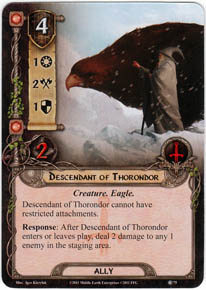

Yup, another eagle. What distinguishes Descendant of Thorondor is a great direct damage effect: you get to deal 2 damage to an enemy in the staging area when the Descendant enters or leaves play. This is a great combo with Meneldor's Flight, effectively letting you do 4 damage in the staging area for 4 resources (3 if you have Horn of Gondor). When you're up against a Goblin Sniper hiding behind high-threat enemies you really don't want to engage, or, Eru forbid, Hummerhorns, having a way to do damage in the staging area is absolutely brilliant.

**

The Dead Marshes - DL 5


Set in a very memorable part of Middle-earth, this adventure pack provides a climax of sorts to the whole cycle: we finally catch Gollum! Or, well, it's meant to, at least. I already talked about this quest before, so I won't repeat myself; suffice to say that it's boring, poorly designed and far too easy. You're chasing down Gollum and have to keep making escape tests, effectively questing twice, or he gathers enough resource tokens to escape. Theoretically, this is a bad thing, but in practice it just absolves you of bothering with the escape tests until he pops out of the encounter deck again - an encounter deck weak enough that you can hang around waiting for him. We once had him escape and then get discarded as a shadow card, meaning we had to work our way through the entire encounter deck and then some - and still won. This is easily the worst quest in the whole Mirkwood cycle.

Card spotlights: Boromir, Elfhelm


As I've mentioned, Boromir is the reason we bought this pack in the first place, and he's worth it. Not only does he have excellent stats, but his ability to ready at the cost of a threat increase can really save the day, letting him either defend multiple times or both defend and attack, for instance. A very powerful Tactics hero who's a great fit with the core set heroes as well.


Elfhelm is another fantastic Rohan ally with heroic stats, but more importantly, he negates threat gain from encounter cards and failed questing. Together with Éowyn's willpower boost from card discards, Elfhelm can negate damage from a failed questing phase, and he lets you laugh at Doomed 1 treacheries. Also, since his ability requires him to be ready during questing, he's also there to provide emergency defence or an extra bit of offensive punch in the combat phase.

The player cards aren't half bad in general, so even though the quest is the weakest in the whole cycle, the pack isn't a complete waste of money. Oh, and if you're looking to build a Hobbit deck, you'll need this pack.

**

Return to Mirkwood - DL 7

Having finally caught Gollum, our last task is to deliver him to King Thranduil. This is by far the most difficult quest of the cycle, as it should be. One player has to guard Gollum, which comes with all sorts of unspeakable treacheries, attacks and a constant increase in threat. As if that wasn't bad enough, the quest itself is difficult enough, and many of the enemies are just awful.


We gave this three attempts two-handed; we won once, but twice we drew a Hill Troll, Ungoliant's Spawn and Attercop, Attercop (or two) right off the bat, and there was just nothing we could do. So I'd say that while this is an appropriately epic quest, I find it a bit too dependent on the luck of the draw. One Attercop we can deal with; two (Attercop, Attercop, Attercop, Attercop?), Ungoliant's Spawn and a Hill Troll? No chance. When you do manage to beat a quest like this, it's immensely satisfying, but the other times it just felt pointless, because we never had a chance. That can be massively frustrating. I would think that as a general design principle, you wouldn't want people to walk away from your game thinking "why did I even bother".

Card spotlights: Dáin Ironfoot, Eagles of the Misty Mountains, Support of the Eagles, Mirkwood Runner, West Road Traveller

Yeah, there's a couple of these, for the simple reason that there's something in this pack for everyone. I absolutely agree with Tales from the Cards that if you're going to buy one Mirkwood pack for the player cards, make it this one.


First, the lord of the Iron Hills. I haven't covered any Leadership cards so far, for a simple reason: I play Spirit/Lore, and my partner uses Tactics. Dáin, though, is so essential a hero that we can hardly ignore him: he's the mainstay of the Dwarf deck, one of the most powerful theme decks in the game. As long as he's ready, Dáin provides all Dwarf characters with +1 attack and +1 willpower. This is an incredibly powerful effect, especially in multiplayer. Dwarf decks generally benefit from having several dwarven characters in play, and Dáin makes them all that much better. An absolute must-have if you want to build a Dwarf deck.


If Dáin is the keystone of dwarven synergy, Eagles of the Misty Mountains and Support of the Eagles complete the Eagle deck provided by the Mirkwood expansions. The Eagles are a great ally in their own right, with the added bonus that other Eagle cards leaving play can be attached to them to boost their combat stats further.


Support of the Eagles, on the other hand, lets you lend any eagle ally's attack or defense abilities to your heroes. These are both tremendous cards that give eagle-themed Tactics decks a whole new dimension.


How many good things can I say about Mirkwood Runner? At the moment, there are exactly two (2) Spirit or Lore allies with an attack higher than two. This pretty much means that even Mirkwood Runner's base attack of 2 is considerable, but it's the special ability that makes this card so noteworthy: when attacking alone, Mirkwood Runner ignores an enemy's defence stat. So you can either lay down two damage on just about any enemy, or add an extra two attack to Elfhelm and whoever else you've got on hand for the job. In our usual two-handed setup, the combination of one point of initial damage from Thalin and a guaranteed two from Mirkwood Runner is enough to see to quite a few enemies, letting me help out with combat so the Tactics deck can concentrate on the nasty stuff. When I play solo, Mirkwood Runner probably accounts for 80% of all combat damage I inflict, my favorite tactic for taking out large enemies being to Forest Snare them and let Mirkwood Runner look after the rest. An absolutely essential card go make Lore decks a bit more fighty.


And finally, West Road Traveller. Two willpower for two resources is still a fantastic deal. How I could ever have made it through We Must Away without my three West Road Travellers, I don't know. Their location-switching ability is a bit marginal, but it can be useful to avoid some nasty location effects that are keyed to the refresh phase, like raising threat. Mostly, though, these ladies do the legwork on questing along with Éowyn, and they're absolutely indispensable. It would be a very strange Spirit deck that left them out, unless there was a very specific theme that for some reason excludes incredibly useful cards like this one.

**

Overall, the Shadows of Mirkwood adventure packs are excellent. We quite liked both Conflict at the Carrock and Hills of Emyn Muil. A Journey to Rhosgobel is very good, despite the last quest stage being glaringly stupid the first time around. The Hunt for Gollum is fun, but a bit too easy; Return to Mirkwood is a good quest that suffers from being randomly murderously difficult. Dead Marshes is the only dud in the whole cycle, and even that pack comes with some very good player cards to offset the disappointing quest. All in all, this is a really good set of expansions for a truly fantastic game.

**

Finally, a deck update. We're aiming to sort of more or less get the various expansions in order, but I do have to admit that I cheated a bit and grabbed a copy of The Lost Realm. Eriador is a region very dear to me, not least because my first role-playing campaign ever was set there, so I was really keen to get Lost Realm, and eventually succumbed to the temptation. And hey, it comes with Neil Young Aragorn. So far, I've only included a couple of cards from it; I switched my copies of Lore of Imladris for Athelas, if only to have a way of dealing with Condition attachments after a traumatic experience with Watchful Eyes, and included a side quest. Side quests are a new card type introduced in The Lost Realm: you can play a side quest from your hand to the staging area, accumulate progress on it like on any other card, and reap benefits when you complete it. This one, Gather Information, lets each player search their deck for a card of their choice and add it to their hand. For a measly four progress, that's brilliant in multiplayer! It also comes with the added bonus of being a reliable way to delay advancing a main quest in scenarios like We Must Away.


I've wanted to stick to a single deck as much as possible, and so far I feel I've been quite successful with it. Obviously some quests would become much easier if I customized my deck to suit them more precisely, but to me, that takes away so much of the fun of deck-building. I did at this point decide to make one exception. I've found that solo play is in many ways quite different than playing with several others; so far, one key difference has been that multiplayer games tend to take far less turns. This is especially true since my deck has both a lower starting threat than the others I tend to play with, and because I have the most powerful threat management tools. At one point, I've actually managed to lower my threat below 20 in solo play! Given that Beravor and Gleowiné provide me with plentiful card draw, it hasn't been uncommon for me to work through my entire deck in a solo game. This was obviously why I included a copy of Will of the West, which lets me recycle my discard pile into my deck. In multiplayer, though, Will of the West is pretty much a waste of space, because the discard piles rarely get big enough to justify using it. On the other hand, the Gather Information side quest is fantastic in multiplayer, but not really very useful in a solo game where I end up drawing my entire deck. So what I've decided to do is have a sideboard of cards that I can swap in for solo play. In addition to Will of the West, I decided to include Resourceful for a laugh, just in case I have another brush with Secrecy!


Next time around, I'll be sharing some of my solo experiences. Until then, here's my deck as of this writing:


The Amazons

52 cards: 26 Spirit, 21 Lore, 5 neutral; 3 heroes, 25 allies, 10 attachments, 13 events, 1 side quest

Éowyn
Eleanor
Beravor


Allies: 25 (13/9/3)
Elfhelm (TDM) x2
Northern Tracker x2
Arwen Undómiel (TWitW) x2
Escort from Edoras (AJtR) x2
Westfold Horse-Breaker (THfG) x2
West Road Traveller (RtM) x3
Haldir of Lórien (AJtR)
Daughter of the Nimrodel x3
Mirkwood Runner (RtM) x2
Gléowine x2
Henamarth Riversong
Gandalf (Core)
Gandalf (OHaUH) x2


Attachments: 10 (1/8/1)
Unexpected Courage
Forest Snare x2
A Burning Brand (CatC) x2
Athelas (TLR) x2
Protector of Lórien x2
Song of Wisdom (CatC)


Events: 13 (10/3)
The Galadhrim's Greeting x2
A Test of Will x2
Dwarven Tomb
Hasty Stroke x2
Elrond's Counsel (TWitW) x3
Radagast's Cunning
Secret Paths x2

Side quests: 1
Gather Information (TLR)

Solo sideboard:
swap one Daughter of the Nimrodel for Resourceful (TWitW)
swap Gather Information (TLR) for Will of the West

**

And my partner's Tactics deck:

Team Boromir

51 cards: 49 tactics, 2 neutral; 3 heroes, 19 allies, 18 events, 11 attachments

Boromir (TDM)
Legolas
Thalin

Allies: 19 (17/2)

Beorn
Landroval (AJtR)
Radagast (AJtR)
Descendant of Thorondor (THoEM)
Eagles of the Misty Mountains x3 (RtM)
Bofur (OHaUH)
Gondorian Spearman x2
Winged Guardian x3 (THfG)
Vassal of the Windlord x3 (TDM)
Dúnedain Hunter (TLR)
Gandalf (Core) x2

Events: 18

Swift Strike
Thicket of Spears
To the Eyrie (AJtR)
Blade Mastery x2
Feint x2
Quick Strike
Tireless Hunters (TLR)
Goblin-Cleaver x2 (OHaUH)
The Eagles are Coming! x3 (THfG)
Foe-Hammer x3 (OHaUH)
Meneldor's Flight (THoEM)

Attachments: 11

Citadel Plate
Support of the Eagles x2 (RtM)
Dwarven Axe x2
Secret Vigil x2 (TLR)
Blade of Gondolin x2
Horn of Gondor
Born Aloft (CatC)

Oct 12, 2015

Sipilänomics, part 2: Unit labor costs, competitiveness and the export fixation

In my previous Sipilänomics post, I talked about how the Finnish ideology of national competitiveness continues to drive our economic policy to a short-sighted, if not actually ultimately disastrous, focus on reducing labor costs at the expense of cutting the deficit. Indeed, successive right-wing-led cabinets have cut public spending and immediately spent the dividend in reducing employers' labor costs, so that in spite of extensive cuts to the public sector, government spending has actually increased in real terms. I managed to provoke some macroeconomic analysis, which I urge you to read.

This time around, I want to look more closely at the specific issue of unit labor costs, and whether reducing them is a sensible goal for national economic policy or not.

**

First, to give some context, I want to throw out some ballpark figures on government spending that the current administration isn't cutting. Remember that our net deficit is around five billion euros.

Wealth transfers to corporations obviously start with direct corporate subsidies, which, according to the Cabinet office's report on corporate subsidies, total 1.3 billion euros a year. The current administration is not making any significant cuts. In addition, Finnish businesses receive six billion euros' worth of tax breaks every year.

Incidentally, total tax exemptions in Finland are a staggering twenty-three billion euros annually. Every third tax euro is exempt. You'd think the tax system could do with some streamlining.

This is a slightly artificial number, but if you want to talk about eliminating the deficit, we can total up all the money we're throwing at businesses. One billion in direct subsidies plus six billion euros' worth of tax breaks is already a larger sum than the entire central government budget deficit. Add to that the three billion dollars of tax and social security payment cuts I talked about in my previous post, and you can argue that as a ballpark figure, over the last decade or so we've been giving Finnish businesses ten billion euros per year.

Another massive money sink we're not touching is farm subsidies. The 2015 government budget lists some 1.8 billion euros in agricultural subsidies, 400 million to forestry and fisheries, and another 400 million to rural development, totalling about two and a half billion euros annually. We pay more in farm subsidies than we do in unemployment benefits.

Again, though, this two billion figure doesn't capture anything like the whole expense of Finnish "area policy". The cabinet office report on corporate subsidies points out that all subsidies and tax breaks are created for a variety of political reasons that are difficult to untangle. It's impossible to even estimate how much of the seven billion euros of corporate subsidies and tax breaks are in practice area subsidies. A far greater challenge would be in trying to come up with some notion of the opportunity costs of agricultural and area subsidies, as well as untangling municipal finances and state interventions in them. So the direct budget expenditure of two billion is barely scratching the surface of what our illusion of agricultural self-sufficiency and "area equality" actually cost. These subsidies have all been increased during our so-called austerity, including by the Sipilä cabinet.

**

So we're not cutting any of those expenses. We're not even really talking about them. Instead, the constant focus has been unit labor costs. In his farcical, patronizing televised speech last month, Sipilä again insisted that labor costs must be reduced by 5%; his cabinet and party have repeatedly made it clear that they're willing to negotiate on how this can be achieved, but not on the reduction itself. The idea of reducing vacation compensations and/or lengthening working times amounts to the same thing as the pay cuts the cabinet has suggested: reducing labor costs.

For a company, unit labor costs are an important figure. Obviously the less a company has to pay out in wages to produce a given quantity of product, the better. On the national level, though, unit labor costs are a completely different animal: effectively, national labor costs are the share of national income that goes to workers. So when a company says it wants to reduce labor costs, it's saying it wants to produce more efficiently; however, when you say that a country has to reduce its labor costs, what you mean is that income has to be distributed less equally: less needs to go to workers and more to, effectively, shareholders. So in a sense, the literal meaning of lower labor costs is greater income inequality.

What's more, as is explained in some detail here, unit labor costs are actually a terrible indicator of national competitiveness. Unit labor costs are in many ways an unreliable aggregate number that can give a serously misleading picture of the development and competitiveness of an economy.

The World Economics Association newsletter I linked to includes a graph of real unit labor costs in selected EU countries, including Finland (orange):


As you can see, real unit labor costs rose dramatically in 2008. At the same time, though, there was no corresponding rise in real incomes, which rose steadily until 2009 and have since plateaued.


So whatever it was that made Finnish unit labor costs suddenly rise in the late 2000's, it wasn't wages. It's also worth pointing out that in the context of plateaued real wages, the Sipilä cabinet's wage cuts combined with continuing insistence on extremely low raises will mean that real incomes will actually decline.

What happened, then? According to the Labour Institute for Economic Research, what happened was a dramatic decline in the electronics and paper industries, not to mention a global financial crisis. This would seem to be in line with the criticism of unit labor costs linked above, where change in one industry can give the misleading impression that the entire economy has become less productive. Elsewhere, aggregate productivity statistics have been misleading.

So effectively, what we're trying to do now is compensate for losing Nokia, and the continuing decline of our paper industry, by lowering everyone's wages.

Further, as Jesus Felipe and Utsav Kumar argued in 2011, unit labor costs don't explain Germany's strong exports, but rather, complexity and diversity of exports do. Attempting to compete with Germany solely by lowering unit labor costs is, in their view, completely misguided. Especially if our unit labor costs are actually already lower - it does strike me that most presentations on Finland's diminishing competitiveness focus on change in unit labor costs, which can be tremendously misleading; see also Haaparanta. Moreover, it's a generally accepted fact, known as Kaldor's paradox, that low unit labor costs don't correlate with increased output. Therefore, their conclusion is: "Wage reductions would do probably cause more damage through a compression of demand." When real incomes haven't risen for five years, this seems inevitable.

**

But if reducing unit labor costs isn't an effective way to boost exports, how do we do that, then? Because if there's one thing pretty much every political party and public commentator in this country agrees on, it's that we need to boost exports.

Here, from Finnish Customs, is our trade balance over the last couple of years:


Here are monthly figures for imports and exports:


What I am going to say now is so heretical that I need to warn any Finnish readers in advance. Make sure you're sitting down, not eating and drinking at the moment, and brace yourselves.

I don't see why we need to worry about exports.

Seriously. Our trade balance is all right. Other things being equal, exporting more would always be nice, so I'm certainly not in any way opposed to anything that can enhance our foreign trade, but there doesn't seem to be any reason at all why we should panic about the state of our exports. Certainly no reason to make massive cuts and depress domestic purchasing power in favor of a minute, theoretical boost to exports.

So to sum up, not only are lower unit labor costs not a sensible way to enhance our exports, but there isn't even anything in our foreign trade balance that suggests we should be particularly concerned about exports at all - especially when what we should be concerned about is our government deficit and national debt.

Unfortunately, our decision-makers seem to feel the opposite way. MTV3 interviewed the head of the Finnish Federation of Enterprises, and asked him to explain how cutting nurses' salaries helps Finnish exports. A good question! His reply was that cutting public sector salaries reduces the deficit, which will allow more tax breaks for exporters. So when I said in my previous post that we can only conceive of cutting the deficit through increasing exports, I may have been wrong. Instead, the only reason we want to cut the deficit is so that we can increase exports. This isn't so much putting the cart before the horse, but rather harnessing a horse to a cart so that we can lighten the cart to make the horse go faster. Amazing.

This is how deep the cultural fixation of prosperity through exports goes. As far as I know, not a single Finnish party questions the need for Finland to concentrate on exports and international competitiveness.

**

How bad is our competitiveness, then, since our cabinet constantly insists on such drastic measures to restore it? According to the World Economic Forum's Global Competitiveness Report published last summer, Finland is the second most competitive economy in Europe, ranking fourth worldwide. This is no fluke: Finland consistently ranks very highly in international competitiveness surveys. This makes the massive sense of doom propounded by the right about our competitiveness somewhat difficult to understand.

The World Economic Forum uses 12 pillars to assess a country's competitiveness. Some of these are being dismantled by our right wing. The third pillar, for instance, is the macroeconomic environment, prominently including government fiscal deficits and debt levels, which we've seen continue to get worse. The fourth pillar is health and primary education, both targeted for sweeping cuts. The fifth pillar is higher education and training - also cut. The twelwth pillar is innovation:

This progression requires an environment that is conducive to innovative activity and supported by both the public and the private sectors. In particular, it means sufficient investment in research and development (R&D), especially by the private sector; the presence of high-quality scientific research institutions that can generate the basic knowledge needed to build the new technologies; extensive collaboration in research and technological developments between universities and industry; and the protection of intellectual property, in addition to high levels of competition and access to venture capital and financing that are analyzed in other pillars of the Index. In light of the recent sluggish recovery and rising fiscal pressures faced by advanced economies, it is important that public and private sectors resist pressures to cut back on the R&D spending that will be so critical for sustainable growth into the future.

My boldface. Perhaps coincidentally, on the same day that the prime minister's pre-recorded speech was shown on television, the University of Helsinki announced they're cutting staff by approximately 15% over the next five years. Overall, university funding is being cut by half a billion euros annually. So our R&D spending is being cut quite massively.

The four pillars of competitiveness the Sipilä cabinet is so intent on toppling can be summed up in one concept: human capital. If there's one thing we do know correlates strongly with economic performance, it's human capital. If nothing else, a more highly skilled workforce is more productive and more innovative. Finland, for instance, can hardly claim to owe its present prosperity to abundant natural resources or other accidents of geography. Nokia came about because of the high level of human capital in the Finnish economy; if we want to see similar success in the future, we need more investments in human capital, not less. Unfortunately the Sipilä cabinet is committed to doing exactly the opposite. According to some statistics, the quality of Finnish exports is already so low that attempting to compete through cheaper labor is doomed to fail. Reducing our human capital would seem to be most likely to lower that quality even further. The new head of the government's economic research institute agrees, and points out that the few investments the government is making are minuscule and misguided.

The WEF report divides countries into three groups based on their economic development, in ascending order: factor-driven, efficiency-driven and innovation-driven. Right now, they place Finland at the very top of the innovation-driven economies, but the current administration's goals are focused on efficiency at the expense of innovation. In that sense, you could argue that they're actually trying to drastically reduce our competitiveness by downgrading the entire economy.

**

So, some conclusions. First of all, the Sipilä cabinet's monomaniacal fixation on reducing unit labor costs doesn't seem very likely to actually increase the competitiveness of our exports. What's more, it isn't at all clear why we so desperately need to enhance either our national competitiveness or our exports right now. I, for one, would much prefer trying to actually cut the deficit.

What makes everything much worse is that barring some completely unexpected chain of events, the negative effects of this labor cost policy are likely to be substantial. In the short term, cutting wages will necessarily reduce domestic demand, depressing the economy even further. In the long term, making large cuts to health care and education will severely diminish our human capital, which means that future growth will be less than it otherwise would have been. Furthermore, the hardships inflicted by the cuts, disproportionately borne by lower-income citizens, will rebound in larger problems in the future - just like after the last recession. At this rate, though, the deficit will land us in serious trouble before any long term effects make themselves felt. I strongly agree with Björn Wahlroos: our sustainability gap is never going to be a problem, because at this rate we'll go bust long before it hits.

In my previous post on the subject, I tried to demonstrate that there hasn't at any point been, and still isn't, any austerity or deficit-cutting going on in this country, because all Finnish parties agree that exports are more important than the deficit. In this post, I've done my best to examine the particular strategy of export-boosting adopted by the Sipilä administration. At the very least, there are strong doubts that a focus on unit labor costs is going to produce the results the cabinet claims; it seems far more likely that in the long and short term, this is a disastrous strategy. The only people who will benefit are corporate shareholders in the short term. That should make it pretty clear to everyone whose interests this cabinet represents.

In general, it's tremendously imporant to understand that right-wing rhetoric relies heavily on a srategy of depoliticizing economic policy, where political decisions and value judgements are presented as the only possible course of action, when in fact this is almost never the case. A further problem that arises from this is that too many critics of right-wing economic policies believe this, and imagine that politicians slavishly obey the dictates of some imaginary worldwide cabal of economists. This is complete nonsense, and dangeous, because it abandons the rhetorical playing field to the right. The economic policies of, say, the Sipilä administration, are very much open to challenge from the same paradigm of economics that they purport to draw on themselves. Don't let them get away with equating their policies with economics in general.

If there is an ideology that our current administration follows, it's the same one that the entire rest of the political field shares: national economic competitiveness through exports. My opinion is that both this strategy, and the specific means chosen to advance it, are disastrous for this country in both the short and long term, both in general as well as on its own terms. Our tragedy is that our political discourse needs to be fundamentally unpacked to address this, and this is far from easy.

**

It's definitely true that our fiscal deficit is a problem. However, the current administration, like several preceding ones, refuses to address this problem by looking at structural problems in the Finnish economy. Instead, their solution is to sacrifice our human capital and degrade our long-term competitiveness in order to, at best, improve our economic prospects in the short term. The current policy of cutting salaries, health care, social services and education to improve competitiveness is robbing the future to pay the present - and is entirely contingent on a growth of world trade that may not happen, and may pass us by. The damage will be done regardless. To call this kind of policy irresponsible is putting the matter very, very mildly.

Oct 5, 2015

Let's Read Tolkien 13: Not at Home

In the meanwhile, the dwarves sat in darkness, and utter silence fell about them.

Smaug is gone, leaving the dwarves and hobbit huddled in the pitch-black corridor. They stay where they are, barely daring to move or speak, for what feels to them like days, in complete silence. Eventually the waiting becomes unbearable enough that they try the door, but Smaug's assault on the mountainside has jammed it solidly shut. The dwarves despair, but Bilbo again takes charge and decides that the only way out is down. The entire party heads down toward Smaug's lair, with Bilbo going the last stretch alone and invisible.

Admittedly, the chapter title gives away much of the tension: Smaug is indeed not in. Realizing this, Bilbo calls for light, and the dwarves produce some torches, but they're either too afraid to go into the chambers of the mountain yet or too willing to sacrifice the hobbit, so Bilbo goes out on his own. This turns out to be a costly decision for the dwarves, because as he wanders around the dragon's deserted lair, Bilbo finds a fabulous jewel: the Arkenstone, lusted after by the dwarves and Thorin in particular.


This, if you like, is the first payoff we see from the tragic conversation between Bilbo and Smaug, and the first real working of the curse of Smaug's hoard: Bilbo decides to pocket the Arkenstone. He reasons to himself that he was, after all, promised a share of the treasure, so why couldn't this be it? He knows full well that this would never fly with the dwarves, but grabs the jewel anyway and pointedly fails to mention finding it, although he guesses Thorin is looking for it.

Once they've established to their satisfaction that Smaug is gone, the dwarves join Bilbo in bumbling about the deserted dragon lair. Here I have to say that Tolkien's descriptive powers fail him; it's actually a bit difficult to get a handle on what the dragon lair is really like, or how the dwarves are moving about in it. But move about it they do, poring over the mounds of treasure. They find themselves weapons and suits of armor, and as an advance payment for his services, Thorin presents Bilbo with a coat of mithril armor that they find in the hoard. The dwarves, bewitched by the dragon's hoard, would gladly stay sifting through it forever, and it's up to Bilbo again to recall them to the present. Thorin and Company make their way through the deserted halls all the way to the front gate; again, we only get the barest impression of corridors and stairways of stone, and it's tough to form any real impression of what the inside of Erebor is actually like. This is a bit of a shame.

Eventually, the company treks as far as the Front Gate, where they stand in a chilly breeze, overlooking the ruins of Dale and a valley conspicuously empty of dragons. Finding no news of Smaug, Balin takes the lead and directs the dwarves and hobbit to an abandoned watchpost on Ravenhill, one of the spurs of the Mountain. The company camps out there, still completely ignorant as to the fate of the dragon, as is the reader.

Next time, we'll fix that.

Sep 28, 2015

Lord of the Rings LCG: Over the hills and far away

One of the reasons I was so excited to play the Lord of the Rings living card game was how nicely it dovetailed with my Tolkien-reading project. Since I'm currently working my way through the Hobbit, the most natural choice for our first big purchase was obviously the first Hobbit saga expansion. For those of you not familiar with the structure of the game, the Lord of the Rings LCG is made up of cycles of individual adventure packs: the first six can be played with the Core Set, and the subsequent cycles all start with a larger deluxe expansion. In addition to these, there are the saga expansions, which run through the stories of Tolkien's books: there are two saga expansions for the Hobbit, and four Lord of the Rings expansions are out as of this writing. Each comes with several heroes, a pile of player cards, and three quests.


The first Hobbit expansion is called Over Hill and Under Hill, and the appropriate title of its starting quest is We Must Away, Ere Break of Day. You get Bilbo as a fourth hero, and off you go. It's quite an experience the first time around. The initial quest stage is easy: a little bit of light pottering about in the Wilderlands, at worst being harassed by a crow. Unsuspecting, we moved on to the second phase, and boom: Roast Mutton. Suddenly there are three trolls, and they will just straight up murder you. As I insist in not spoiling quests before I play them, we literally had no idea that we would have to take on the trolls the instant we hit the second quest phase. I was playing two-handed with my brother and his Beorn-inspired Leadership/Lore deck (Aragorn, Theodred, Denethor), and the trolls destroyed us completely.

There are two ways to deal with the trolls: either killing them or questing enough to get past them. Seeing as how my deck really isn't built for combat, I figured I should be going for the questing, but it just wasn't working out: I would be overwhelmed by the second stage every time. Either several trolls would come at me, or so much threat built up in the staging area that I couldn't get any questing progress - meaning the trolls came at me and I got murdered. To add to the misery, every time a troll engages you, you have to draw a card from the frankly awful Sack deck, which basically disables one of your heroes every time. I think I tried half a dozen times before deciding to give up and sleep on it.

**

The next day, I had it figured out. It was pretty obvious that in order to survive the second stage, I was going to need two things: a low enough threat to keep two of the trolls in the staging area, and enough questing allies to make progress while they were there. It could be done - barely. My strategy would be to take the first quest phase as slow as possible while getting my allies into play, and making use of Eleanor's treachery-canceling ability to avoid Roast 'Em or Boil 'Em?, which would just destroy everything. I would hope to use Galadhrim's Greeting to keep my threat low while I built up my forces; since I'm only playing with a single core set, I only have two copies, but with Dwarven Tomb and Will of the West, I can potentially play it six times, theoretically reducing my threat by 36! Not to mention Gandalf. (side note: every damn time I see Will of the West this starts playing in my head)


I got off to a strong start with Mirkwood Runner, Protector of Lórien and West Road Traveller in my opening hand; the first two would deal with the troll, while the last would start up my horde of questing allies. I also lucked out by drawing the irreplacable Henamarth Riversong early, letting me know exactly what the encounter deck was going to throw at me. So I hung out at the first quest stage, using Henamarth to get pretty much exactly the right amount of questing in to keep the staging area manageable but not progress to the second stage yet, and using Eleanor's ability to avoid the horrible ally-destroying treachery. I built up an army of allies that would provide me with enough questing to get through the second phase, and got a copy of Troll Camp in the staging area, which lets Bilbo deal with the Sacks. I managed to draw both copies of Galadhrim's Greeting; at one point I reduced my threat to 18 - low enough to qualify for Secrecy!

So on we go to stage 2 of the quest, i.e. bring on the trolls! My threat was low enough that only Bert engaged us, and I'd managed to hang around long enough to attach both Troll Key and Purse to him. The trick to this quest is that it isn't enough to just beat it: you also want to get your hands on the treasure cards, whuch you can then carry over into the next quests with you! For that, you need to explore Troll Cave, and you can only do that with Troll Key. Seeing how well I was doing, I obviously wanted to get this done as well.

Everything started decently: I quested enough to get some progress in, Bilbo took care of the Sack, and Eleanor held off Bert with Protector of Lórien, while my Mirkwood Runner started whittling away his hit points. Next turn, we managed to grab the Troll Key off him. Then, disaster: Wind-Whipped Rain wiped out my attachments. I couldn't counter it with Eleanor's ability, because if it was replaced with Roast 'Em or Boil 'Em, I'd be toast. Next, More Like a Grocer wiped out Bilbo's resources, meaning I not only had to deal with Bert's 5 attack without the benefit of Protector of Lórien, I had to kill him and wait around for a bit before I could travel to Troll Cave.


In the end, we did it! Several of my allies tragically gave their lives chump blocking Bert, but I managed to defeat him, travel to Troll Cave and finish the quest, treasures in hand. I'm very happy about this, because it's really the first time I've taken on a quest solo with a plan, and seen that plan more or less work out. And this isn't an easy quest, especially if you want the treasure cards.

**

The next quest takes us over and under the Misty Mountains, with both storm giants and goblins galore. It's actually very similar in structure to the first one, with an initial hanging-out-and-gathering-allies phase, followed by a fight with the Great Goblin and his horde - thematic, but not a great quest. I beat it on my second attempt, with Gandalf making an appropriate entrance just as the orcs rushed us. Beravor, unreasonably dual-wielding Glamdring and Orcrist like a Dúnadan Drizzt Do'Urden, dealt with the Great Goblin, and we made our getaway.

To be honest, I wasn't crazy about the second quest; it felt a bit rushed, and the two separate encounter decks really just feel like a ham-fisted attempt to shoehorn two quests into one. Also, the mechanic of a sort of preliminary stage where you build up in order to face the next phase is exactly the same as in the previous quest. The third quest, Dungeons Deep and Caverns Grim, splits your party into two: Bilbo is cordoned off into a special "riddle area" with Gollum, while everyone else keeps on questing through caves and goblins. I tried it once, and to be honest, I hate it. The riddle mechanic is awful, and the more conventional side of the quest is very similar to the previous one. It's also really hard and requires extensive deck customization, neither of which I associate with fun.

Coming to this expansion straight after the Shadows of Mirkwood adventure packs, many of the quest mechanics feel a bit fiddly and unsatisfying. Having seen Over Hill and Under Hill recommended quite strongly, I was maybe expecting more. Mind you, I'd still buy this just for the first quest and the player cards! But don't expect too much from the two other quests.

**

While solo play is all well and good, where the game really comes into its own is, for me, multiplayer; it was obviously high time to try the Hobbit quests four-handed. Our lineup was, again, my Amazons, Team Boromir (monosphere Tactics with Eagles), a Leadership/Lore deck and a Leadership dwarf deck. Having learned from our initial crushing defeat and my solo experiences, we figured we'd take it nice and easy, build up our forces, and take on the trolls when we were good and ready. Or at least that was the plan. What actually happened was that we drew three treacheries in our first staging phase, so boom: trolls. Some of us had threat scores high enough that two of the trolls engaged us, so out came the sacks and off we went.

It was a complete disaster, but we did our best with it. Appropriately enough, the dwarf deck started laying into Tom at once, while the Tactics guys did their best to hold off Bert, leaving the rest of us to quest. My latest addition, Arwen, was worth her weight in gold with her special defence-boosting ability, and when things started looking a bit grim, I found that Arwen makes a wonderful combo with another card I'd only just added to my deck: Gandalf!


My solo attempts at this quest had finally convinced me that I needed Mithrandir Stormcrow's help, but since we're running three separate decks from a single core set, I only have one copy. I'd been a bit dubious about the Over Hill and Under Hill version, but since he was all I had, I added two copies to my deck. As it turns out, a wizard who quests at four willpower and can then defend with a strength of 5 and sentinel from Arwen's bonus is actually quite brilliant! I kept him around, too, even with the additional threat; the way things were going, my threat was the least of our worries. With Gandalf helping out on defense, we just barely managed to keep the trolls at bay until we quested through the encounter deck and the sun came up to save us. No treasure, alas, but a hell of a ride. We'll have to try it again and see if we can't score some magical swords.

**

Here's the state of my deck at the conclusion of our Hobbit adventures:

The Amazons

52 cards: 27 Spirit, 21 Lore, 4 neutral; 3 heroes, 25 allies, 8 attachments, 16 events

Éowyn
Eleanor
Beravor


Allies: (25, 13/9/3)
Elfhelm x2
Northern Tracker x2
Arwen Undómiel x2
Escort from Edoras x2
Westfold Horse-Breaker x2
West Road Traveller x3
Haldir of Lórien
Daughter of the Nimrodel x3
Mirkwood Runner x2
Gléowine x2
Henamarth Riversong
Gandalf (Core)
Gandalf (OHaUH) x2


Attachments: 8 (1/6/1)
Unexpected Courage
Forest Snare x2
A Burning Brand x2
Protector of Lórien x2
Song of Wisdom


Events: 16 (11/5)
The Galadhrim's Greeting x2
A Test of Will x2
Dwarven Tomb
Hasty Stroke x2
Will of the West
Elrond's Counsel x3
Lore of Imladris x2
Radagast's Cunning
Secret Paths x2

Like I mentioned before, my solo attempts at the Hobbit quests finally convinced me that my deck needs more Gandalf in it, so I went for his Hobbit-era incarnation - which actually turned out brilliantly! To make space for the Grey Pilgrim, I dropped my Lórien Guides. At a cost of three each, I always seemed to have something better to spend those Spirit resources on. When I got my hands on the Watcher in the Water adventure pack, I also had no compunctions getting rid of both copies of Favor of the Lady for Arwen: not only is she an excellent questing addition, but her defense-boosting ability will make my life that much easier - and above all, since the theme of my deck is Amazons, how could I not include her? Also, since she's a unique Noldor character, hello Elrond's Counsel. Threat management is pretty vital to my deck when playing solo. I never did get to use Astonishing Speed, as it is a bit expensive, and while Ancient Mathom is nice, I'm already doing okay for card draw, so I swapped them for three copies of Elrond's Counsel.

The last additions to the deck come courtesy of Conflict at the Carrock: the ever-necessary A Burning Brand, and a copy of Song of Wisdom so I can get one on Eleanor. (side note: every damn time I see A Burning Brand this starts playing in my head) I ditched Strider's Path to make room for it, and decided to try going with 52 cards from here on. We'll see how it goes! I'm looking forward to trying A Journey Along the Anduin solo with my new additions, and next time, we're taking on the Shadows of Mirkwood adventure packs. Also, I can't wait for the Grey Havens expansion!

Sep 21, 2015

Simpkin's iceberg

Something quite surprising happened yesterday: a British general, speaking anonymously, said that the army would mutiny rather than serve under Jeremy Corbyn.

The general staff would not allow a prime minister to jeopardise the security of this country and I think people would use whatever means possible, fair or foul to prevent that. You can’t put a maverick in charge of a country’s security. There would be mass resignations at all levels and you would face the very real prospect of an event which would effectively be a mutiny.

This is astounding: a serving officer threatening a military coup in a Western democracy. Or is it?

**

Brigadier Richard Simpkin has, through his magnum opus Race to the Swift, been a considerable influence on my thinking. I re-read it as I was working on my thesis, and one particular section struck me again, as it's done in the past. In chapter 15, The Supple Chain, Simpkin is discussing the choice between a professional and a conscript army. He takes rather a rosy view of conscription, but the interesting bit is when he moves on to talk about professional armies.

By contrast I have lost count of the number of United Nations members ruled by their military or by governments placed and kept in power by the armed forces. We now know that practically anything can 'happen here', whether here in Britain, the Federal Republic, France, the Netherlands or the United States. So let us for the moemtn [sic] focus on the political threat implicit in the existence of long-service standing forces.

One saw first the danger in Britain in the sixties, with the ending of conscription and the butchery of the reserve forces. Even where strong local links exist, the standing forces, notably the Regular Army, have become divorced from society as a whole. This is perhaps no more than an accentuation of a trend which has been evident in England since the days of Cromwell, and was one of our earlier and more enduring exports to the United States. Over the past 25 years, however, the tip of an exceptionally ugly and menacing iceberg has manifested itself more than once in Britain, France, Germany and the United States. Prudence dictates gobbledygook here. Se let us content ourselves with "extra-parliamentary activity of a paramilitary nature", and let who runs read.
- Race to the Swift, Brassey's 2000 reprint, pp. 250-251.

The very last bit is a biblical reference. From the context, it seems clear that Simpkin is talking about the threat of the professional armed forces interfering in the political process. Unfortunately he then leaves it at that and moves on to his next point. Prudent, no doubt, especially from a general officer, but I can't help being fascinated by this passage. I've tried to find some exegesis or commentary of this and have failed, so it's time to crush prudence to the sward and try to decipher this on my own.

The reference to Germany, I think, must be to his belief that Willy Brandt was framed (Race to the Swift, p. 285). It's absolutely fascinating that Simpkin, who was fluent in German and had ties to the Bundeswehr, seems to have thought that the German armed forces were involved in ousting Brandt. If the reference is to something else, then I have no idea what it might be. A 25-year time frame from the 1984 publication of Race to the Swift strongly suggests that the French reference is to the Algiers putsch, which must anyhow be the first instance that comes to anyone's mind on the subject. A conventional interpretation of the American reference would be General Walker and the John Birch Society, which would fit the timeframe. So, of course, does the Kennedy assassination.

But when a British general officer mentions "extra-parliamentary activity of a paramilitary nature" in the UK, this has to be the focus of interest. Again, an obvious reference is to the Troubles, specifically the collusion between the British Army and Ulster "loyalists". But is that what he means? As nasty as the secret war in Ireland undoubtedly was, is Simpkin really comparing it to the Algiers putsch? My interpretation is that what he's referring to is the coup plot against Harold Wilson. For Simpkin to mention it in the same list as Algiers is, in my opinion, significant. Leaving aside the MI5 angle - I've read Peter Wright's Spycatcher and didn't quite know what to think of it, but Christopher Andrew's official history is unsatisfactory, especially given his own comments on it - to me, Simpkin's brief statement here has been a strong reason to take the allegations of a military coup plot against Wilson more seriously than I otherwise might. Again, I can't think of anything else he could be referring to. If there's something I'm missing, do let me know!

**

This argument that professional armies will become more divorced from societies than conscript armies is quite a common one. What's rarely stated is the flip side: a society less distant from its armed forces is also a more militarized one. Simpkin also talks about the fading away of western "bellicism", or the belief that war is, if not actually virtuous, then at least an excellent way of settling differences. Even today, western countries mostly tend to see military violence as a policy to use against overseas others, whereas in the past war was the go-to solution in the metropole as well. My question would be whether this increased distance between the people and armed forces isn't both a cause and effect of the downward trend of bellicism. Our public understanding of conscription as indoctrination is sadly deficient.

But nonetheless, although I'm quite sure that most of us Europeans think of military coups as something that happens to other countries overseas, this isn't actually the case. For a Finnish example, see the Mäntsälä rebellion, which had supporters throughout the army. With better (read: less drunk) leadership, the movement might have become a national insurrection, and crucially, it had so many friends in the army that had Finland not been fortunate enough to have had a commander of the defence forces so dedicated to democracy, it's more than likely that Finnish democracy would have ended in the 1930's.

So the anynomous general's comments in the Sunday Times are quite surprising, but hardly unprecedented. The specter of military intervention in domestic politics has hovered over quite a few Western democracies in the cold war years, and the massively militarized xenophobia of the "war on terror" will hardly have exorcised it. It's not a law of nature that Western countries should be democracies; for the vast majority of their history, they've been anything but. To echo Simpkin, practically anything can, indeed, happen here!

Sep 14, 2015

Sipilänomics, or Finland's fake austerity

While everyone is more or less horrified by the ongoing train wreck that is the Donald Trump presidential campaign, it's worth remembering that in Finland, we elected our own version of Trump prime minister. Juha Sipilä, a Christian millionaire businessman, became an agrarian party MP in 2011, was elected party leader in 2012 and went on to win the 2015 parliamentary election and form the current cabinet. This fall, he's been busy shocking the nation with unprecedented cuts in education, social security and now public sector salaries. All is, however, not as it seems.

**

The recession of the early 1990's hit Finland particularly hard, not least because it coincided with the collapse of our friendly, co-operative and helpful major trading partner. Government debt, already rising in the 1980's, exploded during the recession when unemployment hit 20% and the economy contracted dramatically.


Even though growth resumed, we'd only gotten about halfway through the debt before the collapse of Nokia and the current financial crisis. Again, the economy contracted, and growth since has been slow or nonexistent, with the government running multi-billion euro deficits for several years in a row.


This is the essential background to the previous election. Even though neither the debt or deficit are alarmingly high in themselves, all parties except the extreme left agreed that this couldn't go on, and we needed to balance the budget. Sipilä didn't so much make a convincing case that he could do this, as he maddeningly refused to commit to any concrete measures whatsoever before the elections. Instead, what I think happened was that his general aura of masculine leadership was felt to be exactly what the country needed. In other words, he ran Ray Smuckles's election campaign, and won. Welcome to Finland.

**

After the election, Sipilä formed the first majority right-wing-only cabinet in Finnish history with the Coalition party and the populist racists who have the effrontery to call themselves the "Finns party". The new cabinet came out swinging, with a political program that promised four billion euros of spending cuts over their four-year tenure. The main targets were welfare, health care and education; on a personal note, the University of Helsinki, where I study, is set to lose at least a fifth of its government funding over the next couple of years. Sipilä then summoned the labor unions to negotiations over what he hilariously called a social contract, in practice a program for lowering salaries to boost national competitiveness. When the unions predictably refused and Finland, presumably, returned to a state of nature, the cabinet announced they would implement their competitiveness measures unilaterally.

Last week, we got a taste of what this Sipilänomics was going to mean in practice. The cabinet announced considerable cuts to salaries and benefits: Sunday pay will now no longer be double, but rather 175% of normal, the first day of sick leave is unpaid, a couple of holidays come off the calendar, overtime pay is halved, and public sector workers lose a bunch of vacation days per year. Overall, this adds up to savings of over a billion euros.

Our professor of economic history estimates that the net effect of these cuts will be to increase our government deficit by half a billion euros. No, I didn't mistype that. First of all, lower salaries also mean lower tax incomes, but crucially, the cut package also includes a 1.72% deduction in social security payments from employers, which will henceforth be covered from the government budget. This comes with a price tag of some 800 million euros, wiping out over half of the nominal savings by itself.

Of course, the idea is that the deduction in employment costs will encourage companies to hire more people. Our minister of finance, Coalition party leader Alexander Stubb, has blithely assured us that the cuts will create "tens of thousands of jobs". At least one prominent economist dismisses this entirely, believing the cuts will create no new jobs whatsoever. The cabinet has generally been criticized for overly optimistic views of the future, and this seems to be an excellent example; with world trade the way it is, plus the fact that the cuts will reduce domestic purchasing power by 3%, it's very difficult to understand where the tens of thousands of jobs are going to come from. The net effect of the cuts was calculated ceteris paribus, so it's entirely possible that the cuts will increase the deficit even more.

So if the government's cuts are actually going to make the deficit worse, where does the money go? Effectively, the Sipilä government is subsidising corporate payroll expenses by almost one billion euros. So the newest round of spending cuts aren't actually spending cuts at all; they're a wealth transfer from workers, and especially public sector workers, to corporate shareholders. If the net effect of the cuts really is to increase the deficit, then they are, in fact, a transfer of wealth from all taxpayers to shareholders. This isn't balancing a budget, let alone austerity; this is the opposite. The Sipilä administration is increasing our public deficit in order to redistribute income.

**

For a number of years, the political and economic debate in Finland has been framed as a juxtaposition of balanced budgets and stimulus. Supposedly, the right wants to cut spending to balance the public budget, while the left insists that the correct course of action is countercyclical stimulus. Their version of the story has Finland gripped by merciless fiscal austerity under a succession of penny-pinching right-wing governments.

For comparison, this is what austerity looks like: (image: Wikipedia Commons)


Greece underwent an extremely painful process of austerity, at great human cost, to almost eliminate their primary deficit. Until Syriza came along, that is. But in terms of statistical indicators, the above is austerity: a clear and sustained drop in government expenditure, ideally to the point where borrowing is no longer required. At that point, the budget can be called balanced.

I've put together the following graph from official government statistics collated by the Taxpayers Association of Finland and Statistics Finland. The blue line shows real central government debt in millions of euros; the red line is net central government budget expenditure. The time is 1990-2014.


Would any of our left-wingers like to show me on this diagram where, exactly, the Finnish government has done anything that even remotely resembles austerity?

**

As the graph shows, in this millenium Finnish central government expenditure has, with very few minute exceptions, only gone up. The national debt is skyrocketing. In short, at no point since the beginning of the current series of financial crises has there been any austerity whatsoever in Finland. Overall government spending has not been cut.

To anyone who's lived in Finland, this is a massively unintuitive conclusion. Surely we know for a fact that several successive right-wing-led cabinets have made several cuts to public spending? The university cuts I mentioned, for instance, were only the latest in a long series of cuts and budgetary interventions by the state. So where the hell is the money?

To answer this question comprehensively would take a lot more work and expertise than I can put into this blog post, but I'll give a couple of examples. Sipilä's agrarian predecessor Matti Vanhanen's cabinet removed the Social Insurance Institution payments from employers. This came with an estimated cost of 800 million euros, and because of the particular progression of the payments, chiefly benefited large, capital-intensive corporations. According to the rhetoric of the time, this was supposed to generate thousands of jobs. There are no good reasons to think that it created any at all. At one point, a regional experiment actually tried removing employer social security payments entirely - and found no overall benefits whatsoever (h/t to the sadly defunct Markkinakohinaa blog). So the end result was that government spending went up, and a billion-euro subsidy was delivered to Finnish corporations. Sound familiar?

The agrarian cabinet was finally ousted by a Coalition victory, which brought us Jyrki Katainen's six-party cabinet. One political measure all parties could agree on was, rather surprisingly given the presence of the Left Alliance and the Social Democrats, lowering Finland's corporate tax rate. This made a dent in the budget of approximately a billion euros, but the "dynamic effects" of the tax cut were estimated to increase revenue by at least half that, and, of course, create ten thousand jobs. Before writing this, I had no idea that ten thousand jobs and a billion euros is the Finnish government equivalent of about tree fiddy. Predictably, the dynamic effects never showed up; corporate tax income fell by, coincidentally, 800 million euros, and the jobs were nowhere to be seen. Instead, the money seems to have mostly been paid out as dividends to shareholders.

In both these cases, the failures of the stimulating effects was chalked up to the poor performance of the world economy. Or to put it another way, in both cases Finnish politicians had been far too optimistic about future economic growth, and gave up sizeable chunks of government revenue to boost growth that never happened. So against this background, it's hardly surprising that the Sipilä cabinet has come up with a billion euros of cuts, which he intends to use to directly subsidize corporate shareholders because economic growth is just around the corner. Apparently this is what we do in this country.

But to sum up, it seems to me that a large reason why government spending continues to rise despite expansive cuts is that the money saved has been given away, saddling the central government with more fiscal responsibilities while leaving it with lower tax revenue.

**

Having been quite critical of the left, I have to say that the right's rhetoric is also at times unbearable. The cuts the current administration are making are not the only possible way to respond to our fiscal situation. Even if you firmly believe that the deficit needs to be cut, there are other ways of going about it than these specific cuts. The right has been alarmingly succesful in creating a rhetorical environment in which any criticism of the government's cuts means fiscal irresponsibility. At worst, they pretend that the cabinet has no choice but to make these exact cuts, and couldn't possibly make any others. This is an outrageous lie. Choosing to make cuts that disproportionately impact the poorest citizens, women with low incomes and higher education, while barely touching higher income classes and giving money to big companies and farmers, are all political choices made by the current administration. It takes an astonishing degree of willful blindness and idiocy to maintain that there are no alternatives. We incessantly hear the right bleat about the massively expensive welfare state, and never acknowledge that we already pay more in farm subsidies than in unemployment benefits. The vast sums of money wasted in botched information systems are similarly completely exempt from cuts. These are all political choices, not the inevitable functioning of economic realities. It's deeply reprehensible for the right to try to deny its own political agency.

By far the most ludicrous aspect of right-wing rhetorics is the constant posturing over fiscal responsibility. If you believe the right, heroic right-wing politicians have been tirelessly trying to plug the deficit while an evil, greedy labor union movement does everything it can to stop them. Rightists moralizing about balanced budgets are equally welcome to show me on the diagram where, exactly, a succession of right-led cabinets has done anything at all to curb overall spending. Until you can do that, it might be smarter to not pretend to champion some fiscal responsibility that the parties you represent have no intention of executing.

**

There are two conclusions to draw from this. Firstly, for all its pseudo-corporate jargon and pretense of novelty, the Sipilä cabinet is doing exactly what its predecessors did: making sweeping cuts to government spending, only to give the money saved away to big business. I hate to sound so much like a socialist, but unfortunately that seems to be the reality of what our politicians do. This includes all parties of the left, who have enthusiastically participated in subsidizing our corporations and their owners. While this may seem surprising to an outsider, it makes perfect sense in a country dominated by a nationalist-corporatist ideology of national competitiveness. One of the most widely held articles of economic faith in this country is that the only sector of the economy that produces real value is the export industry. This is completely nonsensical, but articles of faith often are.

The second conclusion, which I wish would propagate even a little, is that the all-pervasive debate on austerity and cuts versus borrowing and stimulus is senseless. Not one single party in this country has at any point shown the slightest intention of balancing the budget. There has been no austerity; there will be no austerity. Instead, each party has its own particular schemes for ensuring the competitiveness of our export industry for when the upturn comes, which is literally the only way we can conceive of of reducing the deficit. The Sipilä administration's plan to reach a primary surplus by 2021 is nonsensical - unless you assume that the world economy will boom and Finland's exports will boom with it. If that doesn't happen, and given what's going on in China one is tempted to say when rather than if, we're screwed. No party is willing to even contemplate the idea that slow growth might be the new normal.

The only substantial fiscal policy difference between Finnish parties outside the lunatic fringe is which sectors of government spending that aren't farm subsidies to cut in order to transfer more money to our major corporations.

So a reasonable prognosis for the future is that Finnish parties will continue to engage in public spending cuts with dramatic impacts on our quality of life, human capital and purchasing power, in order to fund various hare-brained stimulus schemes with imaginary "dynamic effects". Although that's probably unfair to rabbits. It's utterly pointless for the left to rave about imaginary austerity and budget-balancing when no such things are even being attempted. Actually challenging the economic policies of the current administration requires critically dismantling the myth of national competitiveness through exports, and the endless optimism that sees 5% annual growth perennially around the next corner.

The problem is that the general Finnish population is completely economically illiterate. I personally know intelligent, academically educated people who can't even understand the simplest market transaction, let alone what economic policy even is. Because they don't understand that they don't understand economics, most people are faced with two alternatives: accept the right-wing neoliberal narrative that the only possible thing that can be done is cut welfare and salaries, or embrace some lunatic fringe theory that economics and money are all a scam. I'm honestly kind of surprised we don't have sovereign citizens in this country, and that the political left is doing so badly, because the complete ignorance of economics that so much of the population demonstrates would seem to be fertile ground for both brands of nonsense.

The biggest single reason for this is the unwillingness of our school system to actually teach any basics of economics. These days, there is one compulsory course on economics in high school, but this is a fairly recent development. What exacerbates this into a serious issue is the ignorance of our media on the same subject, which leads to the same effect on its pages: Finnish journalism will, in general, either parrot the government's competitiveness narrative, or challenge it with conspiracy theory garbage. Mostly, our media seems to see its task as explaining the government's actions to the people, rather than doing actual journalism. The run-up to the elections was a pathetic mess, and after it they've regressed to reporting on the government and then reporting on the opposition's reply. No analysis is being done, or is going to be done, because there's apparently simply no-one to do it. To question the competitiveness narrative, let alone massive money sinks like farm subsidies and conscription, is to question nationalism, which in a small, xenophobic country in thrall to its invented heroic past is simply not done.

Because of the dominance of the economic doctrine of national competitiveness, and the extreme difficulty of challenging it due to popular ignorance and media ineptitude, it's difficult to see how Finland can expect to escape the debilitating fixation on labor costs and export industries. Add to this the nationalist lunacy of wasting billions of euros each year on maintaining the illusion of agricultural self-sufficiency and "area equality", and it seems inevitable that things are going to get much worse before they get better. Despite the right's scare-mongering, Finland is far from going the way of Greece, but not only are the constant cuts to health care and education destructive right now, they'll be rebounding on us later with far greater effect, like they did after the previous recession. Because we can only conceive of competitiveness in terms of labor costs, we're effectively eradicating our human capital. This is complete madness.

The only thing that can save this country is if there's an upturn in world trade that boosts our economy before the pseudo-austerity of "competitiveness" wrecks it completely. If this happens, the main question will be whether the upturn lasts long enough that we can repair the damage. Last time, it didn't, and we entered the next downturn with a massive debt burden and huge structural problems. Next time, it'll probably be worse. The way it looks now, I don't think our political system can solve this problem. In the long term, we're a failing state.

Sep 7, 2015

Let's Read Tolkien 12: Inside Information

For a long time the dwarves stood in the dark before the door and debated, until at last Thorin spoke:

So, if the previous chapter was a very short tension-builder, this one's got everything and a dragon in it. Now that the door into the Mountain is open, Bilbo heads inside to burgle the dragon. If that seems completely insane to you, you've clearly been paying attention. Balin comes along for a short way, but Bilbo is basically left on his own to make his way down the ancient dwarven passage, right into the lair of Smaug the dragon. On the way in, we get a description of Thorin and company, which finishes with this:

There it is: dwarves are not heroes, but calculating folk with a great idea of the value of money; some are tricky and treacherous and pretty bad lots; some are not, but are decent enough people like Thorin and Company, if you don't expect too much.

This is pretty well in line with what we've seen of them so far - at least if you don't assume that they're necessarily very good at calculating. I quote this to once again point out that the racialized notions in fantasy where dwarves are Always Good don't originate here.

So Bilbo heads down the pitch-dark passage, and we're treated to some pretty good buildup as a dim red light and vague throbbing noise slowly begin to resolve into a sleeping dragon. What follows is a decent take on courage:

It was at this point that Bilbo stopped. Going on from there was the bravest thing he ever did. The tremendous things that happened afterwards were as nothing compared to it. He fought the real battle in the tunnel alone, before he ever saw the vast danger that lay in wait.

I don't care what you call me, but I very much like the idea that the real test of courage isn't murdering orcs or fighting dragons or whatever, but rather that it's facing your own fear of what's to come, alone. Poignant stuff from a veteran of trench warfare.

Having mastered his fear, on Bilbo goes, right into the lair of Smaug the dragon. Of the various Hobbit covers, my favorite has always been John Howe's, because it captures this magical moment so well:


Smaug, lit by a red glow, lying on a massive bed of treasure. The dragon's hoard isn't just any pile of treasure, though: as in Beowulf and the Volsunga saga, it has a magical quality of its own, and that enchantment, "the desire of dwarves", holds Bilbo spellbound. Eventually he recovers himself, and deciding to establish some better burglarizing credentials, grabs a cup from the hoard and heads back outside.

The dwarves are absolutely delighted by their first piece of treasure, patting Bilbo on the back and making grandiose plans to recover the rest of it, when Smaug wakes up and finds his cup missing.

Thieves! Fire! Murder! Such a thing had not happened since first he came to the Mountain! His rage passed description - the sort of rage that is only seen when rich folk that have more than they can enjoy suddenly lose something that they have long had but have never before used or wanted.

Tolkien on privilege?

As Smaug comes roaring out of the mountain, the dwarves panic, and Bilbo has to take charge and start hustling them into the tunnel. Suddenly they remember that Bofur and Bombur were left behind in the lower camp. No doubt because Bombur is fat, as they rarely tire of pointing out. Dwarves are apparently really big on body-shaming. They manage to rescue him and Bofur, but then Smaug flies by and all they can do is hide in the tunnel, barely escaping being roasted by his fiery breath.

**

While Thorin and company camp out in the tunnel and their poor ponies are eaten by a dragon, a discussion is had that is somewhat satisfying to the attentive reader.

They debated long on what was to be done, but they could think of no way of getting rid of Smaug - which had always been a weak point in their plans, as Bilbo felt inclined to point out.

As I've said, up until now, it's been a complete mystery how a traveling circus of unarmed dwarves witty enough to walk into a troll ambush was ever supposed to be able to even mildly annoy a dragon. Now we know what the great plan to defeat Smaug was: nothing. There really never was one in the first place. Frankly, this whole expedition seems completely barking mad. The only real question is why Gandalf chose such an incredibly elaborate way of getting Bilbo killed. When I played Oblivion and did the Dark Brotherhood assassination quests, I murdered a particularly challenging target by crafting an enchanted shirt that did constant fire damage and reverse pickpocketing it onto him so he put it on when he got up in the morning. It was entertaining watching him go about his daily routine while noticeably on fire. Up until now, I thought that was a moderately elaborate way of committing murder; it never once occurred to me to persuade my target that he's a burglar and sign him up with a posse of incompetent dwarves who intend to assault a dragon without so much as half a plan.

The current plan, as near as we can tell, is to hide in the tunnel until something happens. In the meanwhile, Bilbo volunteers to sneak back into Smaug's lair, trusting in his magic ring and assuming that the dragon will be sound asleep. Of course, he's quite awake and expecting Bilbo, and their encounter is one of the best scenes in the book. The dragon tries to tempt Bilbo out into the open, but Bilbo knows better - because naturally a solidly middle-class gentlehobbit who's more like a grocer than a burglar knows how to talk to a dragon. There's a bit of repartee where Bilbo (and the reader!) thinks he's come off quite well, until his parting shot nearly gets him broiled alive. In reality, Bilbo didn't do nearly as well as he thought, since his clever riddling did give away that he'd come from Lake-town; our intrepid burglar has paid the people of Lake-town for their hospitality by siccing a dragon on them. Smaug has found out this and more, and planted a seed of doubt in Bilbo's mind as to the honesty and intention of the dwarves - but in his fatal vanity he rolled over to show off his under-armor to the hobbit, who clocked his weak spot. So in short, this epic dialogue between the hobbit and the dragon sets off the climactic events of the whole book, and in great style. Simply a brilliant scene.

**

Bilbo barely makes his getaway up the tunnel, and finds his way back to the dwarves. A long conversation on treasure, dragons and whatnot ensues, confirming that not only do the dwarves really not have any kind of a plan, but they're also a bit mad about the dragon's hoard, Thorin going particularly my precioussss over a fabled jewel called the Arkenstone. The talk is punctuated by Bilbo's unease as he uncharacteristically throws a rock at a nearby thrush, and eventually begs the dwarves to shut the door before the dragon gets there. They do so, barely in time to avoid certain death as Smaug batters the mountainside where he's worked out the door to the passage has to be. Having failed to catch the thieves, Smaug resolves to make the Lake-men pay for helping them, and swoops off to wreak his vengeance.

**

Next time: spelunking, and an absent dragon.