Mar 14, 2022

Let's Play Adeptus Titanicus: The Battle of Bitter Tower

My miniature wargaming hobby started with second edition Space Marine in 1991. As near as I can remember, I saw the box at a toy store in Copenhagen, and somehow persuaded my parents to get it for me. I must have been all of ten years old.


It was one hell of a box, by the way: you got three whole starter armies (Marines, Orks and Eldar) and a Warlord Titan. Space Marine was an expansion to the original Adeptus Titanicus, which I think is where the whole 6mm Epic thing started. I've still got a bunch of my 6mm Titans, which I recall were to represent Legio Draco:


Space Marine et al. were followed by Epic 40,000, which was so unsuccesful it pretty much killed epic scale for GW altogether; 6mm resurfaced briefly with Specialist Games' Epic: Armageddon, but then vanished altogether. I played some Space Marine back in the day, but never really got around to any of the later Epic stuff. Now, though, I have the new Adeptus Titanicus starter set.


So yeah, I'm kinda reneging on my resolution to not start new projects, but in my defense (sort of), I already have quite a lot of Epic... Technically, new Adeptus Titanicus is a different scale from the old Epic stuff. We reckon it ends up being something very close to 1:200 scale, so this means I can assuage my regret at not getting to build any 1:100 terrain. I also feel that the scales are close enough that I can use these plastic ruins that came with the old Epic 40k boxed set with new AT.


I should try to find some of the Space Marine era cardboard buildings.

**

First, though, it's time to build the models from the starter set.

Cerastus Knight-Lancers

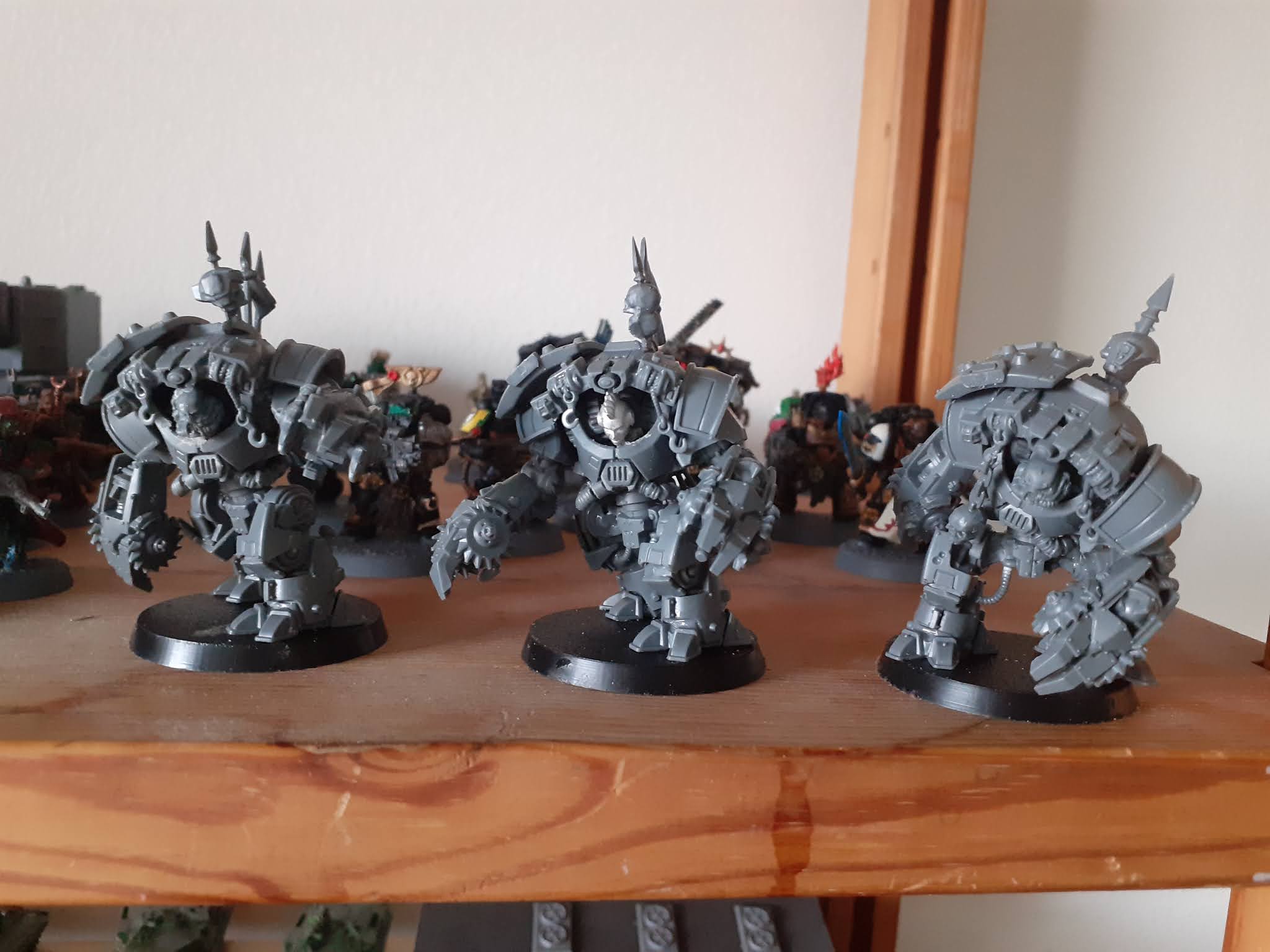
We'll start with these two little guys, since they have no weapon alternatives so there's no magnetizing or anything like that to be done. Like the two Renegade Armigers I already built for Warhammer 40,000, these Knights will also represent Auxilia Daedra and bear their black and silver heraldry. The body is Gunmetal Grey with a Black Ink wash. I used what I learned on my previous (28mm) knight build and painted the body and armor plates separately, and it was worth it. The armor is Black and Natural Steel, also with a light Black Ink wash.


I rather liked the trans flag stripe I painted on my Mechanicus knight, so I've repeated it on these guys as well.


In keeping with the Auxilia Daedra theme, I guess this has to be Cerastus Knight Banner Hircine, on account of the spear. I have to say, I'm not crazy about the models; I don't really like the gangly look. We'll see if they're any good on the battlefield.

Reaver Battle Titans

My first proper Titans! My Titan Legion is going to be Legio LXIX Venefica, or the Venom Legion, and these two are the first models to sport their green and gold colours. I got started while I was still working on the Knights by assembling and painting the Reavers' legs, and the backsides of all the little armor panels. The upper body was easier to assemble and paint in one chunk, but obviously magnetizing the weapons would be a thing. I started with the carapace weapons, where GW has made it delightfully easy: a 5mm magnet slots right into the carapace. The process is similarly easy on both carapace weapons, like this turbo-laser destructor:


Unless, that is, you fuck up the polarity of the magnet you're supergluing into the base of the rocket launcher, and get it stuck in there so badly that you end up building an entirely new mount out of green stuff. This time I stuck a magnet inside there, the right way around.


Once I cut it down a little bit, it doesn't look so bad, does it?


Next it was time to magnetize the shoulder mounts. I carved a more-or-less round hole in each:


And superglued in a magnet.


I used Primal Horizon's 1/8" * 1/16" magnets, and they fit in nicely without being overly fiddly. On the weapon side, I shaved a magnet-depth bit off the ball joint and just superglued a magnet on top of it.


When I was angry with myself for fucking up the Apocalypse Missile Launcher, I ordered a replacement, which meant I had doubles of the arm weapons. It's a bit of a drag that you would have to magnetize the connecting arms as well to be able to swap weapons from left to right, but I couldn't be bothered and just made a left-side and right-side Gatling Blaster.


Here's the gatling blasters and Reaver carapace weapons.


There's also the second set of Reaver weapons, and frankly, it's a bit weird that I had to go to imgur for the assembly instructions, as none were included in the box! This doesn't usually happen with Games Workshop. Also, I had to go to the online store to figure out which Titans went on which bases; all in all, this is the worst-documented GW product I've ever bought. Nonetheless, here are the shooty weapons.


Meanwhile, I was also practicing my Daedric on the carapaces and painting the heads. These are really models where I can't imagine not painting them in parts and then assembling them. The armor is obviously done in my favorite color, Luftwaffe Camo Green, and the edges are Old Gold with a Flesh Ink wash, as pioneered on my Custodes. The metal bits are just Gunmetal Grey with a black ink wash.
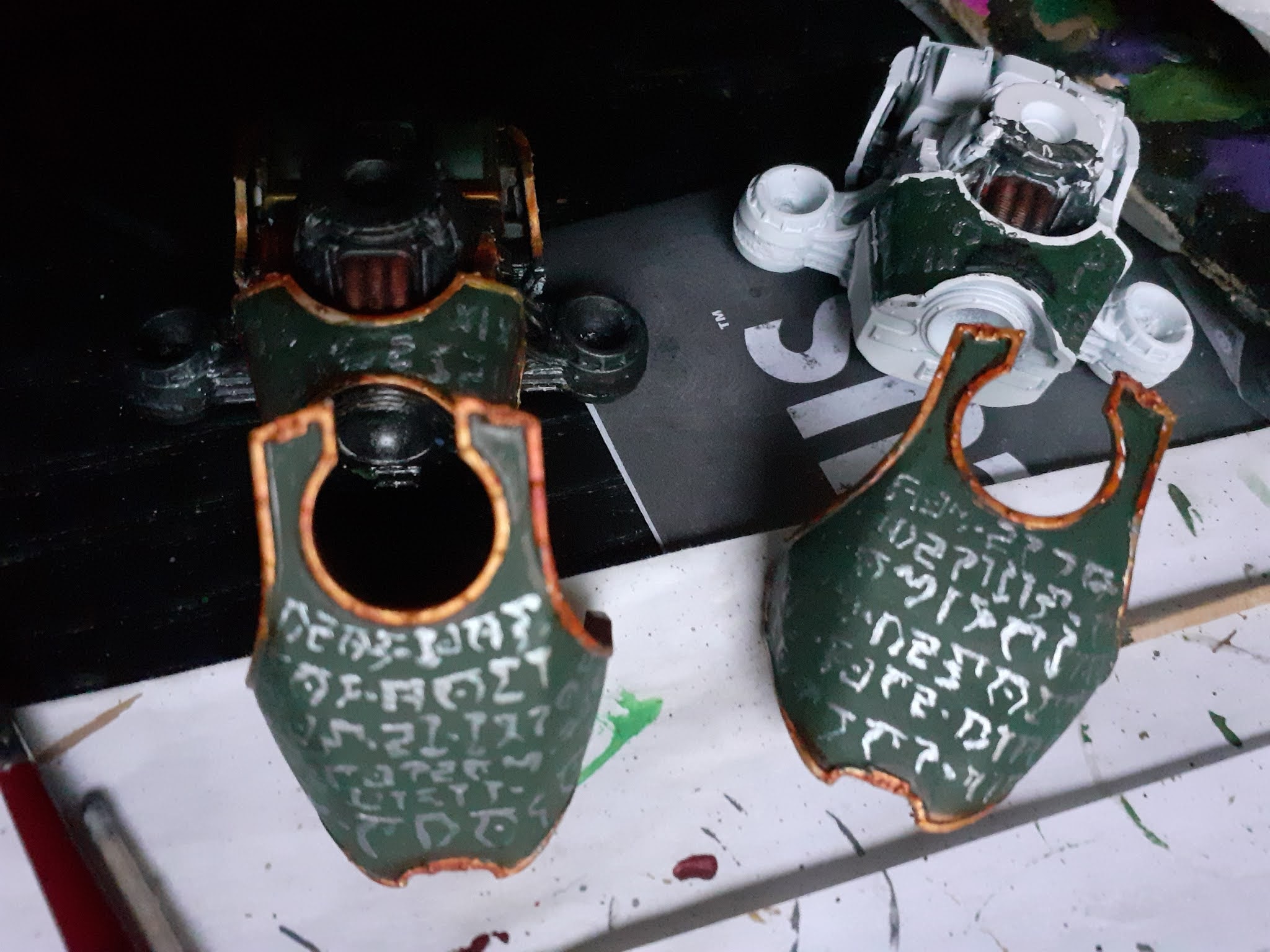

And the close combat weapons:


**

So here they are! I'm extending the starship naming convention from my Rogue Trader tabletop campaign to Adeptus Titanicus, which means my first Reaver Battle Titan will be called Cum ergo videritis abominationem desolationis, quæ dicta est a Lorgar propheta, stantem in loco sancto, qui legit, intelligat, referred to in brief as the Abominatio Desolationis.


While I was at it, I decided to see what it was that the prophet Daniel had to say about the abomination of desolation back in the day and found, somewhat to my surprise, some excellent Chaos theology. Therefore, I give you the Reaver Battle Titan Deos tuos non colimus, et thronum auream, quam erexisti, non adoramus, or in short, the Non Adoramus.


I think I want to run my Legio Venefica as Legio Damicium ruleswise. Since I don't really know how I want to play, I would ideally like to start with a legion that doesn't commit me to a specific playstyle. Damicium's abilities revolve around tanking damage, basically, and that's something that always comes in handy.

Warhound Scout Titans

Finally, the Warhounds: the Canes ad Lacerandum. Keeping with my Book of Daniel theme, they will be the Regnum transiit a te and the Et regnum erit velut ferrum.

I had a spare plastic ruin bit, so I went for a slightly more scenic base than usual. I think that means this one is the Regnum transiit a re.


The Warhounds didn't require quite as much separate assembly; I did the legs and bases in one go, then the torsos, carapace, heads and weapons separately. Magnetizing the weapons was quite easy, or maybe to be more exact, I was jaded enough at this point to just cut off the ends of the weapon arms and stick on a magnet.


I tried to be a little more elegant with the weapons, and shaved off the bottom of the sockets and stuck a flatter magnet inside.


I think the end result works quite adequately!


The Titans themselves were a fairly simple but satisfying paint job.


And here they are complete with heads and weapons! First, the Regnum transiit:


And the Regnum ferrum.


And the rest of their weapons:


**

So that's the starter set assembled!


I have to say, these are some of the best models I've ever built. The Reavers and Warhounds especially are more like small, high-quality scale models than Warhammer miniatures, and building and even magnetizing them has been deeply satisfying. I know some people are put off by the high cost of Titanicus models compared to other GW stuff, but I think they're worth it.

**

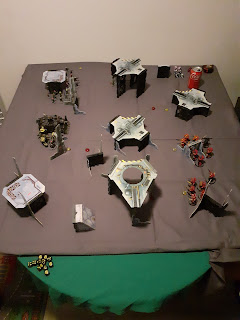
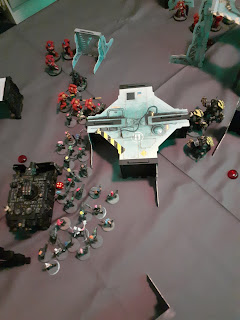
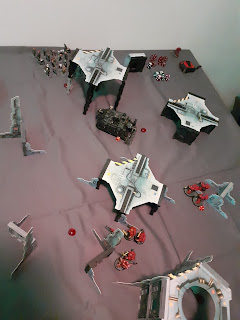
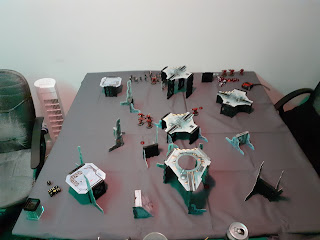
The obvious thing to do now was to try the game. I'm lucky enough that my good friend and colleague also has some Titans, which he was kind enough to bring over. I don't really have any proper epic terrain yet, so we set up a 4'×4' table with some improvised scenery.


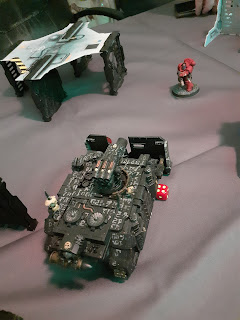
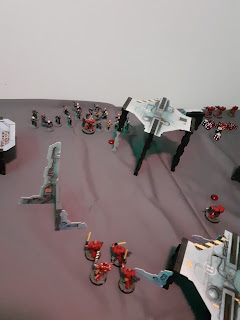
That's Seamanship Hill in the foreground, the Del Monte Tower to the right, Communism Peak in the middle, and Bitter Tower at the back. We're playing the Titanic Clash scenario from the basic rules. You can see my opponent's Titans on the left, representing Ryza's own Legio Crucius: a Warlord and two Warhounds. I brought both my Reavers and the Regnum Ferrum. By coincidence, the two forces were exactly the same combined scale.


I had no real idea what I was doing, so I set up the Non Adoramus and Regnum Ferrum to attack on the right of Communism Peak, and hid the Abominatio Desolationis behind Del Monte Tower, so the opposing Warlord wouldn't immediately blow it up!


We were therefore quite dismayed to see the Warlord climb onto Seamanship Hill and open fire on the Non Adoramus!


One defining factor of this game was that I was very lucky with my void shield saves. Still, the Non Adoramus and Regnum Ferrum surged forward, engaging the lead Crucius Warhound.


The Crucius Warhound lost its shields and started taking heavy damage, so its princeps opted for a glorious death and charged at the Non Adoramus, while the other Warhound backed off to engage the Regnum Ferrum.


The Non Adoramus opened up on the enemy Warhound at point blank range, and won the honor of scoring Legio LXIX Venefica's first kill as its laser blaster tore apart the Warhound's legs. This sent it staggering back - straight into the Regnum Ferrum!


The collision knocked out the Regnum Ferrum's Vulcan mega-bolter, and the Crucius Warhound collapsed at the foot of Bitter Tower.


Meanwhile, on the other side of the battlefield, the Abominatio Desolationis emerged from the shelter of Del Monte Tower and turned to face the enemy Warlord.


My improbable streak of void shield saves continued as the Abominatio withstood the barrage of fire from the Warlord, and charged in!


As the Abominatio and the Warlord traded blows at point-blank range, the surviving enemy Warhound dodged out of the Non Adoramus's fire arc, its shields easily shunting aside the parting shots from the Regnum Ferrum's plasma blastgun. And with that, the battle was over!


If I recall correctly, the Regnum Ferrum ended the battle structurally compromised, but the destruction of the Crucius Warhound means that the Battle of Bitter Tower is technically a Legio Venefica victory. I certainly hope this was just the opening skirmish of a very long war!

**

For future reference, this was the Legio Venefica force in the Battle of Bitter Tower.

Reaver Battle Titan Cum ergo videritis abominationem desolationis, quæ dicta est a Lorgar propheta, stantem in loco sancto, qui legit, intelligat (Princeps Seniores) - 250 pts
 Melta Cannon - 35 pts
 Power Fist - 20 pts
 Turbo Laser - 20 pts = 325 points

Reaver Battle Titan Deos tuos non colimus, et thronum auream, quam erexisti, non adoramus - 250 pts
 Volcano Cannon - 25 pts
 Laser Blaster - 25 pts
 Apocalypse Missile Launcher - 10 pts = 310 points [635]

Warhound Et regnum erit velut ferrum - 180 pts
 Plasma Blastgun - 30 pts
 Vulcan Mega Bolter - 10 pts = 220 points [855]

I was very happy with my Warhound, and for my next game, I'm seriously considering bringing two Warhounds and a Reaver, which could make a Fortis maniple.

**

So, impressions. The rules are quite complicated, but not insuperably so. They're quite different from Space Marine, which I apparently remember better than I thought, since it caught me out a few times! I never thought the void shields could take that much punishment, and it's going to take a moment for me to internalize that in this game, getting up close and personal to a Warlord Titan can be a good idea!

Like I said, I was tremendously lucky on my void shield saves. I like the void shield rules, as you really need dedicated weapons to beat down the shields, and then the ones that do damage to armor. The Vulcan mega-bolter on my Warhound was simply excellent for the first, and just in case I want my Reavers to get up close and personal in the future as well, I think I'm adding a carapace Vulcan to my next Forge World order.

Overall, I definitely enjoyed myself, but I feel like I'm going to need several more games with just the basic rules before I get a handle on how this really works. But I'm very happy with my purchase, and delighted to be playing epic again after, well, decades!

Mar 7, 2022

Let's Read Tolkien 84: Vae Victis 5-6

Middle Earth, the War of the Ring 
Historical brief 
Should our reader be minimally acquainted with analysis of major military campaigns and examine the map of Middle Earth, he would easily ascertain that all actions of both new coalitions (Mordor-Isengard and Gondor-Rohan) were dictated by merciless strategic logic, undergirded by Mordor’s dread of being cut off from its food sources.

Chapter 5 starts the alternative history of the War of the Ring. Yeskov's comments on military history and strategy really reinforce the feeling from the previous chapters that he isn't nearly as clever as he thinks he is, but luckily the meat of these chapters is the diplomatic warfare leading up to the War of the Ring, and I like it.

After the White Council has decided on war, Saruman goes on diplomatic maneuvers. He assures both Théoden and Denethor, in this story the King of Gondor, that Mordor and Isengard only want peace, and teaches Denethor and Sauron how to use their palantírs to stay in touch. Gandalf, however, is also working: Théoden's son and heir is mysteriously killed, supposedly fighting orcs, and Éomer, prominent in the "war party" in Rohan, becomes the new heir. In a counterstroke, Isengard's accredited ambassador to Rohan, Gríma (missing his accent) arranges for some of Éomer's less cautious talk about the imminent succession to come to Théoden's ears, and Éomer is disgraced. Saruman's agents also arrange for King Denethor's truculent heir, Prince Boromir, to be sent on some fool's errand to the north. Much of this actually plays out a lot like the early game in War of the Ring, with Gondor and Rohan moving back and forth on the political track, which is a nice bonus; Yeskov's story predates the board game.

Things are going badly for Gandalf, so he raises the stakes: mysterious rangers from the north ambush several Mordor-bound caravans in Ithilien, and the parliament of Mordor, uncharitably described as "fear-crazed storekeepers" votes to send the army into Ithilien. Gondor responds by mobilizing and occupying Osgiliath.

Mordor then attempts to change the strategic balance by covertly sending four battalions of troops across northern Rohan to Isengard, to form a strike force to deter Rohan from going on the offensive. Unfortunately, the ploy is detected through the Mirror, and Gandalf informs Éomer, who takes advantage of Théoden's illness and his personal popularity among the troops to lead a cavalry force to rout the Mordorian troops.

As the Mordorian survivors withdraw to Fangorn, they "fell to the poisoned arrows of the Elvish bowmen in their tree perches". I can't pass this by without noting that this is a possible reference to Finland. One of the oddities of Stalin's invasion of Finland, i.e. the 1939-40 Winter War, is that for decades afterward, Soviet veterans would insist that Finnish snipers fired on them from trees, while the Finnish army maintains they never stationed snipers in trees. A treetop would be a terrible firing position anyway, and I can't think of any reason the Finnish military would lie about this, so it's a genuine mystery where this idea came from. This has been your random Second World War trivia of the day.

Anyway Gandalf succeeds: Éomer is hailed as a conquering hero, and Théoden has no choice but to go along. Soon enough, Éomer is clamoring to attack Isengard.

It's a plot point here, then, that food is imported into Mordor by caravans through Ithilien. Because the Ithilien crossroads are specifically mentioned several times, the caravans are presumably coming up the Harad road into Ithilien. I'm going to repeat myself, but this is flatly impossible, and also makes no sense at all. With the technology available in Middle-earth, it just isn't possible to transport sufficient amounts of food to feed entire cities by land over these kinds of distances. The amount of food needed to feed the animals doing the hauling would be so prohibitive that the logistics just cannot be done.

Also, we were told that the food comes from Khand and Umbar. Umbar is a seaport. It would be complete lunacy to haul anything by land from Umbar to Ithilien when you can get on a boat and sail up the Anduin. Even then, there's no way to get the food to Barad-dûr, but if the plot point was that food is shipped up from Umbar to Minas Morgul, that at least might make an ounce of sense.

There's a double irony here. It's not just the air of superiority which Yeskov has assumed over Tolkien and the didactic tone of his work, both entirely based on the idea that Tolkien hasn't bothered to think about the practicalities of the world he set his stories in - only for him to completely fuck up a key plot point in his story. But what's worse is that if Yeskov had realized that the food needs to be moved by water, it would have made the diplomatic maneuvering much more interesting. If the food was loaded onto ships at Umbar, the logical place to offload it would have been at Osgiliath - meaning Gondor would have been making good money out of the trade. Unfortunately this opportunity was lost.

If I was to write a sequel or response to the Last Ringbearer, I'd insist that it's flatly impossible for the Mordor described in the work to exist where it did, because the logistics are totally implausible. Mordor and Barad-dur must have actually been somewhere else, and the story was later transposed to Gorgoroth. Isn't it actually much more believable that "Barad-dur" was actually, say, Minas Tirith?

Since a Middle-earth Fomenko was already mentioned, I have to say that I finally feel like I'm living up to my potential as a student of Arabic and Islamic studies at the University of Helsinki, which I still technically am, by setting up as a Middle-earth Patricia Crone.

**

Meanwhile, the armies of Mordor and Gondor are facing each other across the Anduin in what Yeskov terms a "phony war". I don't quite know what to make of the constant anachronistic allusions to the Second World War, but to be honest by this point I'm getting kind of tired of them. If the idea here is that Tolkien's world is great, can it have an existence of its own instead of being a constant foil for analogies to ours? In other words, if Tolkien protested too much that nothing in Middle-earth was an analogy to anything, Yeskov damn near does the opposite.

Anyway this all changes with the loss of the four battalions sent to Isengard - we'll call them task force Grishnákh. We're told that even before the task force was dispatched, Mordor and Isengard were seriously outnumbered. Now, after the Battle of Fangorn, Mordor's forces are so depleted that they can no longer hold Ithilien and ensure the passage of the impossible food caravans. This means Mordor needs to drastically change their strategy and attack before Rohan conquers Isengard and the combined Gondor-Rohan forces take Ithilien.

Yeskov said earlier, of task force Grishnákh: "as it always is with strategic decisions, that could only be judged post factum: had the move worked, as it had every chance of doing, it would no doubt have been recorded as brilliant". He's trying to be very clever again, but this is flat out wrong. If the loss of task force Grishnákh invalidates Mordor's entire strategy and forces them into a desperate offensive, then the risk was far too great, and sending the task force was a mistake a priori.

Mordor's plan now is to gather as large an army as possible, and defeat Gondor quickly, before the Rohirrim can successfully besiege Isengard. This initially seems like a good plan, but the elves solve the Isengard problem: to the horror of Gandalf and the Rohirrim, they destroy the dams on the Isen, drowning the entire city of Isengard overnight. Worse, Mordor knows nothing of it, because Gríma has defected and taken Saruman's palantír with him.

The offensive by Mordor's South Army is still a success: they cross the Anduin, breach the Pelennor walls and besiege Minas Tirith. When Sauron offers Gondor peace in return for the right to occupy Ithilien, King Denethor agrees immediately. Before the agreement can be finalized, Denethor mysteriously falls ill, and with his heir, Prince Faramir, also indisposed, a figure in a white cloak takes over the negotiations as the military commandant of Minas Tirith. He insists that the peace treaty will be signed, everyone just has to wait a bit for the king to recover.

This is really almost lampshaded in the Siege of Gondor, when one of Denethor's servants asks Pippin: "Who is the master of Minas Tirith? The lord Denethor or the Grey Wanderer?" Pippin's reply, "The Grey Wanderer or no one, it would seem", verges on smart-alecky, and to be honest, what Gandalf does in the Lord of the Rings damn near amounts to a coup.

So, the South Army camps out around defeated Minas Tirith. What could possibly go wrong?

**

We're six chapters into the Last Ringbearer; let's take stock.

As a general writing tip, I would reconmend not starting a chapter with condescending nonsense about being "minimally acquainted with analysis of major military campaigns" and then completely fuck up the most elementary logistics of your grand war narrative, while also dropping snide remarks on strategy that are just rubbish.

So yeah, I have to admit that Yeskov's arrogance is really starting to grate on me. At best, it comes across as smart-alecky, at worst as sneering condescension; both combine poorly with the fact that he is a total dilettante when it comes to anything to do with the military. I really hope there's an actual story at some point, because while I like some of this stuff, I'm also reaching my limit on poorly written "ha ha look how much smarter than Tolkien I am" fanfic. If there isn't, I will just give up on this.

Next time: war.

Feb 14, 2022

Warhammer 40,000: Let's Play Filthy Casual - 500 pts Word Bearers vs Blood Angels

Of the coming of these monstrosities and evil Forces, no man could say much with verity; for the evil of it began before the Histories of the Great Redoubt were shaped; aye, even before the sun had lost all power to light; though, it must not be a thing of certainty, that even at this far time the invisible, black heavens held no warmth for this world; but of this I have no room to tell; and must pass on to that of which I have a more certain knowledge.

 - William Hope Hodgson, The Night Land


It's now time to play some 9th edition Warhammer 40,000! We're trying the Filthy Casual rules for a slightly more accessible attempt at 9th, which, frankly, seems a little difficult to wrap my mind around. Here's what I'm bringing to the table.

**

I enjoyed playing Chaos in Gladius so much that I also wanted to make some models based on it. I started with the Chaos Lord from Blackstone Fortress. The Lord is my favorite unit in the game; there's nothing like them walking up to literally anything and smashing it to pieces with their thunder hammer - and if you're very lucky, immediately turning into a Chaos Spawn afterward. I gave them a Statuesque Miniatures head, and I think it worked beautifully.


Which does remind me that I need to make a Chaos Spawn model. Proxy Studios later changed the Gladius rules so that Chaos characters don't get turned into Spawn any more, because they're cowards.

**

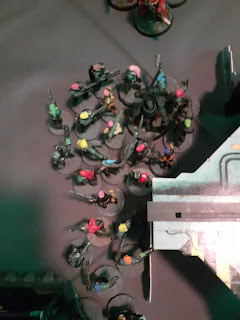
My Chaos Cultists were instrumental in my first 8th edition victory. They got shot to pieces, would have run away if not for my Dark Apostle, and then outflanked the enemy with Tide of Traitors. The models are quite dear to me as they were a very succesful Escher gang in our long Necromunda campaign back in the day. Obviously I wanted more cultists, and Brother Vinni had some models that suited the aesthetic exactly. I got Anna the Bonecrusher to be our cultist leader, and Veronika Zemanova because, well, I had to.


I thought the Necromunda Ambots looked really cool, and someone on reddit suggested fielding them as Mutilators in 40k. I took a stab at converting one, with a Chaos Marine head and one of those spiky things from the Chaos Terminator sprue. I think it worked out all right:


So I made two more, with CSM bits and a Statuesque roider head.


And here they are in my Word Bearers colors:


So how could I not try them?

**

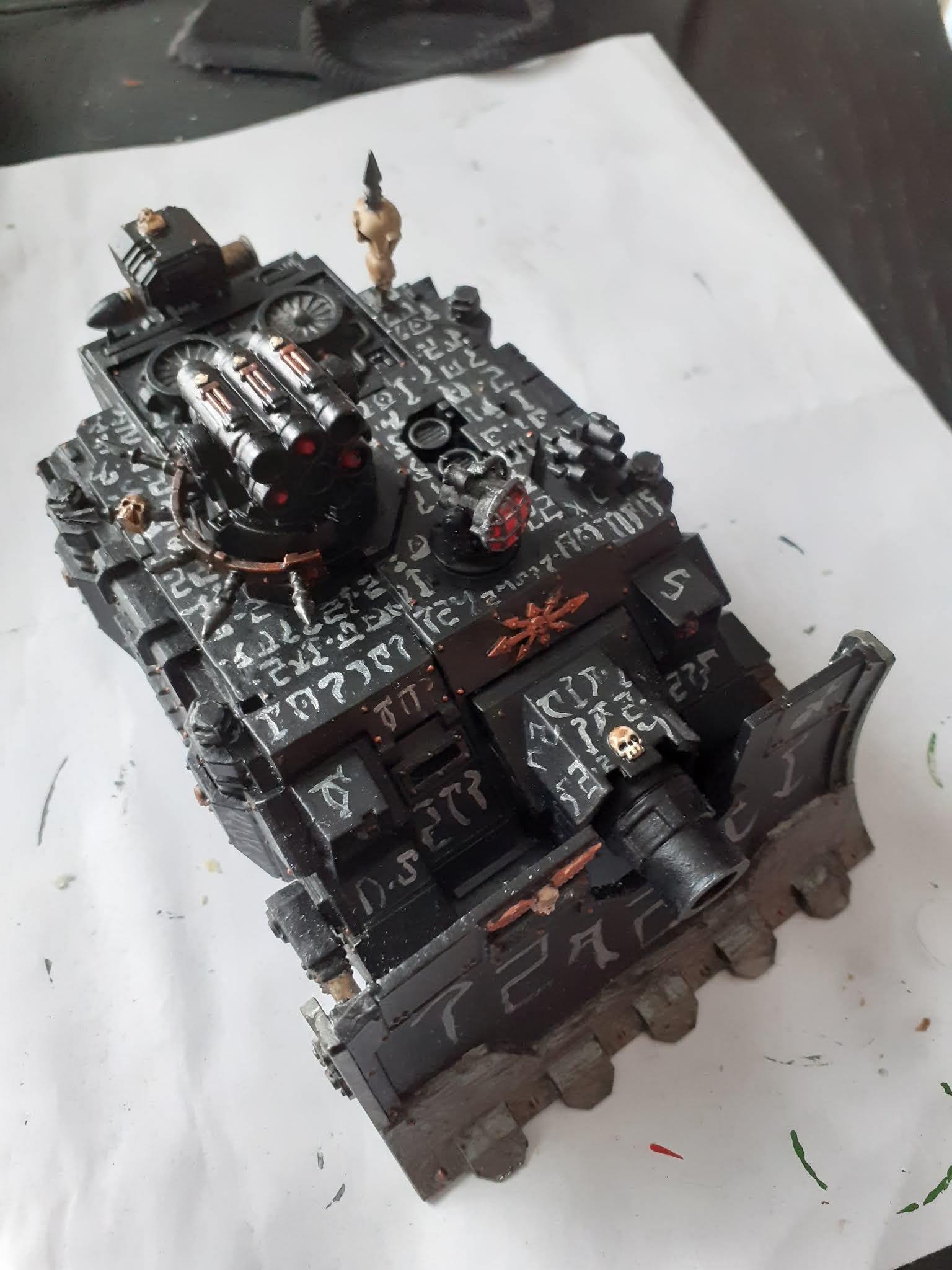
Last year, I was lucky enough to get to teach a course on Trumpism at the Espoo adult education center. Taking Richard Hofstadter's Paranoid Style in American Politics as my guide, I talked about colonial and early USian anti-Catholic propaganda like the Awful Disclosures of Maria Monk, a direct predecessor of the satanic panic of the 1980s and its latter-day reincarnation as QAnon. A prominent anti-Catholic publication of the tine was the splendidly named American Protestant Vindicator, which led directly to the firm conviction that my Word Bearers absolutely need a Vindicator. Well, here it is!


This is my first shot at the black-and-silver Daedric look that I used for my Renegade Armigers on a vehicle, and I think it worked out pretty nicely.


**

So here's my 500 point Word Bearers army:

HQ - Chaos Lord - 80 pts
 Plasma pistol [5], thunder hammer [20] = 105 points

Troops - 29 Chaos Cultists - 145 pts
 13 × autogun (0), 13 × autopistol & ccw (0), cultist champion w/autopistol & ccw, 2 × flamer [10] = 155 points [260]

Elites - 3 Mutilators - 105 points [365] 

Heavy Support - Vindicator - 130 pts
 Havoc launcher [5] = 135 points [500]

I will be facing Shaun's Blood Angels:

HQ - Primaris Lieutenant - 80 points

Troops - Assault Intercessor Squad (5) - 100 points [180]

Troops - Assault Intercessor Squad (5) - 100 points [280]

Elites - Judiciar - 85 points [365]

Heavy Support - Eradicator Squad (3) - 135 points [500]

**

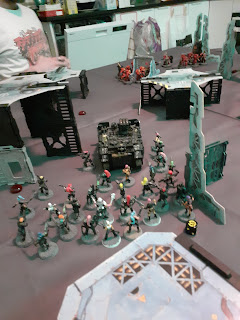
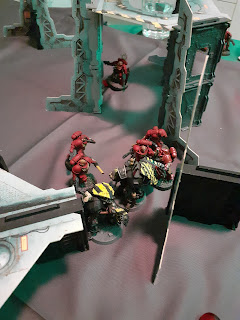
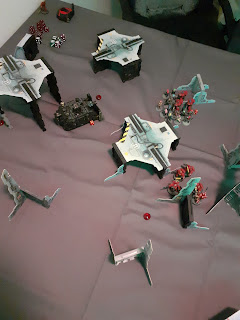
We set up some of my fairly ancient Necromunda terrain and rolled up a mission, ending up with Encircle.


I got the first turn, and my plan was simple: charge.


My Vindicator's shooting did absolutely nothing to anyone, and return fire from the Eradicators knocked it down to four wounds remaining. The Mutilators advanced on the objective on the right, and my Chaos Lord and Cultists charged the Intercessor squad in the center. The Judiciar used his special ability to make my Lord fight last, and he took several wounds – and then wiped out the Intercessors with his thunder hammer.


Meanwhile, the Mutilators were having a bad time: they failed their charge and the Eradicators knocked one of them out. The remaining Intercessor squad charged them, but the Lieutenant failed his charge roll.


In the central mêlée, the Judiciar charged both the Chaos Lord and the Cultists, the latter of which would have made for some hilarious overwatch if it was available. He killed my Lord, but was in turn swamped by the Cultists. The Judiciar promptly failed all his armor saves and was killed!


The Cultists consolidated into the Eradicators at the cost of a few casualties, the Intercessors finished off the last Mutilator, and the heavily damaged Vindicator continued to hang onto the objective.


At this point, I had a decent victory point lead, and elected to use my stratagem, Tide of Traitors, to regroup my cultists so they could hold the objective on my left.


With the cultists out of the way, the Vindicator opened up on the Eradicators, killing two of them! In retaliation, the Eradicator sergeant blew up the Vindicator with his melta rifle.


The Primaris Lieutenant made a heroic charge into the cultist mass and killed five of them, but to no avail.


The game was over: although the entire Chaos army except for the indomitable cultists was wiped out, I won the game with 25 VPs to 15.


This was a tremendously entertaining game, with lots of dramatic moments. I had a great time.

**

What did I learn? For starters, to not rely on my Vindicator's shooting ever getting anything done! Heavy D6 is so swingy, because a couple of bad rolls on the number of shots means nothing happens. I love how the model looked on the tabletop, but I feel like those points could have been better used.

Mutilators are garbage. They're excruciatingly slow, yet when they do get into combat, they're not that great at it either. I rolled poorly for their AP every time, so they barely made a dent in the Intercessors, but it's not like they have the attacks to seriously threaten lighter-armored units either. I don't really get what they're for. I was also a little surprised by how fragile the Chaos Lord was.

The star of the whole show was obviously my venerable Escher gang. Maybe it was the familiar surroundings, but for whatever reason, they really excelled. My opponent and I agreed that the shocking death of the Judiciar was a turning point: after that, the cultists and Eradicators tarpitted each other, letting the Vindicator clock up more victory points, and the remaining Intercessors couldn't close the gap. I'm obviously delighted by how well the cultists did, and I'm definitely keeping them as the core of my army.

As a general note, I like the Filthy Casual rules, because I think the complexity of 40k is getting a bit much. Even without stratagems, secondaries and so on, it was challenging enough to keep track of all the various auras, special rules, doctrines, chapter tactics and what have you - and all this despite the fact that my army is still basically an 8th edition one. I'm looking forward to a new CSM codex, as I think the army needs it badly, but at the same time I dread how many different sets of special faction rules it's going to have in it! I think the game is already too complicated for its own good, and looks to be getting worse.

Still, this was fun, and we're definitely playing more. I'm already thinking about my next 500-point army list...

Feb 7, 2022

Let's Read Tolkien 83: Vae Victis 3-4

Middle Earth, the arid belt 
A natural history brief 
Two types of climate epochs follow one another in the history of any world, including Middle Earth – pluvial and arid; the growth and shrinking of polar ice caps follow a single rhythm, which is a sort of a pulse of a planet.


Talleyrand, as depicted in the
KOEI video game L'Empereur


I said climatology and I meant it. Yeskov is a biologist, and he talks us through the idea that planets go through cooler and warmer climate periods. This, he states, is "obscured" to historians, even though climate change is much more meaningful to history than most of what we consider important historical events. This is exactly the kind of reductionist Jared Diamond nonsense that non-historians love, where they take something that's obvious to any historian, in this case something I teach as part of our high school history curriculum ("climate impacts society!"), and present it as a devastating new insight that none of us have heard of. It's nonsense in terms of Yeskov's own story as well, but I'll get back to that.

What we're told is that Middle-earth (I don't know why the translator insists on "Middle Earth") is entering a drier phase, and that's bad news for Mordor: with less rainfall hitting the mountains, agriculture in Gorgoroth goes into a crisis. They decide to fix the problem with an irrigation scheme drawing on Lake Núrnen, charmingly depicted in Middle-earth: Shadow of Mordor. The trouble is that while this is initially succesful, in the longer term poorly done irrigation will lead to so much salt building up in the soil that it becomes a wasteland, and as is explained to us in a slightly excruciating but factual infodump, this is what happens to Mordor.

We're told the architects of the irrigation scheme were sentenced to twenty-five years in the lead mines, by the way, which suggests I was on to something with my Soviet Mordor schtick in War of the Ring. Seeing as how Mordor is "the smithy of the nations", they can compensate for this by importing food, and their prosperity continues: a full-fledged industrial revolution is underway, with steam engines and everything, and King Sauron VIII even proclaims a national literacy law.

For what it's worth, I have an issue with this story. Yeskov writes that Mordor "could trade its manufactured goods for any amounts of food from Khand and Umbar. Trading caravans went back and forth through the Ithilien Crossroads day and night". Khand is southeast of Mordor and Umbar, as we know, is to the south. If food imports from Khand and Harad are feeding Gorgoroth and especially the city of Barad-dûr - how? How does the food get there? Caravans, he says, but that's a terribly uneconomic way of hauling food. At some point, and it isn't very far, the animals hauling the grain or whatever else start to need so much fodder for the trip that there's no room for anything else. Maybe you could haul food from the Anduin to Minas Morgul, say, but getting it to Barad-dûr? But there's no conceivable water route to Barad-dûr either, and if there was enough rainfall on the Gorgoroth plateau to dig canals, they wouldn't be necessary to transport food in the first place.

I would suggest that given the technology involved, transporting enough food to Barad-dûr to feed a city simply can't be done. Logistics on this level couldn't be carried out by land until the invention of the railroad, and even though we've heard of steam engines in Mordor, so far they've been stationary and there hasn't been so much as a whisper of rails. This idea that Barad-dûr subsists on imported food is, I think, impossible.

So in my opinion, ironically enough, Yeskov hasn't quite thought this through. It's not like this is a fatal flaw, but if you're going to have a go at Tolkien for this stuff, it's only fair you be held to the same standard yourself.

**

We move from climatology and irrigation to completely different things, with this dramatic paragraph closing the third chapter.

But it was exactly at that time that the words that changed the entire history of Middle Earth were said; strangely, they repeated almost exactly a prophetic utterance made in another World regarding a very different country: “A nation that is unable to feed itself and is dependent on food imports cannot be considered a formidable foe.”

Somebody asked about the quote on stackexchange, and I have no idea where it's supposedly from either, or even what the country is. The parallels made in the following chapter are all intensely 20th-century, and Britain comes to mind first, but I have no idea who would have said something like this about them, or indeed anyone else for that matter. It could be that the idea got lost in translation.

The scene it sets up is a meeting of the White Council in the Tower of Amon Sûl. Again, the diacritic is wrong in The Last Ringbearer, where it's rendered Amon Súl, like Barad-dúr (sic); later on we also get Nazgúl, as if the acute accent was the only diacritic that exists. In Appendix E of the Lord of the Rings, Tolkien explains that the acute accent is used to mark long vowels, with the circumflex (^) used in Sindarin for long vowels in stressed monosyllables, because "they tended in such cases to be specially prolonged". So it's not a horrible crime to write Amon Súl instead of Amon Sûl, but with modern word processing, swapping out the circumflex is inexplicable. The only message I'm getting from it is that the translator can't be bothered to write names properly.

The White Council of this chapter consists of Saruman, Gandald, Radagast and a fourth wizard dressed in blue. Gandalf has just finished advocating that they go to war with Mordor. With the aid of a foretelling device called the Mirror, which I presume is the Mirror of Galadriel in the Lord of the Rings, the wizards have determined that the development of industry and technology in Mordor will outstrip the western nations and soon become unstoppable. Gandalf's proposal is to enlist the elves, "the inhabitants of the Enchanted Forests", on their side, and offer to lend them the Mirror for the duration of the war. The elves, Saruman warns, are only ever out for their own advantage. He argues against war, referring to it as a "Final Solution of the Mordorian problem", and predicting that if Gandalf wins, he'll write history to justify himself, i.e. the Lord of the Rings. Saruman fails, and resigns his position as head of the council.

The prose is not only clunky but melodramatic; it shifts jarringly between registers and fairly clobbers you with anachronisms, so I have to be honest and say that the fourth chapter isn't exactly pleasant to read. It ends with a quote from, of all people, Talleyrand. But thematically, what's being set up here works as an anti-story to the Lord of the Rings. Gandalf says:

The Middle Earth [sic] is a multitude of peoples living in harmony with nature and the heritage of their ancestors now. These peoples and their entire way of life are now under a dire threat, and my duty is to avert it at all costs.

The idea of protecting the immemorial customs - the mos maiorum - of Middle-earth from evil innovation is basically identical to Tolkien's theology of the Machine; in Tolkien's terms, Gandalf is setting off to fight Sarumanism, just as he did in the Lord of the Rings. Tolkien's Gandalf would probably not have taken this as far as launching an offensive war to destroy science and literacy, but many of Tolkien's fellow religious conservatives certainly do, from Afghanistan to Alabama. So the Gandalf presented here is a very credible evil doppelgänger to Tolkien's kindly wizard, indeed quite close to what many critics of Tolkien seem to have imagined his Gandalf actually was. Tolkien's Gandalf stressed that he felt pity even for orcs; Yeskov's Gandalf dismisses pity as weakness. Maybe this is something like what Gandalf would have become if he had accepted the Ring when Frodo offered it to him. In that sense, what we have here is both a counter-narrative to Tolkien and, arguably, a very Tolkienian exploration of how power might corrupt even Gandalf.

In his speech against Gandalf, Saruman makes the argument that Gandalf is jealous of Mordor, which works as an inversion of the position in the Lord of the Rings, where Saruman imitates Sauron. Here Saruman's argument is that magic, as used by the wizards, can never really advance; on the contrary, as time goes on, more and more of it is lost, whereas science and technology can grow. This is also a fair extrapolation of Tolkien's conservativism: new things are Sarumanism and therefore bad. But it's also an interesting inversion of one of the points of Tolkien's cosmology, namely that evil can never truly create new life. Here it's turned on its head: conservative, backward-looking magic can't create new things, but science can.

**

So chapters 3 and 4 are a bit of a mixed bag. Where the certain clunkiness of the prose was, at worst, tolerable and at times almost endearing in the first two chapters, here it's at times difficult to read because, well, it's quite bad. There's a didactic, almost smug tone to the infodumps of the third chapter, and Saruman's heavy-handed, anachronistic moralizing is very poorly executed. Tolkien used anachronism deliberately to create distance between the narrator and the story; Yeskov uses it to batter the reader into submission. I don't know if it's an artifact of the translation or a quality of the original, but these chapters especially left me with the unfortunate impression that Yeskov may be very clever, but not nearly as clever as he thinks he is.

Having said all this, the counter-narrative is taking shape, and I'm definitely interested in seeing where it goes, even if it's rough going at times.

**

Next time: diplomacy.

Jan 10, 2022

Rogue Trader: The Trial of Brother Aphesius for Arson in the Emperor’s Dockyards

In their most recent operations in the Acheron Sector, Rogue Trader House Frunze has had the exceptional misfortune of employing two missionaries from the Ecclesiarchy, and seeing both of them put on trial for various high crimes against both the Ecclesiarchy and the Adeptus Terra – one of them twice. This is a selection of transcripts and accounts from those trials, starting with the trial of Brother Aphesius for Arson in the Emperor's Dockyards.

**

Entry from the Periplus Ultra Pars Akherontis:

Vestigium Hanini (O.Ac.U.5) Imperial navy outpost. Some small scale mining operations.

The station at Vestigium Hanini stands at the head of the Holy Gates as the first stop in Ultra Pars for voidfarers from the coreward sector, and serves as a transit hub and naval outpost. Two routes run from Vestigium Hanini to Babylonia Typhonis: the circuitus meridionalis to the galactic south, a longer route passing through the dead system of Fortunae Bellum; and the circuitus septentrionalis to the galactic north: a shorter route, but passing through the hazardous dentae typhonis, an unstable area before Auster Clementiae.

**

Excerpt from Synopticon quarterly monitoring report from Vestigium Hanini, 1/944M41:

On Emperor's Day, the station was shockingly attacked by the foul xenos known as the Eldar. Station security, assisted by His Excellency the Rogue Trader Frunze and his retinue, drove the alien enemy from the station; in co-ordination with the Imperial Navy, His Excellency pursued the xenos to the Fortunae Bellum system and destroyed a suspected enemy facility there.

Even though the xenos were quickly vanquished, their treacherous attack had targeted the voidfarers' quarters on the station. Several plasma grenades were detonated in the dormitories, causing heavy casualties. In the aftermath, the remains of the dead xenos were collected and stored in the security compound. Inexplicably, several xenos artifacts went missing, and the matter is being investigated by the Ordo Xenos.

The mood on the station in the aftermath of the attacks was febrile. The system had been peaceful for so long that the sudden eruption of violence was shocking, and rumours and unrest were rampant.

**

Report of Arbiter Nicola Haussmann, Vestigium Hanini, to Arbiter Primus Nurul Masud, Babylonia Typhonis:

Long live the Emperor!

On 5118944M41, late night station time, station security received a report of a disturbance in the residential section, followed shortly by a fire alarm. Security officers responding to the alarm found that forcible entry had been effected to the residence of [REDACTED], an actuary employed on the station, and a fire was observed inside the residence. Initial observations suggested that an incendiary weapon had been discharged inside the residence. [REDACTED] was not present at the residence and his wherebouts are currently unknown.

Concurrently with these events, station security was monitoring a disturbance in the station mezzanine, where an individual was addressing a large group of voidfarers and station residents. This individual was subsequently identified as Ecclesiarchical Missionary Brother Aphesius, in service to Rogue Trader House Frunze. Station security officers observed that Brother Aphesius was armed with an incendiary weapon typical to a clergyman of his station.

According to station security officers and multiple witnesses (statements appended), Brother Aphesius proceeded to incite the crowd with a series of false statements regarding station security. Brother Aphesius falsely accused station security of collaborating with and abetting the recent xenos assault on the station. Brother Aphesius further claimed that station security were responsible for the alleged disappearance of xenos artifacts taken into custody after said attack, and falsely alleged that station security continued to collaborate with the xenos. Brother Aphesius publicly accused station security of treason and apostasy, and incited the group of people he was addressing to join him in assaulting the security compound.

In view of the size of the crowd and the apparent success of Brother Aphesius's incitement, I ordered all station security personnel to withdraw to the security compound. I contacted the cruiser Aut Imperator Aut Nihil and requested assistance in the form of a shore party equipped for crowd control duties. The Master-at-Arms of the Aut Imperator Aut Nihil promptly dispatched a large party of armsmen to secure the compound.

Once the compound was secure, we received technical intelligence that Brother Aphesius was leading an assembly through the dock area toward the security compound. Having ensured the integrity of the compound, I led station security forces and the naval armsmen to the docks, where Brother Aphesius and the crowd he had incited were ordered to surrender. Brother Aphesius incited the crowd into resisting station security. He was arrested and the crowd was succesfully dispersed.

**

From: Office of Director Elizabeth Draken, Imperial penitentiary, Babylonia Typhonis 3
To: Arbiter Primus Nurul Masud, Babylonia Typhonis
Re: Prisoner Aphesius

The prisoner Aphesius, processing number 22817/944 (clergy), is being transferred to Babylonia Typhonis station per your directive. Be advised that the prisoner was involved in a violent affray while confined, and has received administrative discipline; documentation appended. The prisoner is considered dangerous (security class 2BeV) and is being transported under restraint.

Long live the Emperor!

**

List of Charges

In the Name of the Emperor of Mankind, we the Office of the Imperial Prosecutor, Ultra Pars Akherontis Sectio, indict Brother Aphesius, late of Dementia Praeger, late of Erasinos, in service with House Frunze, of the following crimes against the Emperor's Justice:

 Resisting the Adeptus Terra
 Incitement to treason against the Emperor of Mankind
 Treason against the Emperor of Mankind

We further indict the same Brother Aphesius of the following crimes against local law:

 Disturbing the Imperial Peace
 Willful destruction of Imperial property
 Willful and reckless endangerment of life support systems on an Imperial facility
 Arson in the Emperor’s dockyards

We further append a report from the Imperial Penitentiary where said Brother Aphesius was confined, indicting him of the following crime:

 Violent affray in an Imperial penitentiary

We further note that proceedings are underway in the Doom-Capitol of Saint Isabella the Just of Acheron to determine whether the said Brother Aphesius should be indicted of the ecclesiastical crime of heresy.

We respectfully submit these charges to Her Excellency, Procurator Natasha Maya, for further action. May the Emperor's justice be done! He is the Law.

Compiled by assistant prosecutor Ayana Rufius.

Long live the Emperor!

**

Office of the Procurator Ultra Pars, 4232944M41

Her Excellency Procurator Natasha Maya,

 in the case of the prisoner Brother Aphesius, in service of Rogue Trader House Frunze,

 having received the list of charges prepared by the Office of the Prosecutor in this matter,

 having noted the decision of the Doom-Capitol of St. Isabella the Just of Acheron to defer judgement until the conclusion of this investigation,

 having consulted with His Excellency, the Rogue Trader Laurenz Frunze,

 rules that the said Brother Aphesius be sentenced in the following counts:

for Resisting the Adeptus Terra - to death

for Incitement to treason against the Emperor of Mankind - to death

for Treason against the Emperor of Mankind - to death

for Disturbing the Imperial Peace, willful destruction of Imperial property, willful and reckless endangerment of life support systems on an Imperial facility, and violent affray in an Imperial penitentiary  - to death

for Arson in the Emperor’s dockyards - to death

 this penalty being suspended, and said Brother Aphesius being sentenced to exile in perpetuity, under pain of this penalty being executed on his return to Imperial space.

For the execution of this penalty of exile, said Brother Aphesius is hereby released into the custody of His Excellency the Rogue Trader Laurenz Frunze.

The Emperor is the Law. Long live the Emperor!

Jan 3, 2022

Let's Read Tolkien 82: Vae Victis 1-2

Is there a sight more beautiful than a desert sunset, when the sun, as if ashamed of its whitish daytime fierceness, lavishes a bounty of unimaginably pure soft colors on its guests?

Last summer, I finished my series of blog posts on the Lord of the Rings; my Let's Read Tolkien series took 81 posts to cover the Hobbit and the three volumes of the Lord of the Rings. Obviously I started thinking about what to do when it was done. Having a regular monthly blog post has been a fun thing to do, and doing a sort of leisurely close reading of books I know and love was just a pleasure. Now, though, I decided it was time for something completely different.

That's right: I'll be reading Kirill Yeskov's The Last Ringbearer, the unofficial sequel or retelling of the Lord of the Rings, denied official publication in English by the Tolkien estate but nevertheless released unto the world in 1999. I have to say that it's completely beyond me why the grandchildren of a man who died in 1973 are allowed to exercise this kind of control over creative works by other people, but here we are. As I don't read nearly enough Russian to be able to tackle the original, I'll be working with the second edition of the English translation by Yisroel Markov.

The essential background reading is Yeskov's essay in Salon, "Why I reimagined "LOTR" from Mordor's perspective". It's kinda charming, and at this point, I was completely sold:
Plus Middle Earth surely has PR and info wars (how else?); perhaps it even has its own Professor Fomenko to claim, in all seriousness, that there was no Second Age, Angbad is nothing but Mordor, and Fingon, Isildur and Aragorn were the same person…
A Middle-Earth Fomenko! That's it, I'm definitely reading this.

Yeskov's starting point, in brief, is that he loves Tolkien's world but isn't that crazy about the stories Tolkien set in it. So he's decided to rescue Middle-earth from Tolkien with a sort of counter-narrative to the Lord of the Rings. I'm definitely interested. A couple of points he made struck home, the most important of which echoes the observation made by the commenter to my earlier Tolkien blogs: Tolkien didn't really care about human geography. Yeskov has set out to fix this, and gleefully introduces his trick question to Tolkien scholars: when the hobbits drink beer at, say, the Prancing Pony, what kind of money do they use to pay for it?

It's a damn good question. I claim partial credit for having asked questions about the hobbit economy way back when I did Chapter 2, including what, exactly, the inherited Baggins wealth is and where it's held, including whether there's a hobbit bank somewhere. I've even run an entire Middle-earth Role-Playing campaign, where we just used the game's anodyne system of metal coins in denominations of ten, without ever giving the whole matter a second thought. But more to the point, I agree entirely that Tolkien managed the perhaps slightly strange trick of totally neglecting huge parts of his "sub-creation", while still making it compelling enough to make you want to fill in the blanks.

Other than that essay and a general awareness that The Last Ring-bearer exists, I don't really know anything about it, and I'm going to keep it that way. The book is divided into four parts, with lots and lots of chapters which look quite short, so I'll be tackling several of them in each blog post. Probably. Like I said, I don't really know what I'm getting into!

I'm doing it anyway. Here goes.

**

After some Kipling and a short paean to deserts, we meet who I presume are our main characters trudging through one: Haladdin the Field Medic, and Sergeant Tzerlag of the Cirith Ungol Rangers. They're refugees from Mordor's South Army, defeated in the Morgul Vale, and Haladdin is severely wounded from an elven arrow to the leg ("poisoned, as usual"). They've had a harrowing escape, hiding out next to a gallows erected by the Western army and crossing by Cirith Ungol. It all sounds like a sort of reverse Shadow of War, and frankly, I'd play the hell out of that.

Haladdin tries to persuade Tzerlag to leave him behind and make for safety, but the Orocuen (i.e. "orc") won't have it: if the elves find him, they'll torture him and find out too much. They get water from what's called an adiabatic collector, apparently better known as an air well, or in other words, a pile of rocks that condenses moisture out of the air. It's unclear if these were ever actually used anywhere, but it's an interesting concept and works nicely here. They hide for the day in a dugout quickly prepared by Tzerlag, and Haladdin passes out to a hallucination where he's back in Barad-dûr. Therefore, it's time for exposition!

Gorgoroth has a long history as a prosperous oasis in the Mordor desert, where a whole bunch of Orocuen have settled down, while most of the others still lead nomadic lives in the desert. Caravans from Umbar make the long trek to trade here, especially for valuable metals mined from the Ash Mountains by the trolls, and all these people - who are throughout described as human - intermingle and -marry.

This, then, was the yeast on which Barad-dúr rose six centuries ago, that amazing city of alchemists and poets, mechanics and astronomers, philosophers and physicians, the heart of the only civilization in Middle Earth to bet on rational knowledge and bravely pitch its barely adolescent technology against ancient magic.
The diacritic in Barad-dûr is consistently wrong, by the way, and that's annoying. The impression we're being given here is of a sort of idealized secular Arabic-Islamic civilization, juxtaposed with the primitive West "picking lice in its log ‘castles’ to the monotonous chanting of scalds extolling the wonders of never-existing Númenor" - only a slightly caricatured rendition of early medieval Europe and what we now call the Middle East. Haladdin has fond memories of the streets of Barad-dûr, his time at the university and a certain trollish girl called Sonya.

Sadly, Haladdin's consciousness returns to the desert, and when night falls, the two get underway again. Tzerlag has explained to him how the desert, which seems barren and featureless, is divided between the various Orocuen clans, and how it contains much more life than the casual observer would think. Tzerlag also reminiscences on how he grew up as a nomad, became a traveling craftsman, and ended up in the army. He roundly curses the war and wonders who wanted it in the first place.

**

And with that, the short second chapter ends. This has been an effective, if slightly cliche introduction, but hey, they're cliches because they work, right? We've met who I assume are our protagonists, but at least two characters, and we've been given a strong introduction to the "counter-story" to the Lord of the Rings that we're here to experience. The prose is a bit clunky, but its no-nonsense modernity and the expository focus on exactly the kind of human geography Tolkien cheerfully ignored, it's effective, and I'm curious to read more.

**

Next time: ...climatology?