Nov 21, 2016

Let's Play Arkham Horror: The Card Game

At long last, we've gotten our hands on a copy of Arkham Horror: the Card Game, and we're here to tell you if it's any good or not.


Nicholas Roerich: Рассвет (незакончена) [Sunrise (unfinished)], 1930

**

Full disclosure: as a household full of H.P. Lovecraft fans and several devout Lord of the Rings card game players, we were very much looking forward to this game. If anyone unfamiliar with the Lord of the Rings LCG happens to read this, I apologize in advance for comparing Arkham Horror to it constantly. This post will also contain mild spoilers for the first scenario in the core set.

Here's what's inside the box:


There's five investigators, enough player cards to make full decks for two of them, three scenarios for them to tackle, and all the counters and paraphrenalia required to make that happen. Unsurprisingly, it's a lot like the Lord of the Rings LCG; one of the major exceptions are the Chaos tokens, which basically work like the Hunt pool in War of the Ring. The cards and counters are made of good quality material, although as always, I do strongly recommend sleeving all the cards before playing. The art on the cards is of fairly high quality, as I think we very much expected, but although I can't say we're disappointed, the cards aren't quite as lovely overall as the Lord of the Rings card game's. For the backs of the player and encounter cards, they've gone for a sort of art deco Cthulhu look, which is quite all right, but especially the flat beige of the encounter cards isn't the most attractive choice. Art deco is a bit cold at the best of times, and here it comes off as quite distant. But certainly nothing here is ugly!

In terms of content, the cards aren't really terribly evocative or even all that interesting on their own. I suppose this is one area where the comparison to the Lord of the Rings card game is at its most unfavorable, but going from, I don't know, Light of Valinor to Physical Training or Blade of Gondolin to Switchblade is a bit of a downer. Most of the cards are very generic and and only take on any life once you've used them in the game. By themselves, few of them evoke anything at all. Even fairly obvious opportunities for thematic hooks are ignored; we get Research Librarian rather than, say, Miskatonic Librarian and Guard Dog rather than watchdog or even "canine guardian" as they're referred to in the Dunwich Horror. Even the flavor texts aren't usually from Lovecraft or the broader mythos. So the initial impression from the cards is unfortunately almost bland.

**

The proof, though, is in the pudding: now that we've seen the actual physical game, it's time to try playing it. We're going to start with the first scenario in the core set, the Gathering, and use the recommended starter decks. That means one of us gets Roland Banks, the Fed:


While the other gets Wendy Adams, the Street Urchin:


Because we both think we'll want to make different choices later when we settle on a particular deck to call our own, I picked the Fed and my partner got Wendy. The numbers across the top right-hand side of the card are their skills: willpower, intellect, combat and agility. As you can see, both investigators have fairly well-rounded stats, Wendy's lousy combat score being the only exception. The cards also detail their abilities: Roland can find clues by defeating enemies, while Wendy can swap a horrible Chaos token - used to resolve skill tests - for a hopefully better one. Finally, there's the starting health and sanity for both characters.

The reverse of the investigator cards gives us a little backstory on the character and, crucially, their deckbuilding requirements. Arkham Horror has five different classes of characters and cards; Roland's class is Guardian, and the back of his investigator card tells us we can include Guardian cards from levels one through five in his deck. He can also use Seeker cards from levels 0-2, and neutral cards. A starting deck for Roland will have thirty cards from those classes, plus his two special cards, Roland's .38 Special and Cover Up. The last of these is a Weakness: a card you draw from your player deck that hurts you. So far, each investigator has one specific weakness, and must also include one random basic weakness.


The deck itself is made up of three kinds of cards in addition to the mandatory weaknesses: assets, events and skills. Assets include allies, tools, weapons and so on; they remain in play, and the number of "slots" your character has restricts how many you can have at any time. For instance, characters only have two hand slots, which means you can have two assets that take up a hand slot, or one two-handed asset. Events are played and resolved immediately, while skill cards are committed to boost skill tests. Each card has one or more skill icons, and when you take a skill test, you can discard card to boost your skill score. Skill cards are only useful when discarded to skill tests, and will have a specific effect when discarded. For now, though, we don't really have to worry about deckbuilding, since we'll be using the ready-made starter decks.

**

Now to get the game started! As in the Lord of the Rings card game, we pick a scenario to play against; in this case, the first scenario of the core set, the Gathering. We make progress in the scenario by working through the Act deck, which we do by collecting clues from the various locations in play.


The first Act, above, requires us to find two clues per investigator in order to advance. However, while we're working to find those clues, the Agenda deck will simultaneously be advancing.


As you can see, you're meant to read them in the opposite order. But the agenda card tells us that once three Doom counters have been placed on the Agenda deck, the agenda will advance, and that's not going to be very good for us. So we'd better get cracking on those clues!

The scenario setup instructions tell us that we start in the Study. All locations enter play with their "unrevealed" side up:


Once an investigator enters a location, in this case by starting there, it's flipped over to the "revealed" side:


The number of the left is the location's Shroud value: in order to discover any clues there, we need to beat the Shroud value with an investigator's Intellect. The number on the right is the total amount of clues at this location; it's two per investigator, i.e. the same number as we need to advance the Act deck. The circles at the bottom of the card tell us which locations this one connects to; they're all blank, meaning we're not going anywhere!

Each turn, every investigator gets to take three actions. Obviously we need to find those clues, and as lead investigator, Wendy gets us started by Investigating. This is a skill check pitting her intellect of 3 against the location's Shroud value of 2. To make it more interesting, we also have to draw a Chaos token, which will either modify the skill value or cause something different and unexpected. In this case, the token is a -1, meaning that Wendy's intellect counts as 2 for the purposes of this test. It's still equal to the Shroud value, though, which is enough for a success: we've found our first clue! A clue token is moved from the location card to Wendy's card. On my turn, I play an asset card and summon an ally:


Given that we're trapped in the study, I don't know how he got there, but this is a card game, let's not get hung up on details. The icon in the lower right corner tells us that Beat Cop occupies my ally slot. He has a health and sanity of two, meaning I can use him to absorb some damage if necessary. He also grants me a bonus of 1 to my combat score, and I can discard him to do damage to an enemy. The fist icon on the upper left edge of the card means that instead of paying four resources to put him into play as an ally, I could've discarded him for a +1 modifier to a combat skill test. In addition, I also investigate, succesfully netting a clue, and use my last action to gain one resource.

This all sounds a bit too easy, which is why from the second turn onward, the turn starts with the Mythos phase. First, we place one Doom counter on the Agenda deck, moving it one step closer to presumably something bad. Then each of us draws a card from the encounter deck, which are pretty much always something bad. I drew an enemy that couldn't spawn because the location where it would've appeared wasn't in play, so it was discarded, but my partner drew A Swarm of Rats, which engaged Wendy.


After the investigation phase, where we take out turns, those rats are going to attack Wendy, so we'd better do something about them. Wendy is our lead investigator, but my partner decides that this turn, Roland will go first. I'm not taking any chances, so I'll start off by playing a Knife.


Armed with a knife and backed up by my Beat Cop ally, my combat score is an unnecessarily high 6 against the rats' 1. The only Chaos token that could defeat us is the autofail tentacle one, but I don't draw it, and the rats are toast. For my last action, I investigate and find a second clue. On her turn, Wendy finds the fourth and last clue, and we decide to advance the Act deck. As soon as we spend the required amount of clue tokens, we flip over the first Act card and carry out the instructions on the reverse side:


The second act tells us that our way out is still blocked, and we'll need a total of six clues to advance:


We now find ourselves in the Hallway.


There are now three icons at the bottom of the card, signifying three locations that connect to the Hallway. With no clues to be found in the Hallway, obviously we'll need to look in one of the connected locations. Finding herself with actions left, Wendy chooses to descend into the Cellar.


There are four clues to be had in the Cellar, but its Shroud value is an uncomfortably high 4, which Wendy will struggle to beat with her intellect of 3. So for her last action, she plays a Flashlight, which ought to help us find some clues.


However, before she can do that, the Mythos phase rolls around and my partner draws a Ghoul Minion from the encounter deck.
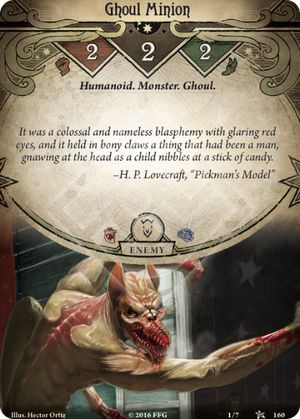

A slightly tougher enemy, the Ghoul Minion has a combat score of two and two hit points. Since their combat scores are equal and each succesful attack only does one point of damage, Wendy might need all turn to defeat the ghoul, and there's a pretty good chance she's take damage doing it. So once again, I start our turn, and Roland charges down the stairs. I use the second action on my Knife, discarding it for +2 combat and one point of additional damage; the combat check is succesful, and the ghoul is discarded from play. This time, I remember to use Roland's special ability, meaning that since I just defeated an enemy, I get to discover one clue at our location. Roland Banks: stabs ghouls, finds clues.

After some succesful investigating with Wendy's flashlight and my Magnifying Glass, and a visit to the Attic, we find ourselves in the Hallway with the required number of clues. First, though, since I have a bad feeling about breaking down magical barriers, I'll play one last asset.


With my .45 Automatic in hand, we bust down the barrier and enter the parlor. Here we have a choice: we can run away through the front door, ending the scenario as unresolved, or fight the Ghoul Priest attacking us.


Misreading the Ghoul Priest's hit points as five rather than five per player, I take the first turn and blast him with my .45 automatic. Two succesful attacks deal four points of damage, and finally, discarding Beat Cop does a fifth point of damage, which we wrongly believed was enough.


To be fair, though, Wendy still had her turn as well, and with some of her card and one of Roland's actions remaining, I'm pretty sure we could've defeated a ten-hitpoint Ghoul Priest as well. It's also a pretty good reminder that when you play one of these games, mistakes are going to happen, even in a scenario as simple as this one. I mean come on, when you actually hold the card in your hand, that investigator symbol next to the hit points is really small...

**

But be that as it may, we won! That takes us to the Campaign Guide, where we find out what happens next. There are four possible outcomes for this scenario. The worst happens if we fail to complete the Act deck, but the bad guys finish the Agenda deck, and it's, well, not good. The campaign goes on, though! If we'd both been defeated, or if we chose to escape out the front door after reaching the parlor, a different set of conditions would ensue. Finally, because we, in fact, won, we have to make an additional choice after the scenario, and what we did is noted down in the campaign log. This is definitely one of my favorite things about Arkham Horror: instead of each scenario being a more or less isolated episode, like the Lord of the Rings quests outside of the saga expansions, they all belong to a campaign where, hopefully, the choices you make will make a difference further on down the road. Also, even in the worst possible case, we'd be able to continue the campaign, only at a disadvantage.

In addition, we gain experience! Each victory point we've earned gets each of us a point of experience, and because we defeated the Ghoul Priest (Victory 2) and cleared the Cellar (1), that's a total of three victory points. The scenario resolution we ended up with grants us a +2 bonus, so we each have five experience points we can use to upgrade our decks before the next scenario. I could upgrade some of my existing cards, but since we've worked out a pretty good division of labor where Roland does most of the fighting, I'm going to pick a new card to help with that: Extra Ammunition. It's a level 1 card, meaning that I need to spend one of my experience points to add it to my deck. Another card I think looks promising is Police Badge: it goes on the accessory slot, which Roland isn't currently using for anything, and in addition to boosting my willpower, I can discard it to give another investigator extra actions. Police Badge is a level 2 card, so it'll cost me two experience points, leaving two which I'll save for later. Because the size of my deck is capped at 30 cards, I'll remove Mind over Matter and Research Librarian to make room for the new cards. Now I'm ready to continue the campaign.

**

So there's gameplay for you. You advance through a series of locations, finding clues and fighting off enemies, trying to outrun the inexolerably advancing Agenda deck. What about building your own starting deck?

Unlike the Lord of the Rings LCG, which was billed as being for 1-2 players but really supported 1-4, this is actually a 1-2 -player game, and in a way that creates some problems. For example, I can tell you right now that my investigator of choice going forward is going to be Agnes Baker, the Waitress.


Now, admittedly, "the Waitress" may not sound like much if you're one of those pompous bastards who don't appreciate the hard work that the men, women and others of our hospitality industry do. The gorgeous Magali Villeneuve art certainly helps, and a willpower of 5 is nothing to sneer at, but what seals the deal is her background story: she's a reincarnated Hyperborean witch. Her card text literally says she is from an age undreamed of. I'm completely sold; she is awesome and I will fight you.


The back of her card tells us that her character class is Mystic, and that she can pick Mystic cards from levels 0-5 and Survivor cards from levels 0-2. The starter deck that we can build for her from our single core set uses all of the 0 level Mystic and Survivor cards, and approximately half of the available neutral cards, so there's not a whole lot of deckbuilding to be done with just one core set. Unfortunately, that also means no-one else can be using those cards at the same time, which means that we're left with the Guardian, Seeker and Rogue classes. The only core set investigators using only those cards are Roland Banks and "Skids" O'Toole, the Ex-con. So if I want to play as Agnes, my partner is forced to choose either the ex-con or the fed, and we don't have enough cards for a third player whatever we pick. I can't help but contrast this with the Lord of the Rings LCG, where we immediately got four fully interoperable decks and could get right into a three- or four-player game, which was crucial in getting us hooked.

Now, admittedly, we've been promised that the very first expansion will feature as many as five new investigators and a pile of new player cards, so hopefully that'll help. But to be honest, it's still a little disappointing. Another thing it does, which I'm not sure the people in charge of these things entirely appreciate, is that it makes it a lot harder to get other people to play the game. With just the Lord of the Rings core set, me and my partner can invite another couple or two friends over and have a game. With Arkham, this is impossible; without multiple core sets, the only way to demonstrate the game is one-on-one. So I really don't think this was a good idea. I'd rather have taken smaller starting decks, for example.

What's more, you'll actually need a second core set just to have reasonable deckbuilding options beyond the starter decks, since there's only a single copy of each player card. And that's just for two people! There are people on the forums talking about buying three or four core sets. Why? Suppose we got a second core, and used the new Guardian, Seeker, Mystic and Survivor card to kit out our investigators properly. What's left for a third player? Our leftovers and a full set of Rogue cards. So actually, if we want two decks with full cardpools and two other starting decks, we'd need three core sets. If the third player wants two copies of each player card, that would require four core sets.

Obviously we'll have to see what the expansions are like; if the Dunwich Legacy really offers us at least one additional fully viable player deck, then this isn't so bad. But I'll be honest, I really don't like that we're pretty much expected to buy two core sets, let alone more. So from a deck-building perspective, this is not good. Coming to this from the Lord of the Rings, I kinda feel like I'm being shaken down for money. If the deluxe expansions only come with one copy of each player card or something like that, meaning that we'd have to buy multiple deluxes, I fucking quit.

**

Deckbuilding dubiosities and our own incompetence aside, we definitely enjoyed our first experience playing Arkham Horror! We're going to at least try to finish the core set campaign, and then get started with our investigators of choice and look out for the first deluxe expansion. Based on the first scenario, the fundamental game mechanics are sound, and I'm looking forward to playing more. Arkham Horror succeeds in blending a little bit of roleplaying feel into the cardgame format, above all by being at a considerably lower level of abstraction than, say, Lord of the Rings. Instead of locations and enemies floating around in a staging area, generating threat against your heroes and army of allies, you're in the cellar, looking for a clue with a flashlight while a ghoul is stalking you. There's definitely some atmosphere here!

The lack of real deck-building options in the core set is a bit of a disappointment, but hopefully that'll start getting corrected soon enough. I'm horribly tempted to buy a second core set, but I resent the fact that even if I did, we'd effectively have to choose between expanding our starting card pools or accomodating more players. So in terms of further purchases, I think we'll wait for the Dunwich Legacy to show up and assess our options.

It's definitely a fun game, though! If the deckbuilding aspect didn't make me feel like I'm being fleeced, and even rudimentary three- or four-player play was possible right out of the box, I'd think this was an awesome game with no ifs or buts attached. As it is, I'd cautiously recommend it if you want an engaging experience for one or two players. We'll wait to see what the expansions are like before going further than that.

Nov 14, 2016

Let's Read Tolkien 26: In the House of Tom Bombadil

The four hobbits stepped over the wide stone threshold, and stood still, blinking.

Last time, the hobbits got lost in a forest and were nearly eaten by a tree, only to be rescued by what appears to be a wandering magical hippie. In case any young people are reading this, I want to make it very clear that the official position of this blog is that if you are in a forest and you meet a strange man singing his own name, do not go with him to his house. Because adventuring hobbits have approximately as little sense as adventuring dwarves, however, Frodo and company do exactly that.

Arriving at Tom's house, the hobbits meet Goldberry, the River-daughter, nowadays Mrs. Bombadil, who inspires Frodo to freestyle about her beauty. The exhausted hobbits get a chance to freshen up before enjoying a vegetarian meal with lots of singing, after which they and Tom retreat to what almost gets called a drawing-room for a little postprandial rest and chat. It's almost cute how Tom initially appears in the story as a bizarre magical hippie, only to lead the protagonists to such a gemütlich reception that it ends in armchairs with little footstools, and slippers. In the Hobbit, the decidedly modern and bourgeois Bilbo Baggins was contrasted to the archaic dwarves with great success, and the same device is used at times elsewhere in the Lord of the Rings, but here it's just odd.

That night, Frodo dreams of a white-haired figure pacing atop a dark tower, while Merry and Pippin have nightmares of their ordeal with Old Man Willow. Only the simple Sam doesn't get a dream, instead sleeping like a content log. In the morning, heavy rainclouds are rolling in, giving the hobbits license to spend the day at Tom's instead of moving on immediately. In a repeat visual from the previous chapter, they again find themselves on a hilltop that appears as an island in a sea of mist, soon to be replaced by a steady rain. If river-crossings represent a sort of symbolic transition for Tolkien, fog also plays a liminal role: the crossing of the Brandywine and the entry into the Old Forest were accomplished in a blanket of fog, and now fog and rain momentarily isolate Frodo and company from the forest around them.

In the strange world of Tom Bombadil, rain means it's Goldberry's washing-day, which in proper patriarchal fashion means that all the men in the house hide away from the work and loaf around telling stories. Tom tells the hobbits all about the Old Forest and its inhabitants. The woods are a remnant of the huge forests that once covered a far larger area, populated by trees that remember when they ruled and resent the two-legged usurpers. Willow-man is apparently their chief, dominating most of the forest. Tom tells the hobbits about the time when men came and built their little kingdoms, which fell into ruin and left only their haunted barrows behind. Having come this close to the present, he then talks about the very beginnings of time on Middle-earth, prompting Frodo to ask him who, exactly, he is. The only answer Tom has to that is his name, but he does venture some biographical information: "Tom was here before the river and the trees; Tom remembers the first raindrop and the first acorn."

After a whole day of story-telling, Goldberry serves supper, and after they've eaten, Goldberry sings for them. Apparently, being the daughter of the river is a pretty shit job. Afterwards, the men retreat for more conversation, this time Tom asking the hobbits all about the Shire and themselves, all of which they gladly tell him about. Tom even goes as far as to ask for the Ring, and Frodo amazes even himself by simply handing it over. Tom clowns around with the Ring for a bit, even putting it on and failing to turn invisible.

Eventually Frodo gets his Ring back, and he decides to test it. While Tom is busy telling a story about badgers, Frodo puts the Ring on and starts to sneak out of the room. Merry is shocked to find he's disappeared, proving that the Ring does still work, but Tom sees him and calls out. Frodo pretends he was just playing a joke, and the conversation next turns to the hobbits' journey. Tom advises them to head north, avoiding the Barrow-downs and the worst of the forest, and teaches them a song to sing so they can call him to their aid if they fuck up. "If", you're thinking. With that, the hobbits are off to bed for their last night in the house of Tom Bombadil.

**

Who is Tom Bombadil? As much as I like Robert Foster's characterization of him as "a Maia gone native", this can't be squared with his own words in this chapter: "He knew the dark under the stars when it was fearless - before the Dark Lord came from Outside." The Dark Lord here is not Sauron but his master of old, Morgoth, and the Valaquenta tells us that "Melkor too was there from the first". If we take Tom at his word, he was on Arda before the Valar ever descended on it. For those of you who like the fan theory that Tom is Eru, i.e. God, not only has Tolkien expressly denied this, but there's also Tom's reply to Frodo:

At last Frodo spoke:
"Did you hear me calling, Master, or was it just chance that brought you at that moment?"
Tom stirred like a man shaken out of a pleasant dream. "Did I hear you calling? Nay, I did not hear: I was busy singing. Just chance brought me there, if chance you call it. It was no plan of mine [...]"

This is Tolkien's theology of luck again; simply put, nothing less than divine providence sent Tom to gather water-lilies just then. Note, however, that divine providence was no plan of Tom's, so Eru Ilúvatar he ain't. Because of the strong influence of Finnish on Tolkien's elvish, by the way, I keep thinking his creator god is female because of that -tar suffix. If only!

There's a good discussion in Shippey's Author of the Century on the idea of Tom Bombadil as a genius loci; in Tolkien's words, "the spirit of the (vanishing) Oxford and Berkshire countryside" (Letters, 19). In other words, Tom is a sort of avatar of the Old Forest, if not of a wider area. Shippey sees Tom's singing as an analogue to the Kalevala. I agree, but given that he's just mentioned the way Tom "catches" Goldberry, I'm surprised he doesn't mention the other striking similarity between Tom and Väinämöinen: their aquatic predation of women. To me, the mention of Tom catching Goldberry in the river immediately brought to mind Akseli Gallen-Kallela's striking triptych Aino (1891).


Väinämöinen is less succesful in his endeavours, as Aino drowns herself rather than be the wife of a dirty old man like him. Like countless other Finnish schoolchildren, I was exposed to the triptych at a tender age in the name of nationalism, and always found the spectacle of a beautiful nude woman escaping a senior citizen in a watercraft both visually compelling and disturbing in its evident lechery. While the otherwise earthy Bombadil doesn't seem to share Väinämöinen's proclivities in this direction, both of them are basically wizards who overcome their enemies with song, and have been around since the world was made.

By contrast, unlike Shippey and others I can't really see many similarities between Väinämöinen and Gandalf. To me, Gandalf has always been a clear Merlin figure, who occasionally takes a hand in the action but is mostly content to point the mythical king in the right direction. The only real connection between them is that both of them take a boat to the land of the dead when no longer needed, sparing Gandalf Merlin's fate (below: Akseli Gallen-Kallela, Väinämöisen lähtö, 1906).


I've never thought of it in those terms before, but Tom Bombadil and Gandalf are basically desexualized versions of Väinämöinen and Merlin respectively. That's Tolkien for you!

**

So in a sense, Bombadil is something like the insufferably rustic mascot of a country fair. But why is Tom Bombadil? What function does he serve in the story? Is the adventure of the Old Forest superfluous to the Lord of the Rings, easily and sensibly omitted in favor of more gripping stuff? Tolkien himself explained Tom in a couple of different ways in his letters, first as an "enigma" (Letters, 144):

And even in a mythical Age there must be some enigmas, as there always are. Tom Bombadil is one (intentionally).

Tolkien repeats his insistence that he doesn't do allegory, but later in the same letter, he takes up the subject of Bombadil again. Noting that "Tom Bombadil is not an important person - to the narrative", Tolkien explains his as a "comment" representing something he feels is "important, though I would not be prepared to analyze the feeling precisely".

I might put it this way. The story is cast in terms of a good side, and a bad side, beauty against ruthless ugliness, tyranny against kingship, moderated freedom with consent against compulsion that has long lost any object save mere power, and so on; but both sides in some degree, conservative or destructive, want a measure of control, but if you have, as it were taken 'a vow of poverty', renounced control, and take your delight in things for themselves without reference to yourself, watching, observing, and to some extent knowing, then the question of the rights and wrongs of power and control might become utterly meaningless to you, and the means of power quite valueless. It is a natural pacifist view, which always arises in the mind when there is a war.

Whew. I will never feel bad about the length of my sentences again. Just typing that out crashed my browser. But if we take this at face value, then the joke I started this post with is spot on: Tom Bombadil is a hippie before hippies. An urhippie! In fact, he seems to be an... allegory.

As many Tolkien fans know, he was very vocal in his opposition if any and all allegorical readings of his works. The best-known example is the angry denounciation of a parallel between the Lord of the Rings and the Second World War in the preface to the second edition. There's also a particularly excellent letter (229) in which Tolkien eviscerates the introduction to the infamous Swedish translation to the Lord of the Rings. The translator, incidentally, went on to claim that the Tolkien fandom is a Nazi occultist sex cabal, so that project seems to have gone well. One of the least silly presumptions quoted by Tolkien is the suggestion that Sauron represents Stalin. Tolkien rejects this, quite reasonably pointing out that "the situation was conceived long before the Russian revolution", which I think is true, and continuing: "Such allegory is entirely foreign to my thought".

Given what he said about Bombadil in 144, though, is it? With reference to Tolkien's views on politics, which I discussed in connection with the first chapter, in letter 154 Tolkien refers to his conception of evil - the Machine - as "Sarumanism". So the ethical dilemma set out above, which is in a sense central to the whole work, could be phrased as Bombadil versus Saruman. Certainly no allegories here! I could quote innumerable examples from Letters, like 190, which escaped me earlier, where Tolkien directly states that the Shire is a parody of rural England. To say nothing of the way in which several aspects of Tolkien's mythos, from Eärendil to such slightly obscure things as the precise dating scheme of the Lord of the Rings, are directly intended to prefigure Christ, in the way Christians have wanted to see him prefigured in the Old Testament, or in the sense that the Tribunal Temple maintained that the so-called "good Daedra" anticipated the Tribunal. Is Tolkien's rejection of allegory inconsistent, then?

In the foreword to the second edition of the Lord of the Rings, Tolkien draws a distinction between allegory and applicability: "the one [applicability] resides in the freedom of the reader, and the other in the purposed domination of the author". Intuitively, this makes sense, but what's the real difference? Tolkien consistently insisted that the Lord of the Rings is a Christian work. Surely this, if anything, is the purposed domination of the author, laying down the terms in which his text must be interpreted. In practice, though, I at least managed to read not only the Lord of the Rings but the rest of Tolkien's legendarium as well, and come away with no notion whatsoever of a sensus spiritualis. Intent is not magic; the plans and purposes of the author aren't recorded into his words. There is only the text and the reader. On its own terms, Tolkien's distinction is false; applied to his work, it's a double standard that lets him both insist that he has no message (e.g. Letters, 208) and that he has a profoundly Catholic message (e.g. 142).

My feeling is that when Tolkien decries allegory, what he means is a kind of reductionism. This is just my hypothesis, but to Tolkien, allegory in the negative seems to be the idea that the allegory is just a simple substitution: Eärendil is Jesus, Tom Bombadil is pacifism, the Ring is nuclear weapons. In a scheme like this, there would be no reason for the Lord of the Rings to exist, since it would just be a retelling of the Second World War, but with orcs instead of Germans. I'm reminded of Neill Blomkamp's Elysium, which fell flat because the story was topical and powerful as an allegory, but made no sense whatsoever on its own terms.

If this is what Tolkien means by allegory in the negative sense, then what he's saying makes sense. The difference between allegory and applicability would be that in allegory, there is one obvious and intended interpretation; to take a completely random and entirely unrelated example, Aslan is Jesus. Applicability, on the other hand, suggests several references instead of trying to dictate a single one. In the Silmarillion, Eärendil in many ways suggests Jesus: he's part human and part divine, he bridges the gulf between time and eternity, and he achieves a reconciliation between the gods and their creations. However, in certain crucial ways, Eärendil is not Jesus. For starters, he's not sent down from heaven but makes his way up from earth, which would be a Gnostic heresy if he was just intended to be a word-substitution for Jesus. But this is the point: he's not. Saying "Eärendil is Jesus" would give someone unacquainted with Tolkien a completely misleading impression of the character. Eärendil is Jesus, but he's also more than that. In general, Tolkien's characters and settings are very rarely direct, reducible analogies. Theologically, Eärendil anticipates Jesus, but is a distinct character; in many ways, he's also St. Brendan the Navigator, and in others, purely a Tolkien creation. In this sense, Tolkien's rejection of allegory isn't necessarily dishonest, just poorly phrased.

**

To return to the chapter at hand, in letter 153, Tolkien presents another allegory for Bombadil: science. "He is then an 'allegory', or an exemplar, a particular embodying of pure (real) natural science: the spirit that desires knowledge of other things, their history and nature, because they are 'other' and wholly independent of the enquiring mind, a spirit coeval with the rational mind, and entirely unconcerned with 'doing' anything with the knowledge: Zoology and Botany not Cattle-breeding or Agriculture."

So here we are, then: according to the author, Tom Bombadil is an embodied spirit of the English countryside, an enigma, an analogy for pacifism, and science. Which is it?

In keeping with my interpretation of Tolkien's attitude to allegory, the answer is all of them, and then some. Like Eärendil, Bombadil is an older creation of Tolkien: "In historical fact I put him in because I had already 'invented' him (he first appeared in the Oxford Magazine), and wanted an 'adventure' along the way" (Letters, 153). The story about badgers is a reference to this previous appearance. So one answer to why Tom Bombadil is in the story is simple: because something had to happen between Buckland and Bree, and Tolkien had a character ready. Anyone who's ever run a role-playing game will recognize this! As for being an analogy of this or that, I think the crucial point here is that Tolkien seems to have attached quite a number of ideas to Bombadil, from Berkshire to science and pacifism. None of them are the one correct answer to the who and why of Tom Bombadil. At the end of the day, I think Tolkien's simplest answer is the best: Tom Bombadil is in the story so that the hobbits can have an adventure on their own before they get fully caught up in the greater drama of the Ring. In that sense, there's no particular reason why the adventure of the Old Forest should include Bombadil at all; it could easily have been something completely different.

Personally, though, I like the Old Forest and old Tom, and I do think they have a part to play in the Lord of the Rings beyond providing the hobbits with an adventure. To quote again from letter 153:

But I kept him in, and as he was, because he represents certain things otherwise left out. [...] Also T.B. exhibits another point in his attitude to the Ring, and its failure to affect him. You must concentrate on some part, probably relatively small, of the World (Universe), whether to tell a tale, however long, or to learn anything however fundamental - and therefore much will from that 'point of view' be left out, distorted on the circumference, or seem a discordant oddity. The power of the Ring over all concerned, even the Wizards or Emissaries, is not a delusion - but it is not the whole picture, even of the state and content of that part of the Universe.

Of all the interpretations Tolkien gives in his letters of Bombadil, this is the only one that resonates with me. It's characters like Tom who are such an integral part of why Tolkien's world-building is so succesful. Bombadil is important precisely because he doesn't, in the brutally mechanistic language of script-writers, "advance the plot". Instead, he builds the world of Middle-earth. Bombadil is a reminder that Sauron and the Ring aren't the only things that matter in Middle-earth. From Bombadil's perspective, even Sauron is an interloper; an ephemeral figure in the long tale of the hills and forests. Bombadil is, in a way, a parallel figure to Beorn in the Hobbit: both are singular, almost atavistic characters living out in the sticks who offer the protagonists a vegetarian meal. Both of them could be said to represent an older world than that of the main story.

This, to me, is the fundamental "message" of the adventure of the Old Forest, and of Bombadil. He gives the story a wider alternative context; he makes the world in which it's set have a life of its own. Willow-man isn't an agent of Sauron put there to capture the Ring, nor is Bombadil a proxy of Gandalf sent to look after them. In a sense, the hobbits have stumbled out of their story into someone else's, and a thing of incalculable importance and deadly peril in theirs is an amusing bauble in the other. So while I completely understand why Tom and the Old Forest may seem pointless and ridiculous to many people, to me, the whole book would be much poorer without them.

**

One final question: what are we to make of the Ring having no effect on Bombadil? First, one misconception has to be dismissed: the Ring is not, strictly speaking, a ring of invisibility. It made the hobbits who wore it invisible, and judging from Gandalf's version of the story in the second chapter, Isildur also. But these ringbearers were all ordinary mortals. Certainly the Ring didn't make Sauron invisible! Nor was invisibility the power that Gandalf feared would corrupt him. The Ring is far more powerful than that. So the simple fact that Bombadil doesn't become invisible might not be significant at all.

It's Tom's attitude to the Ring that makes all the difference. He treats the Ring playfully, as an amusing bauble but nothing more. It seems to have no power over him whatsoever. The various analogies of Bombadil all suggest different reasons for this. If Tom represents pure science, a curiosity in things as themselves, then the Ring is just another object of study. If he represents a pacifism that renounces power, then power holds no temptation for him. However, there's also a theological interpretation. In Tolkien's theology, the Ring is the ultimate Machine, produced by the Fall as an attempt to conquer death. Bearing in mind what Bombadil said about remembering the night when it was fearless, i.e. before Morgoth, should we see Tom as a representative of nature before the Fall? Is he, in fact, unfallen? This would explain why he has no interest in the Ring: it's simply completely foreign to him, an irrelevant artifact of another world. In this case, his benign playfulness and unproblematic relationship with nature would represent nothing less than Paradise. Tom would be a sort of counterpart and antithesis of the Lilith of Jewish folklore. This is downright suspicious if not damn near heretical from a dogmatically Christian standpoint, but applying Tolkien's theological scheme here does suggest it, at least to me.

**

That ended up being a bit longer than I expected! I should say that although a full chapter of a woodland eccentric telling stories doesn't exactly sound gripping, this is a far better chapter than I remembered. Moving on, stop me if you've heard this one before, but next time, the hobbits leave their place of refuge and set off across the Old Forest, only to end up in desperate trouble, crying out for some mysterious inhabitant of the enchanted wood to rescue them.

Oct 24, 2016

CKII: What to buy

To unwind amidst all the PhD stuff and the dystopianly horrible teacher studies, I started playing Crusader Kings II again this fall. I do genuinely consider it to be one of the best video games I've ever played in my life. In the spirit of my previous buying guides, and with the Black Friday Steam sale approaching, here are my thoughts on what expansions to buy if you do get the game.

There are two DLCs that I think are definitely worth buying fairly soon. Sons of Abraham is one of the cheaper expansions, but it provides some really handy mechanics for novice players, especially when playing Christian rulers. You can get rid of annoying courtiers or even unwanted heirs by making them take holy orders: this will disqualify them from succession, and quite often they'll leave to join a militant order like the Templars. Perhaps more importantly for starting players, you also get to borrow money from either Jewish merchants in your realm or a holy order. When you've overreached yourself in a war, your army's been trashed and the enemy is bearing down on your capital, that loan will be the difference between watching yourself lose a siege and hiring a mercenary troop to save your ass. I can personally testify that this will get you out of a number of pickles you'll manage to get yourself into. So I'd definitely buy Sons of Abraham.

Incidentally, Sons of Abraham also allows heresies to supplant their parent religions if they become more widespread. In my previous game, after the Almoravids converted to Catholicism and the Mongols invaded, the two branches of Islam were the Shi'ites and the Yazidis, and Sunni Islam became a heresy!

The other expansion I'd get fairly soon is Way of Life. It lets you pick a focus for your character, like, say, War, Business or even Theology. This replaces the attribute-based ambitions of the base game and lets you react more intelligently to your situation. For example, if you're married but have no heir, the Family and Seduction foci will increase your fertility. The War focus increases your Martial skill and lets you learn leadership traits, the Hunting focus boosts health, and so on. Not only id this strategically useful, but the foci and the event chains that go with them make your characters feel much more fleshed out. As an additional bonus, the Scholarship focus can trigger an event chain that lets you build an observatory and, among other possibilities, get your hands on the Necronomicon and risk going mad... I highly recommend Way of Life, and couldn't imagine going back to playing without it. If you're only going to get one expansion and don't have your heart set on any of the others, I'd make it this one.

**

Three other older expansions add significant features to gameplay across the board. Legacy of Rome adds depth to playing as the Byzantines, and unlocks retinues for all rulers.

The Old Gods slightly changes revolts to make them a bit more dangerous, and introduces adventurers, who may try to raise troops and attack you. This can lead to some interesting developments, since if you defeat and imprison them, the adventurers will at least sometimes actually become your vassals, and if they don't have any dangerous claims, you can employ them. In my last game starting from Dublin, a Norse adventurer attacked me as I was fighting the King of Norway for control of Glamorgan. I defeated them both, but since the Norse fellow had a better martial score than most of my commanders, I gave him a job. After succesfully commanding a flank of my army against the infidel, he became the count of Alcácer do Sal in Irish Portugal.

More significantly, the Old Gods unlocks an earlier start date in 867 AD, and lets you play as a pagan ruler. I'm mildly annoyed that Finnish paganism is called Suomenusko, which is a modern-day pseudo-nationalist neopagan "revival" whose very name would have been completely nonsensical to the vast majority of medieval Finno-Ugric people, but in general, I do very much approve of the new pagan religions. I'm currently playing as the Hämäläinen dynasty from the 867 bookmark, and it's been tremendously good fun.

Charlemagne gives you an even earlier starting date in 769 AD, some more narrative events, especially involving historically important characters, and several new administrative options. Perhaps most notably, you now get to create your own titular kingdoms and even empires! This last bit will come in very handy indeed to larger realms, since emperors can have kings as vassals, drastically cutting down on the number of direct vassals you need to have. Conversely, I think beginning players will do just fine without it.

**

The latest two expansions are also really interesting, but I haven't gotten my hands on them yet. The Reaper's Due only just came out, and I like the idea of advanced disease mechanics! Very medieval. Conclave also looks fun, but I'm waiting for a sale.

In addition to these, there are the expansions that unlock a certain kind of playable character. Sword of Islam lets you play as a Muslim, The Republic allows merchant republics, Rajas of India gives you Buddhist, Hindu and Jain rulers, and Horse Lords unlocks nomads. In addition, Rajas of India gives all characters the ability to convert to their capital province's religion or culture, which can allow some unusual combinations. Horse Lords adds new rules for nomads and the Silk Road, but all of the other major features of these expansions were patched into the base game for free, so the only reason to buy any of these is if you want to play as the kind of ruler they unlock. Of these, I only own Rajas of India, and have yet to try a game in India.

Finally, there are the graphical DLCs, like unit packs, portrait packs and so on. Of these, I haven't really found the unit packs to be worth bothering with, but the portrait packs do make for a more interesting experience since if you play a game through within the same cultural group, I can tell you that you'll get tired of seeing the same faces over and over again! There are also Music DLCs, which I haven't invested in yet, but you can listen to them on Youtube.

**

So, to sum up, if you're just getting started, I think I'd buy Way of Life, and a portrait pack for the culture I intend to play as. If you still feel like spending some money, Sons of Abraham is also a good choice. In my opinion, that's plenty to get started with. Finally, though, I want to reiterate that this is a very dangerous game. If you like it, you may obsess over it. A lot. Over this past fall, the only thing that's occupied my mind as much as my PhD has been House Hämäläinen. So enjoy yourself, but don't say I didn't warn you!

Oct 17, 2016

LotR LCG: Deckbuilding thoughts and probabilities, and the New Amazons

Alone Éowyn stood before the doors of the house at the stair's head; the sword was set upright before her, and her hands were laid upon the hilt. She was clad now in mail and shone like silver in the sun.
- The Lord of the Rings, book III, chapter VI


John Howe: Eowyn, no date given

**

I want to make a new deck. How many cards should it have in it?

First, the most basic probability: the odds of drawing a single card from a deck of 50 are 1/50: 2%. The bigger the deck, the lower the probability of any single card showing up. In a 51-card deck, the odds of drawing a single card are 1.96%; 52 cards, 1.92%, and so on. Here's a graph (click to zoom):


By the time the deck reaches 67 cards, the probability of drawing any single card has dropped from 2% to below 1.5%. Most Lord of the Rings decks will tend to have very few singletons, though; two or three copies of a card are more usual. Here are the probabilities for drawing a single card, one of two copies or one of three copies:


These sharply declining curves are why most people, myself included, have tended to prefer decks as close to 50 cards in size as possible. However, the optics are a little bit misleading here. At 50 cards, the probability of drawing a singleton is 2%, one of two copies 4%, and one of three 6%. At 60 cards, those probabilities have dropped to 1.67%, 3.33% and 5% respectively. That's actually not a very large difference in absolute terms!

Another set of probabilities to look at is the opening hand. At the start of the game, we draw six cards, and have the option of a mulligan, where the cards we drew are reshuffled into the deck, and a new hand is drawn. If you have three copies of a card in a deck of 50, and are willing to mulligan your hand if you don't get at least one on the first go, the odds of finding that card are actually pretty good: 54.34%, to be exact. For example, with my Silvan deck, I liked seeing a copy of None Return in my opening hand to get Rossiel her defense bonus. If I was willing to mulligan if I didn't see one, I'd end up with at least one None Return in my opening hand more than every second game. Here's how those odds decline as the deck gets bigger:


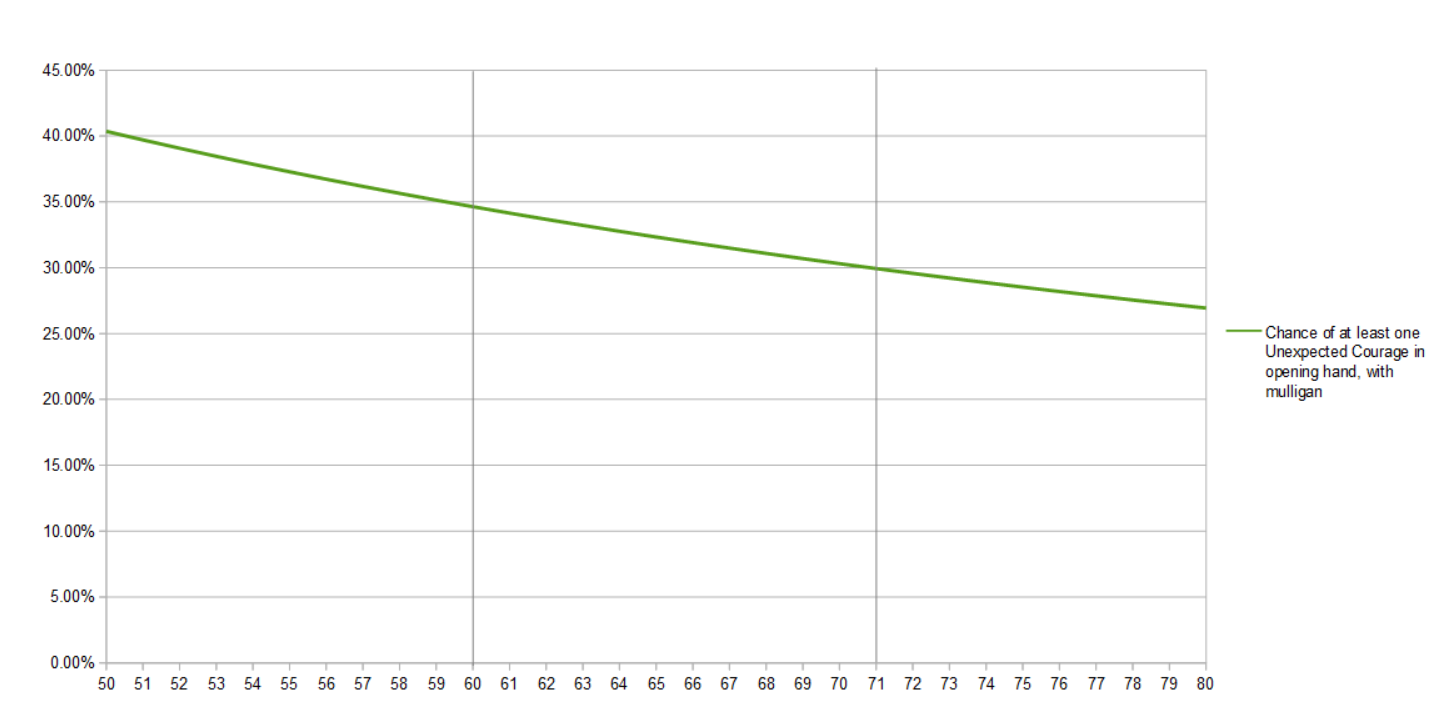
The probability only drops below 50% when the deck exceeds 56 cards; in that exact case, the probability of starting with at least one None Return is 50.01%. What about cards that you only have two copies of? We own two core sets, meaning we've got exactly two copies of Unexpected Courage. Here are the odds of getting Unexpected Courage in your starting hand, mulligan included:


In a 50-card deck, you have a 40.36% chance of getting at least one Unexpected Courage in your hand, provided you're willing to mulligan for it; if not, it's a 22% shot. At 60 cards, these percentages are 34.64% and 19.15% respectively. Again, not a massive difference in absolute terms.

To sum up, here's some key statistics for a 50-card and a 56-card deck.

Deck size:50 cards56 cards
Single card probability2%1.79%
At least one of three copies, opening hand32.43%29.29%
At least one of three copies, mulligan inc.54.34%50.01%
At least one of two copies, opening hand22.78%20.45%
At least one of two copies, mulligan inc.40.36%34.64%

To some extent, this is a prize example of creeping normalcy: 51 cards isn't that different from 50 cards, 52 isn't that different from 51, and so on until 56, 66 or 666. But my point is that in terms of actual numbers, whether your deck has 50 or 56 cards in it doesn't actually make that much of a difference: certainly not enough that decks dogmatically must be 50 or maybe at most 52 cards. Instead, I'd suggest there are two main determinants for how large a deck should be. First, are there specific cards that are absolutely necessary for the deck to function? If so, the deck needs to be leaner to make sure you can find those crucial cards. Second, how much card draw is there? If you can confidently draw through most of your deck during an average game, finding specific cards is a whole lot easier. I'd venture to suggest that these two should combine to form some kind of "deck index" that tells you whether the deck should be on the large or small side. For decks with average or less card draw that don't depend on some particular card or combination of cards to work, I'm inclined to say that the "tournament minimum" of 50 can safely be exceeded.

**

Now to get to building my actual deck. Back when I put together my very first deck, the theme I chose was Amazons: I used all three female heroes from the core set to create a questing-focused Spirit/Lore deck. Even though I designed the deck to work together with my partner's Tactics deck,I did also manage some solo success, perhaps in my mind most memorably against some trolls.


When I wanted to try something different, I built my Lore Silvan deck with Haldir, Mirlonde and Rossiel. I never really played this solo, but together with Team Boromir and my hobbit deck, we were pretty succesful, and Rossiel won a place in my heart as one of my favorite heroes.


Now it's time to move on again. Our experiences with the Ring-maker cycle highlighted the one major drawback of our Silvans-Boromir combo: early questing. As much as I'd enjoyed my Silvan deck, this and the then-upcoming Dream-chaser adventure packs encouraged me to return to a Spirit-Lore setup and focus on questing. In terms of deck abilities, what we need is questing and location control, with a side of healing and treachery cancellation. Luckily, there was one hero who was perfect for providing early questing power and returning me to my Amazon theme: Éowyn. With her long-awaited Tactics incarnation on the horizon, if I wanted to try her in a Spirit questing deck, the time was now.


Like I said, I love Rossiel, and the added value her victory display shenanigans provide to Keen as Lances, especially with several players using it, is huge. She fits perfectly into a Spirit deck as she can make up for Spirit's weakness on defence, and since none of us are crass enough to use Snorefindel, she's a perfect target for Light of Valinor to get the most out of her ability.


The choice of a third hero was a little bit more complicated. I considered Arwen, but with Spirit's weak defense, I tend to prefer her ally version. I'm a big fan of Eleanor, but she can't help us with questing. We could also do with some attack strength, which leads my thoughts to Idraen. I tried Idraen out in a Spirit deck I built, but still haven't been able to make my mind up about her: she has great stats and a potentially useful readying ability, but that comes with a very high starting threat. I suppose now would be a good time to find out if it's worth it.


**

For the deck proper, I was looking for something of a halfway house between my original Amazon deck and my Silvans: knowing that I'd mostly be playing with my partner's Tactics deck, I could pretty much leave combat to them and focus on questing. With the cardpool as large as it is these days, even with such a narrowly defined specialization, picking a deck isn't all that easy. To take an example: Rossiel is a very handy defender, especially with A Burning Brand attached, but with only three hit points, she's a bit fragile. During our Silvan-Boromir co-op days, it was expedient to play Elf-friend on Boromir so my Silvan Trackers could heal him. Because sentinel was also wonderfully handy on him, my partner would include Elven Mail for him as well. If a second copy showed up, or Elf-friend had failed to make an appearance, Rossiel really benefited from the +2 hit points, and being able to provide a risk-free defense is nothing to sneer at.

If I can confidently expect that my partner will be playing an attachment on one of my heroes and I'm playing Spirit, surely this is a perfect opportunity for Renewed Friendship? A zero-cost card, after all!


In a situation like this, Renewed Friendship looks great: any Tactics deck can use card draw and threat reduction. The problem isn't that it's a bad card; the problem is that I can easily name ten or more events that are more useful. Renewed Friendship may not cost any resources, but it takes up space in my deck, making it that much less likely that I'll see those more useful cards when I need them. Unfortunately, the card pool is already big enough that this is getting to be the paramount consideration. It's also why I still haven't been able to work out if including Curious Brandybuck in a deck is worth it!

**

In this case, the events chose themselves: Rossiel's victory display cards and Keen as Lances, and A Test of Will for treachery cancellation. The Lore attachments are also basically carried over from my Silvan deck, and Snowmane and Herugrim seem positively necessary in a deck that otherwise has no attacking power whatsoever, and hell, I wanna try them. For a little more card draw, I stole the Ancient Mathoms from the Rohan deck.

The allies are where the location control comes in, because no way am I not including the ayatollah of location controllah and Greyflood Wanderer. The Warden of Healing is still the best at what he does, to the extent that I might have to consider another copy of The Long Dark so my Amazons can work together with the hobbit deck. Finally, Galadriel's Handmaidens and West Road Travellers provide questing, and some Wandering Ents round out the deck.

Do I want to include Gandalf? For my Silvan deck, I dropped the seemingly mandatory core Gandalfs, because I never had enough resources to get him in play. This deck also has no resource acceleration at all, so I'll be looking at the same problem. With Rossiel around, Keen as Lances pretty much becomes a lower-cost Gandalf substitute. For now, I think I'll do without.

53 cards; 28 Spirit, 22 Lore, 3 neutral; 19 allies, 17 attachments, 15 events, 2 side quests. Starting threat 28.

Éowyn (Core)
Idraen (TTT)
Rossiel (EfMG)

Allies: 19 (13/6)
Northern Tracker x2
Greyflood Wanderer (TTT) x3
Arwen Undómiel (TWitW) x2
Galadriel's Handmaiden (CS) x3
West Road Traveler (RtM) x3
Warden of Healing (TLD) x3
Wandering Ent (CS) x3

Attachments: 17 (11/6)
Herugrim (TToS) x2
Unexpected Courage x2
Ancient Mathom (AJtR) x3
Light of Valinor (FoS) x2
Snowmane (TLoS) x2
A Burning Brand (CatC) x2
Asfaloth (FoS) x2
Cloak of Lórien (CS) x2

Events: 15 (3/9/3)
A Test of Will x3
Leave No Trace (EfMG) x3
None Return (AtE) x3
Daeron's Runes (FoS) x3
Keen as Lances (EfMG) x3

Side quests:
Double Back (EfMG)
Scout Ahead (TWoE)

**

Like I said, this deck has no attacking power whatsoever, so I'm not really expecting it to be able to handle itself solo. This was confirmed by an attempt at Passage through Mirkwood, where we just couldn't for the life of us destroy Ungoliant's Spawn. The proper use of this deck is in co-operation with my partner's Team Boromir: they fight, I quest. Together, we breezed through Passage, and then tackled the high seas. In Voyage Across Belegaer, we did pretty well until we strayed off course and were wrecked, but when we took on the then-brand-new Flight of the Stormcaller, we beat it on our first try! The Tactics deck routed the corsair boarders and sank their ships, while my Amazons sailed and quested. Despite losing several allies to Man Overboard!, we were finally able to catch the Stormcaller on the very last quest stage.

To demonstrate that my focus on questing was succesful, a three-handed run at Trouble in Tharbad with the Leadership/Lore deck was a breeze, Faramir boosting my willpower to unreasonable levels. Especially three-handed, when the encounter deck isn't overflowing with enemies, I've been able to focus on questing; when there have been more enemies, Idraen's action advantage has been useful. Éowyn and her willpower-boosting ability is a gift, and outfitting Rossiel with a Cloak of Lórien, Burning Brand and Arwen's bonus makes for a tremendous defender, and I've often ended up playing Unexpected Courage on her to defend multiple enemies. In Temple of the Deceived, with a little help from Arwen and my partner's Honour Guard, she defended both an Island Watcher and its pile of shadow cards as well as the Temple Guardian without so much as a scratch.

In general, the division of labor between our decks has worked excellently, and for whatever reason I really like a questing-oriented deck. Card draw is still a bit of an issue, and I've very rarely managed to get both Snowmane and Herugrim on Éowyn. There also aren't anything like as many resources to go around as I'd like, but I'm not playing Leadership so I guess I just have to live with it.

**

So far, then, I think my return to Spirit and a focus on questing has been succesful. Later, we're hoping we get to pay a visit to the desert...

Oct 10, 2016

Let's Read Tolkien 25: The Old Forest

Frodo woke suddenly.

At dawn, the hobbits leave Frodo's house in Crickhollow, saddle up their ponies and head for the Old Forest. Fredegar "Fatty" Bolger accompanies them as far as the Hedge dividing Buckland from the Forest, simultaneously reprising two roles from the Hobbit: Bombur's walking fat joke schtick and Bilbo's anguished hand-wringing. I can't remember if there are fat jokes in the Silmarillion, but the evidence so far suggests there must be. Fredegar is left behind as Frodo and company pass through a cutting and gate under the hedge, and enter the Old Forest. The closing of the gate behind them marks Frodo's and the story's final transition out of the Shire.

"There!" said Merry. "You have left the Shire, and are now outside, and on the edge of the Old Forest."

We're then given a little bit of background by Merry, who dismisses "the old bogey-stories Fatty's nurses used to tell him", but does have some spooky forest experiences of his own to share. Someone, he points out, makes paths through the woods. He even tells the story of how the trees attacked the Hedge. "They came and planted themselves right by it"; the first shade of Macbeth's Great Birnam Wood on the march. The present-day reader is entertained by Merry's repeated insistence that the forest is queer, to the extent that I wonder what a certain Hugo nominee would make of this. However, the point is made: this is a forest unlike any the other hobbits have been in previously.

As Frodo and company enter the woods proper, the ground gradually rises and the forest thickens. There's no sound or movement, and the oppressive presence of the trees becomes stronger and stronger until Pippin actually cries out to the forest to let them pass. Instead, the menace only intensifies until Merry succeeds in finding their way to the Bonfire Glade, where the trees that attacked the hedge were burned. It's a gloomy, deserted place, but it makes a gap in the canopy where the hobbits can see the sky, and it cheers them up. What's more, a clear path leads on from the glade, and heartened, Frodo and company follow it. Soon, though, the oppressive gloom of the forest begins to press down on them again, to the extent that Frodo is considering turning back.

Eventually, though, the path takes them to a hilltop above the trees, where the hobbits pause for a midday meal and to get their bearings. Below them, the forest stretches out in all directions. To the north, where they're hoping to go in order to strike the East Road out of the Shire, they see nothing but haze. Far to the east, the haunted Barrow-downs loom on the horizon. Looking back west, the hedge is already lost somewhere in the haze, and to the south, fog still rises from the valley of the Withywindle. That, according to Merry, is the last place they want to go; "the queerest part of the whole wood - the centre from which all the queerness comes, as it were".

Hoping to avoid the queerness, the hobbits find a path heading north. This seemingly straight road disappoints them, though, veering off to the right and heading straight for the Withywindle. They leave the path and try to make their way north, but their way is blocked by what's described as "deep folds in the ground", "like the ruts of great giant-wheels or wide moats and sunken roads long disused and choked with brambles". I'm a little disappointed that Karen Wynn Fonstad didn't discuss these in her excellent Atlas of Middle-earth, leaving me unsure if they're natural features or completely overgrown ruins of the kingdom of Cardolan. Whatever they are, though, they do stop the hobbits from heading north. As the afternoon passes, Frodo and company do their best to make progress, but the forest inexorably drives them to the southeast.

Eventually the hobbits and their ponies end up in a rut they can't climb out of, and are forced to follow it down - straight into the valley of the Withywindle. The horror of queerness takes the form of a slowly flowing river overhung with willows. It's a drowsy, warm afternoon, with the sun shining down, and a gentle breeze rustles the reeds. What's more, Merry finds a footpath on their side of the river leading east, which he hopes will take them out of the forest. Pippin is more dubious, finding the path very suspicious, but he has no better ideas to offer, and Frodo and company set off down the path.

As they make their way along the path, the hobbits start becoming terribly sleepy. They stagger on for a while, until they reach a massive old willow-tree, where the sleepiness becomes irresistible. Merry and Pippin nod off, leaning on the tree, while Frodo wanders to the riverbank to bathe his feet. The ever-sensible Sam sits down to get his bearings, finding the tree and the sudden sleepiness highly suspicious. He thinks to look after the ponies, and just as he's leading them back to where he left the others, he hears Frodo fall in the river. Sam drags Frodo out from under a root hanging over the river, looking for all the world like it was trying to drown him. Merry and Pippin are trapped inside the tree; Frodo and Sam try starting a fire to threaten the tree, but Merry shouts that the willow-tree will kill them if they try to burn it. In the spirit of his illustrious adventuring cousin Bilbo, Frodo panics and takes off running along the path, screaming for help.

This doesn't seem like it would be the most productive thing to do, but on the path, Frodo soon encounters a strange man in a blue coat and yellow boots, singing rhyming nonsense about himself and carrying some water-lilies. On seeing Frodo and Sam, he introduces himself as Tom Bombadil. As the hobbits babble at him about their predicament, Bombadil immediately realizes that Old Man Willow is the culprit, and hurries along to the tree. Tom sings to the willow-tree and commands it to release the hobbits, which it does. Old Man Willow subdued, Tom reasonably decides that the hobbits can't be left to their own devices, and invites them to follow him to his house. Tom hurries ahead and the hobbits follow the path, out of the valley and up to Tom's house on a hillside.

**

The Old Forest is the first capital-f Forest in the Lord of the Rings. As it happens, I have something of a professional interest in forests, so this is going to be something I'll be looking at throughout this series of blog posts. Back in the Hobbit, Mirkwood was an awful, gloomy, miserable and deadly place, nothing like the woods Bilbo and the dwarves had passed through earlier. Similarly, Frodo and company already spent quite a while trekking through Woody End, but that forest, too, was described and traversed quite matter-of-factly.

While a lowercase-f forest is a scenic backdrop for the story, the Old Forest is almost a character in its own right, and dominates its chapter. At first, the forest threatens and resists the hobbits; once they venture too deep, it takes on an active role, directing them away from their path, and finally, in the person of Old Man Willow, trying to end Frodo's journey right on his own doorstep. If, previously, Tolkien has taken care to describe the landscape intimately, he now elevates it to an actor in its own right. In one of his letters (to the Daily Telegraph!), Tolkien says: "The Old Forest was hostile to two[-]legged creatures because of the memory of many injuries" (Letters, 339). What these injuries might have been, we don't know; maybe the hobbit-story Merry tells of the forest's attack isn't quite true, or the trees harbor older resentments, of the clearance of Buckland or even further back. This is a very effective, atmospheric chapter; the cutesy hobbit-ways of the Shire are behind us, and Frodo and company are making their way through a hostile, dangerous landscape.

It's interesting to think what might have happened if the hobbits' journey had ended on the banks of the Withywindle. What would Old Man Willow have made of the One Ring? Would a dark Huorn-forest have sprung up beside Buckland, or would the Ring have been discarded as a bauble, maybe ending up in some magpie's nest? Who would ever come across it in the Old Forest, or fish it out of the stream? Or could the Ring somehow roll down the river into the Brandywine, as Saruman claimed it had made its way down the Anduin and into the sea? Some traveler might spot it glinting in the waters of Sarn Ford, or maybe it would end up in the hand of a woodman of Eryn Vorn. There's a whole world of fan fiction in this!

We never get to find out, because just as Merry and Pippin are about to be devoured by Old Man Willow, someone happens to be heading down the path toward them. In the fabled words of the unknown author of My Immortal: it was Tom Bombadil. After he rescues the hapless hobbits from the willow-tree, Frodo and company spend all of the next chapter hanging out at his digs, so I'll save my comments on him for the next post. For now, all we need to know is that the hobbits have been saved by a singing hippie wizard, and next time, he tells them stories about badgers.