Nov 2, 2020

Let's Read Tolkien 74: The Land of Shadow

Sam had just wits enough left to thrust the phial back into his breast.

Frodo and Sam flee down the road to Mordor, but orcs are approaching from all directions. In desperation, they drop off a bridge to avoid being caught, and end up in a thicket of thorny bushes. They're in a sort of gully running north along the mountains, and begin making their way along it. They have only very little water and some lembas left, and no idea where to find more. As they trudge northward, they are surprised to see daylight: it's the day of the Battle of Pelennor, and the clouds of Mordor have been driven back. They encounter an orc-patrol, a tracker and a soldier, but the orcs quarrel: the tracker shoots the soldier and escapes. Sam deduces from their talk that Gollum is still around.

Eventually the hobbits find a way east, onto the plains of Mordor. The land between them and Mount Doom is an ashen desert, but one that's crowded with armies of orcs and men. As they try to cross it, the hobbits are met by an orc-column, but because they're wearing orcish clothes, and apparently there's wide variety in orcish physiognomy, they're mistaken for orcs and whipped along with the column. The forced march takes them toward Mount Doom, and when the orcs stop and get into a fight with another unit, the hobbits escape.

**

I sincerely hope that anyone reading this can take a moment to appreciate the best thing to come out of all of the various Lord of the Rings film adaptations: the song the marching orcs sing in the Rankin-Bass animation. I think this has to be regarded as the first-ever recorded orcish spiritual.


This chapter is also where we get one of our very few glimpses into the broader realm of Mordor, including Lake Núrnen, which was beautifully realised in Middle-earth: Shadow of Mordor. There's a lot we never got to find out about Mordor and Sauron, presumably because they were only really necessary to the story, rather than part of Tolkien's main creative ambitions.

I wondered earlier about the possible theological symbolisms of Frodo and Sam's journey, but here I think they become fairly obvious. I mean there's constant physical hardship, the shedding of physical burdens and wargear, and literal thorns. Frodo and Sam's journey through Mordor is an ascesis: a mortification of the flesh. The trip is tough on Sam, but much tougher on Frodo, because he is literally bearing Tolkien-capitalized Sin on his neck. This is Frodo at his most Christ-like, crawling to Golgotha to the mockery of orcs.

I quoted Tolkien earlier on the symbolism of lembas as the communion wafer, i.e. faith, and it becomes quite explicit here: after the provisions given by Faramir run out, the hobbits subsist on water they find in the wasteland, and faith. When they're caught by the orc-column, Frodo says they "trusted to luck, and it has failed us"; but he's wrong, because the forced march that culminates in a chaotic brawl actually gets them where they were going but couldn't find a way to. Like the quarreling orc-trackers, this is a case of evil fucking things up for evil, but it's hard to resist the interpretation that the hobbits "earn" this piece of luck (i.e. divine intervention) with their ascesis.

If you want to get all Kierkegaard on this, the hobbits dropping off the bridge at the beginning of the chapter is a leap of faith.

Taken together with the last chapters of Book Five, the theological message Tolkien wants to convey to us here is that he's given you a well-executed, exciting story of war, valor and sacrifice, and none of it really matters, because everything depends on a young gentlehobbit's spiritual via dolorosa through the desert of Mordor.

**

Next time: more theology, more leaps.

Oct 19, 2020

Here I Stand: Army boxes

 Believe it or not, our game of Here I Stand by email is still going on! As I write this, we're in the second round of impulses in Turn 3's action phase. We're really enjoying the game, but one of the problems I mentioned in my introductory post has come up again: the board is starting to get very cluttered in places.

Here, for example, is Calais: we need to fit an English square control marker, fleet and three army tokens onto that space on the map, and it's a little bit challenging. 


I mean yes, we can stack all three armies on top of each other, at which point no-one can see what's in the stack. This is highly inconvenient when playing by email, where everyone except the Sublime Porte is relying on pictures of the board. Even stacks become a challenge when, for instance, an army made up of regulars and mercenaries is besieging a key.

We've decided to implement a solution. Now, the Here I Stand board already has these nifty holding boxes for many of the capital cities on the board, as shown below.


War of the Ring did something similar: it basically had a box like this for every stronghold on the map, but also something ingenious: army boxes.


The square boxes are for strongholds: when one is placed under siege, very much like a key or fortress in Here I Stand, you put the garrison models in the stronghold box. The rectangular white boxes are army boxes. If it becomes difficult to fit all the models in an army on the board, you put them in an army box instead, and use the associated counter. You can see a Free Peoples army counter next to the number 1 box, and a Shadow army counter by the number 3 box. It's a really good system, and we're replicating it for Here I Stand.

**

Here's the army boxes and counters my partner made:


Here are the counters on the board:


And here's the corresponding units in their boxes.


We'll see how this works, but I'm very optimistic it'll make the game board much easier to decipher.

Oct 12, 2020

Blood Bowl: Bleachers 2: The Bleachening

Earlier, I built some Blood Bowl bleachers, which I've been populating with various miniatures since. Now it's time to take the next step and mount them on a plywood base, and add even more spectators.

**

Back when we played a lot of Necromunda around the turn of the millenium, I built a 4' × 4' game board and with some help from my friends, a set of 1' × 1' modular terrain boards for it; you can see them on my Instagram. We're currently using it to play Warhammer 40,000, and since the board itself is fairly solid, I'm going to build my Blood Bowl stadium on it. I even have some of the 1' × 1' plywood boards left, so I'm going to mount my bleachers on one of them.

The way I made the original terrain pieces was with two sheets of 4mm plywood: one 300×300mm and a 280×280mm sheet glued to its underside. The original idea was to have the pieces lock into position on the board, but that turned out to be way too fiddly. It turns out there are several advantages to doing it this way, though: the 4mm gap at the edges of the boards makes it easier to mount hinges on the baseboard, and since 4mm plywood can bend quite a bit, gluing two pieces together helps the whole thing stay level. So I've started by creating a plywood board like the previous ones:


The top side is then spraypainted white:


And then we stick on the stands!


They're a bit wonky, but then again my fluff reasoning is that all this has been built by the lowest-bidding goblin contractor!

**

While all this is going on, I've also got some new miniatures to add to my spectators. First up, from Perry Miniatures, their excellent Female and young rioters.


They'll be joined by three of Perry Miniatures' Female civilians. I've painted so many grimdark 40k miniatures and drab military vehicles that I wanted to do something totally different with my spectators, so it's bright primary colors all the way.


I also painted up some Muslim and Ottoman civilians, plus a leftover crewman from a Gatling gun. Here I felt like the models called for some more earthy tones.


And here's HP Lovecraft from Impact Miniatures.


Can you imagine how much Lovecraft would have hated a football game? I take an inordinate delight in placing an effigy of him in such multicultural surroundings.

**

Earlier this fall, I signed up to be harassed by a bird, so as to learn some rudiments of a new language. Soon enough, I went looking for an appropriate 28mm miniature to paint up as the Duolingo owl, and found it in Dark Sword Miniatures' Owl Mage.


I'd previously noted that Dark Sword's King Robert Baratheon looks remarkably like he's watching a football game, and I've been thinking about building a royal box for my stadium since. However, what I only noticed this time around was that so does Viserys. The Beggar King is obviously going to be slumming it in the stands, and he looks so much like he's losing a sizable bet placed on the game that I got Illyrio Mopatis to be there as the guy he's losing to.


Finally, I got Aeron Damphair, who I think also looks dissatisfied with the score, or maybe the refereeing. With the assistance of one of the casualty figures from Perry Miniatures' superb Zulu Wars infantry box, he is re-enacting a scene from my theology studies, of which the less said, the better.


**

I rather liked this idea of theological characters in my stands, so the natural thing to do was visit the Foundry Miniatures website for some Jolly Monks, Medieval Characters and Anarchists. These are also superb models! I'm delighted with them. Some of them joined Aeron at the back, along with one more Perry Muslim Civilian:


The rest of the monks and some of the anarchists got better spots up front.


Here are two vehicle passengers I got from the Bad Squiddo kickstarter:


Finally, the stands are now getting crowded enough that I think it's time to deploy The Crowd from Sally 4th. There's not that many seated 28mm miniatures about, and even fewer that are perfect for Blood Bowl, so I'd been saving these folks until I had a better idea of what these stands were going to start looking like.


The fellow in grey below has a long hair head from Anvil.


**

So here the stands are in their current glory!


I have to say that this is by miles the best modeling project I've ever done. I'm really happy with it, and very much looking forward to my stands finally making their Blood Bowl debut; hopefully later this year.

Oct 5, 2020

Let's Read Tolkien 73: The Tower of Cirith Ungol

Sam roused himself painfully from the ground.

Frodo's loyal batman finds himself outside the tower in the title, with his master inside. He sets off to rescue Frodo, helped by the fact that, as foreshadowed last time, the orc-garrison has started fighting among themselves over the loot.

On the way, we get our first proper look into Mordor: jagged mountains, an ashen wasteland and the volcano, Mount Doom. To get to the tower, Sam has to make his way past two Watchers: statues that project some kind of force field that blocks the road. He does this by using the Phial of Galadriel.

At the tower, literally all of the orcs are dead, except for a small one called Snaga and Shagrat. The wounded Shagrat encounters Sam, but makes his getaway, bearing the items taken off Frodo which would later (but earlier to us) be shown to Aragorn and the others at the Morannon. Sam then finds Frodo, returns the Ring to him after Frodo flips out about it, and they disguise themselves in orc-clothes and leave.

**

So, after a surprisingly long chapter, Frodo and Sam have escaped from the tower. I guess there's a bit of a disconnect going from the very epic scope of King Elessar and his army to Sam finding orc-pants for Frodo, and it took me a moment to adjust. Of course, the main theme of this chapter is Tolkien's notion that evil ultimately defeats itself, but if I'm honest, the notion of the entire garrison of an at least mildly strategically placed fortress conveniently massacring each other to the point where there's just two of them left stretches credibility. It also feels like the chapter just goes on for a really long time, and I'm not really sure what purpose a lot of it serves. Maybe I'm just being too negative.

It's easy to gloss over Sam's temptation by the Ring as a little bit silly and paternalistic "aw shucks" moment, which is basically what it is; it's the closest the Lord of the Rings ever comes to what Moorcock et al. claim is its dominant theme of "do what you're told and stay in your place". Of course the loyal subaltern has no dreams above his station! The ease with which he hands over the Ring also seems a bit exaggerated. But I was struck by Sam's ambition being defined as a garden of his own. I've talked about Tolkien's use of physical geography, and lately his corresponding lack of interest in human geography. Another juxtaposition is wholesome nature versus artificial evil, which is, of course, strongly present in this chapter, where Sauron's realm is depicted as an ashen wasteland.

But how does Tolkien actually conceive of nature? Good nature, to Tolkien, is basically a well-tended garden. Places like the Shire, Rivendell or Lórien, even Ithilien, are actually fairly bourgeois gardens. How often does anyone even encounter any wildlife anywhere? Even Beorn's animal friends behaved like well-trained servants or drilled soldiers. Outside of the various gardens and lawns, there's the desolate wilderness and scary, almost evil forests. Even when they're not actively hostile, they're very alien. Nature is only really idyllic and good when someone has mowed the lawn and clipped the hedges. Solidly, impeccably middle class!

**

Next time: more singing.

Sep 21, 2020

Blood Bowl: The Orcland Wanderers

Once upon a time, an entirely unremarkable Orc team was making a decent living on the tournament circuit in the Dark Lands. Then one day, they chanced upon an orc who claimed to be a prophet of Nuffle himself. Nuffle had given him a vision: he would lead the team out into the Blasted Wastes, where they would find a golden city, rich beyond their wildest dreams but lacking a Blood Bowl team. The team, almost certainly very drunk, was gripped by the prophet's vision, and they cheerfully set out into the desert, singing songs about the promised land that awaited them.

Eventually, of course, the enthusiasm (not to mention the fungus beer) wore off, and the team realized that there was no golden city. Once they'd eaten the supposed prophet of Nuffle, they were so far into the wastelands that there was nothing to do but keep going. After a succesful tour of the Chaos Dwarf circuit, the greenskins took to their new way of life and started travelling all over the Old World to play. With no home stadium, they took to calling themselves the Orcland Wanderers.

**

In other words, I was going through my old Warhammer stuff and found my old 3rd edition Blood Bowl plastics. This is the team:

6 linemen (300,000)
2 blitzers (160,000)
2 black orc blockers (160,000)
2 throwers (140,000)
4 re-rolls (240,000)

And here's the roster:

#4 Drek Garr, thrower
#8 Mark-um Maaarrgghh, thrower
#15 Nelson Agharghaaarrgh, blitzer
#28 Ork Truk, lineman
#29 Lawaaagh-Joiner, lineman
#52 Waaagh Mack, black orc blocker
#55 Von-Tar Perfect, lineman
#75 Orcius Latham, lineman
#87 Jaaarrghh Cook, lineman
#89 Aaargh Cooper, blitzer
#95 Jihad Waaargh, lineman
#98 Maxx Gross, black orc blocker

**

I started with the linemen. They were primed with Army Painter's Greenskin Primer, and they're wearing Medium Sea Grey loincloths, Ivory socks, Off-White shirts and Gunmetal Grey helmets, for what I think is a quite decent Orcland look! I drybrushed a little Deep Green over the Greenskin Primer.


And here are the positional players, as well as a goblin. I apologize for that, I don't know how he got in there.


I also apologize for the picture quality: my old phone stopped working, and the camera on the new one is rubbish. Anyway here's the team:


**

Painting these guys was a fun little project! I'll see if I can find my humans next.

Sep 14, 2020

Let's Paint Star Wars: Armada

On the sixth week of summer the Norwegian fleet neared Whalsay.
- Tattúínárdǿla saga, Chapter 36: Concerning the Norwegian Fleet


I made my first ever Star Wars: Armada purchase in 2018, when we first played Star Wars: Rebellion. That game ended memorably when the Emperor himself led a single assault carrier to the just-relocated rebel base. In honor of the Imperial victory, I bought an assault carrier pack for Armada, which served as a TV table ornament. Because my co-commander is a big TIE Fighter player from back in the day, I also bought the Imperial Fighter Squadron II expansion on a whim, as it includes Maarek Stele.


**

Eventually, the pressure to buy the actual game became overwhelming - especially as it was dramatically cheaper at our friendly overseas gaming store, and I finished painting Star Wars: Rebellion. However, the lockdown scrapped our gaming plans - especially when our table was taken over by the Reformation. But I found painting the little starfighters surprisingly good fun, so for the moment, I guess I'm mostly just collecting the models.

I don't know why I got such a strong sense of deja vu spraypainting them, though!


I finished the X-wings first. It's very satisfying how much better they look with just a simple paint job compared to the unpainted models. I did the same here as I did with the Rebellion ones: Black details, Gunmetal Grey guns, Ivory hull, the squadron stripes and a Smoke wash over everything.


**

On the Imperial side, I started with the VT-49 Decimators and Lambda-class shuttles. I tried to keep things simple, so I started by painting the windows and whatnots black, and then giving them a base coat of Dark Seagreen and a Light Grey drybrush.


Again, very simple and very effective. The Rogues and Villains pack was somewhat more interesting because of the variety of the models, but I'm quite happy with how I did.


The Falcon, for instance, is just Ivory with black details and a Smoke wash, but I think it works excellently. I never really had any particular feelings about any of the rebel hardware from the movies - I still don't - but painting the Rebellion miniatures made me appreciate how important the worn and scuffed aesthetic is to the rebel side. I'm thinking about some Tau in rebel-like broken white for Warhammer. Incidentally, I'm really happy with Boba Fett's ship:


The YV-666 is in yellow because that's what it looked like on the squadron card? Anyway I don't know how much use we'll ever make of these things, but it's nice to have a tiny little Millenium Falcon, and they were fun to paint. Now if only we could get the Ebon Hawk!

**

During the quarantine, we found a good deal online for the Corellian Conflict expansion. I was interested in it for the campaign rules, but it also comes with squadron cards for Norra Wexley's Y-Wing Squadron and also Poe Dameron's mother. So the sensible thing to do was put in an order for the Rebel Fighter Squadrons pack. I painted the Rogue Squadron X-wings, Poe's mom's A-wings and the Y-wings.


I said earlier I don't have any particular feelings for any of the rebel hardware from the movies, and that's still true, but I'm discovering a real affinity for the Y-wing. It kind of reminds me of the one-man spaceships in Frontier: Elite II, which was a pretty big experience for me as a kid. I repeated what I did with the Rebellion models, so black and gunmetal for the nacelles, copper for the dorsal wiring and, of course, Ivory and Smoke. Norra Wexley flew for Gold Squadron, and I'm painting the other squadron green because I like green.


**

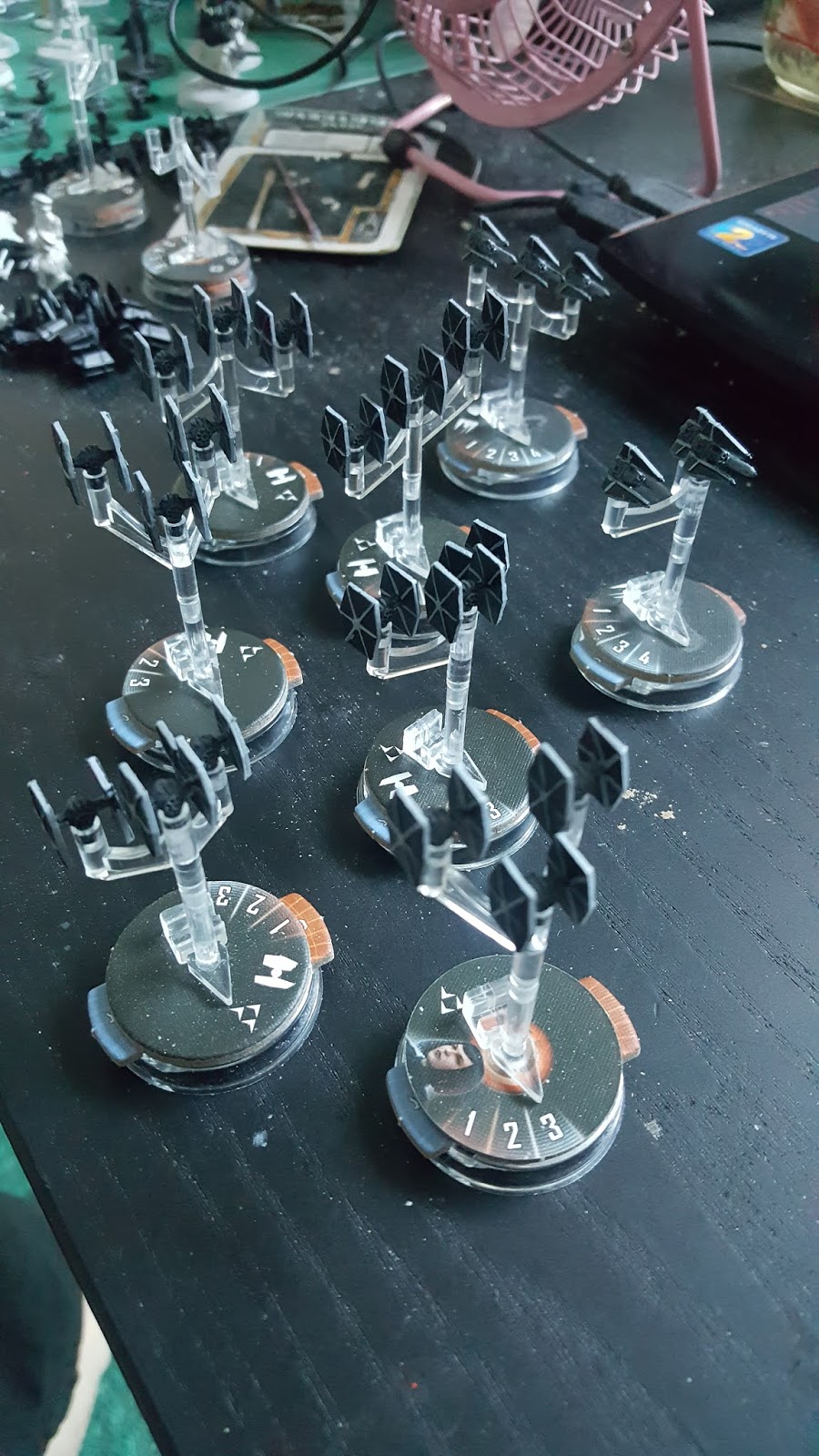
Oddly enough, during all this Armada squadrons have become my favorite thing to paint right now. I wasn't originally very interested in Rebel Fighter Squadrons II, but painting the Y-wings got me thinking about a Rebel fleet with lots of cheap fighters, and the Z-95 Headhunters would be perfect for that. But I mean I really got it for Ketsu Onyo. Look at her!


As an added bonus, there's a VCX-100 freighter, and even E-wings. Bizarrely, I got two extra E-wings! Not sure what to do with them. Looking at pictures of the VCX-100s and Lancers online, their base color seems to be grey, but I've taken the liberty of painting them with the same Ivory/Smoke scheme of the other rebel ships.


And here are the E-wings, Z-95s and Wedge Antilles' X-wings.

**

Finally, yes, I did also eventually get around to painting all the gazillion TIE Fighters that came with the core set, and the TIE Phantoms too. I did what I had done with the Rebellion TIEs as well and started with a Neutral Grey drybrush on the hull, but I did the edges and "spokes" on the wings in Light Grey this time.


And the TIE Defenders, including Maarek Stele's squadron. On the one hand, I could have done better with these; on the other, I never want to see a single Defender on my desk ever again.


Then I made it worse for myself by getting the Corellian Conflict expansion, because it meant I had the squadron card for Ciena Ree's TIE Interceptors, so I got the only squadron expansion I was missing: the Imperial Fighter Squadrons.


And here they are.


**

So yeah, apparently a thing that happened during the pandemic was that I ended up owning every squadron expansion to Star Wars: Armada. I still haven't painted everything, but I've thoroughly enjoyed myself. This has been a really good reminder that my first love in miniatures was 6mm Epic, and I still really enjoy painting the tiny stuff. Now, I still have piles of Warhammer things to finish, but I should really look into more smaller-scale miniatures.

Sep 7, 2020

Let's Read Tolkien 72: The Black Gate Opens

Two days later the army of the West was all assembled on the Pelennor.

Aragorn leads the army of Gondor and Rohan, with assorted hangers-on, toward Mordor. They pass over the Great River at Osgiliath, where it's suggested that they should assault Minas Morgul. Gandalf vetos the idea, because if that's where Frodo is trying to get into Mordor, they need to make sure Sauron is busy somewhere else. So they head for the Black Gate itself. On the way there, as they enter the wastes of Dagorlad, some of the soldiers refuse to go on. Aragorn takes pity on them, and suggests that if they don't want to go on, they should head southwest and capture the island of Cair Andros from the enemy.

Somewhat reduced, Aragorn's army arrives at the Morannon, where they parley with Sauron's herald. He makes even Gandalf completely lose his shit when he presents them with Sam's sword and Frodo's mithril-coat. The parley is unsuccesful, but Pippin comes away from it believing everything is lost, and feeling a sudden sympathy for Denethor. Sauron's armies attack, and in the mêlée, Pippin stabs a troll, but is crushed underneath it.

**

So, the climax of Book Five could hardly be more dramatic!

I talked about the, in my mind, anachronistic industrial wasteland outside the Black Gate when Frodo passed through it, but I'll also repeat another observation: Tolkien is remarkably uninterested in the geography of Gondor. Aragorn's army passes through Osgiliath, the former capital of Gondor, and its heartlands - and pretty much the only thing we hear about is the king's head at the crossroads. We're just about done with Gondor, and I still have no real idea what it's like there.

At the Black Gate, the captains meet the Mouth of Sauron. In Chapter 1, Book III, when Aragorn, Legolas and Gimli are examining the remains of some Uruk-hai, they have this conversation about the S-rune on their helmets:

"S is for Sauron," said Gimli.
"That is easy to read."
"Nay!" said Legolas. "Sauron does not use the Elf-runes."
"Neither does he use his right name, nor permit it to be spelt or spoken," said Aragorn.

Yet the Mouth of Sauron freely invokes his master's name. Maybe Aragorn was wrong, or the Mouth had a special privilege in this. Either way, the inconsistency isn't explained.

I wondered earlier if Gandalf's and Denethor's contrasting leadership styles weren't a commentary on British generalship in the First World War. I'm almost sure that Aragorn's humane treatment of his wavering troops, and especially their positive response to it, is a commentary on British military discipline in the same war. The British army initially dealt with PTSD and other psychiatric problems as cowardice and handed out death sentences very liberally, although not nearly all of them were carried out. Later - I suspect because they realized they couldn't shoot so many thousands of men! - the diagnosis of "shell shock" was invented, and both traumatized soldiers and conscientious objectors like Siegfried Sassoon were put in what passed for psychiatric care at the time. It would have been extraordinary if Tolkien had had no idea of the brutality of British military discipline, and the ferocious hatred of "cowardice"; Aragorn's conduct in this chapter is so diametrically opposed to it that I don't think it's an accident.

**

That was Book Five! It's certainly the most action-packed of the six, with climactic battles, a role reversal where a hobbit stabs a ghost, and a shameless cliffhanger. For all we talk about Tolkien's scholarship, he knows how to pace a story with the best pulp authors.

Thematically and, in a sense, theologically, the main point of Book Five is to showcase Tolkien's idea of "northern courage". I've talked about it before, but briefly, it's the idea that you do the right thing, whether you think it's going to work out or not. Théoden goes to war; Éowyn stands up to the Witch-King; Aragorn leads his army to certain defeat to buy time for the Ring-bearer. The point is made several times that this isn't a courage people should or even can be coerced into, although we retain some doubts about whether anyone really asked all six thousand soldiers who ended up at the Morannon. It is emphatically not the kind of fascism Tolkien gets accused of, where very important men decide what's best for the people, and force them there at gunpoint - a theme we'll be returning to in the next book.

Finally, for all the valor and martial heroism of Book Five, it does need to be remembered that it's all in the service of Frodo's errand. There's been great and glorious battle, the sagas winning out over Christianity completely there, but at the end of the day, theology prevails: brute force can't defeat the Dark Lord. This isn't Harry Potter and the Ring of Power.

Next time: the last book of the Lord of the Rings.