Oct 10, 2022

Epic: Let's Paint Aeronautica Imperialis

Let's face facts: I love painting little planes. What got me back into this whole hobby in the first place was Star Wars: Rebellion, and I liked painting all the little TIE Fighters and Y-wings and so on so much that I bought Star Wars: Armada and all of its squadron expansions just to paint more of them. And Warlord's Blood Red Skies. So yeah I think I like planes.

Also, 6mm Epic was my first love, and I thoroughly enjoyed painting and playing Adeptus Titanicus. However, I've finished painting all my Titanicus stuff for the moment. Is it, therefore, high time to get my hands on Aeronautica Imperialis, if only for the sheer pleasure of painting all the little planes? Especially since they just announced a beautiful golden flyer, and I love gold? Yes. Yes it is.

**

My friendly local game store still had all three starter sets in stock, and I dithered for a while over which one to buy. Eventually my Gladius experience tipped me over into Wings of Vengeance: the Imperial Navy flyers are represented in Gladius, and my brother likes playing orks in our multiplayer games, where he makes devastatingly effective use of Dakkajets.


I'm going to start with the Thunderbolts. Somehow, I did not learn my lesson about fiddling with tiny-as-hell magnets when I built my Epic Knights, so I'll be magnetizing their underwing hardpoints. I've still got a whole pile of those Primal Horizon 1/16"×1/32" magnets, and at least I can console myself with the thought that if I use them on these models, I won't have to use them on anything else. The Thunderbolt's wing is just barely thick enough to take the magnets:


I decided to start with the Skystrike AAMs, and what I ended up doing was simply chopping off part of the pylon to accomodate the magnet. It's not pretty, but it works, and they're under the wing anyway, it'll be fine.


This wasn't as fiddly as I'd feared, but I'm still not doing any of the other munitions unless I need them! So far, this is the most glaring difference between Aeronautica Imperialis and Adeptus Titanicus: with the latter, they've thought about magnetizing in the design of the miniatures, but with Aeronautica, it doesn't even seem to have crossed anyone's mind.


Other than that, the models were a delight to assemble. The quality is similar to Titanicus, which is to say very good, and since there weren't many choices to make here, it was just an easy and satisfying build.


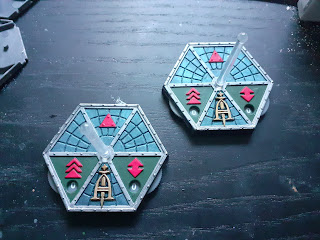
One thing did bother me, though: the bases. Even in that preview of the Custodes flyer I linked earlier, GW always shows the bases completely unpainted. I think that's a tremendous shame, they're big and chonky and practically crying out for paint. There is simply no way I'm not painting that Custodes base gold. Luckily, there's a lovely guide on Goonhammer that shows how to pop the bases open so they can be painted and still stay functional. I tried it and it works.


The planes themselves are going to be painted dark green to match my Imperial Guard vehicles, and if I'm going to do that, I think it would be fun to give them a similar camouflage scheme as I did for my Soviet Blood Red Skies planes. So it's Deep Sky Blue for the undersides.


The blue isn't actually that brilliant, but the light was hitting my desk funny and I like it. I was teaching Swedish history at the time and decided to use the Kalmar union colors for the insignia. Here are the bases:


They were quite easy to reassemble, so I'm definitely going to be painting the rest of the bases as well. For the top side of the Thunderbolts, I painted them Luftwaffe Camo Green with some German Camo Dark Green and Black Green splotches to make a sort of camouflage pattern.


I also went full Soviet on the markings, with the exception that the numbers are significant: these are Blackbird 1 and 2 from whatever I'm going to call my Imperial Navy unit.

**

Then it's on to the Dakkajets! Like I said, I've become quite fond of them during our games of Gladius, and I wanted to try my hand at an epic-scale conversion. I was originally going to do this with a 28mm Dakkajet, but I never managed to pick up one of those three-jet boxes until they went out of production. Anyway I chopped a bit off the top and bottom of the fuselage.


And swapped them. With a little putty and some internal support, it worked out just fine.

I assembled the other two in a more traditional way.


And magnetized the hardpoints, if not any of the ordnance (yet). Then it's on to painting, and since my brother's preferred color in Gladius is orange, that's what we're going with.


The Dakkajets have the name of their mothership blazoned across the bottom of the fuselage, and carry a kunning recognition stripe on the wings in white and Royal Purple. I used the same colors, along with some Copper, on the bases.


Then it was just a matter of finishing up the top fuselage and tail section on each Dakkajet, and they're done.


I'm happy to report my conversion was also quite successful.


**

My actual first purchase, when I'd decided to do this, was some Arvus Lighters from Forge World, but they took their time showing up. Most of the players in my Rogue Trader campaign have spent so much time flying around in their Arvuses that their characters must know them inside and out. I already painted a Land Speeder in House Frunze colors earlier, so I think these lighters will get the same Royal Purple treatment. I got started with the bases.


The actual models were a breeze to assemble. Forge World resin has come a long way since the old days.


The only complaint I have is that one of them is very wobbly on its flying stand. Here they are:


**

I'm not really all that interested in the Fighta-Bommas, so I think I'll leave them in the box for now. Marauder bombers, on the other hand, show up in Gladius and based on my Thunderbolt experience, I think I'd enjoy building them. Even though they have eight hardpoints each.


Eight! Was this really necessary? They're big planes, by the way.


I could paint both Marauders in my Imperial dark green. However, I mentioned that I really liked painting Star Wars fighters. Even though I'm an Empire guy myself, the dirty white rebel scheme was my favorite. I've been meaning to recreate it in Warhammer forever, and now is the time. Therefore, using the Gue'vesa rules in the Aeronautica Companion, here is the first representative of the Shi'ar sept: the Tau bomber What is foolish speech?


I decided to use Light Green as the marking color, and I think it works.


The faction markings proclaim the Shi'ar sept's loyalty to the Group of Seventeen, and the aircraft number is is the green circle. Sadly, the Tau numerals GW has come up with are pretty much identical to ours. Here's the Imperial Navy Marauder:


I did the camouflage colors a little differently, because I figured most opponents will be seeing the bomber from below.


**

So here we are: I really liked painting these lovely little planes, and I may or may not have already bought more...

Oct 3, 2022

Let's Read Tolkien 91: The King and the Steward 23-24

Mountains of Shadow, Hotont pass
May 12, 3019
“There’s your Ithilien.”

We're back with Haladdin and the gang, who are making their way across the mountains into Ithilien, with the help of some trollish resistance fighters. We visit the trolls of the Shara-teg valley in a sort of flashback, and then our heroes find some of the Baron's old soldiers.


To use Tolkien's terms, we're now in Yeskov's own particular sub-creation, and a couple of things do stand out.

First, the language. We experience Hotont Pass, Shara-Teg valley and meet Ivar the Drummer. Oh, and they drink vodka. There is no logic to these names, or to the kind of culture and language Yeskov is trying to portray. Everything is eclectic and poorly thought out, and keeps getting worse as the story goes on.

This is underlined by my least favorite feature of the story, which is the relentless anachronism. We again have guerrilla fighters in a preindustrial society behaving like modern professional soldiers. People point bows at others like they're guns and hold modern military ranks. While they're staying with the trolls, Haladdin meets, of all things, a graphologist. The graphologist produces a psychological profile of the elven officer they killed in Mordor, and Haladdin uses this to come up with a key idea for his plan, to which we are not privy.

A lot of stupid things get said about fantasy and "historical accuracy", especially by people who are fine with dragons and zombies, but insist that if there isn't violent misogyny it isn't "historically accurate". As a historian, I consider this very silly. Fantasy isn't history: there's no reason to demand historical accuracy of it in the first place, and when the demand is made, it's almost invariably made in a way that's so selective that it's obvious it's being used as an excuse.

What I think fantasy or indeed any speculative fiction should be is coherent. If you want to portray a pre-industrial society with Middle Eastern influences, then do that. This seems to be what Yeskov set out to do, but it's constantly undermined by his references being all over the place, his unbearably smug narrative voice, and above all by the fact that all of his characters are clearly 20th-century people who for some reason happen to live in a fantasy world.

Tolkien used anachronisms deliberately, to maintain a distance between the narrator and the story, and sometimes for reasons that are entirely beyond me. I still have no ides why hobbits have potatoes. Yeskov uses them constantly to batter the reader into submission.

I'm still of two minds as to whether or not I actually want to see this whole thing through. Every now and then, I read a chapter and I feel like okay, I want to see where he's going with this. Far too often, though, the "look how clever I am" schtick makes me despair. We'll see what happens.

**

Next time: merry men.

Sep 12, 2022

Game of Thrones board game 3: Here I Throne

Elderr Gutlon rose violently, his large frame towering over the seated brethren. "How dare you, Vitus. How dare you, who has yet to earn a single "R" in his name, who has not even completed his study of the ancient works, and can hardly quote from them by memory, judge us?

- Mark Brendle, Something Awful


in 2019, we played our first ever six-player game of the Game of Thrones board game. But since one regular member of our gaming group was away in California at the time, he's missed out on the particular experience that is an entire day dedicated to murdering your friends all across Westeros. Last May, we tried to rectify this - and then the coronavirus happened.

We ended up playing Here I Stand by email instead, which was quite an experience. At the same time, it's downright hilarious that the last season of the Game of Thrones TV series was apparently so bad that the entire franchise simply vanished from the public eye, especially since the dude can't finish a book (the latest novel in the series was published four months before Skyrim). I'm going to start telling people that this boardgame is the original work it was all based on. Anyway, Here I Stand is over, so now it's time for Here I Throne.


**

Our first game was a five-player affair, featuring a Baratheon blitz into the Reach and an ineffective Lannister betrayal; it was won by House Tyrell. Our second game had six players, and featured a Baratheon blitz into the Reach and an ineffective Baratheon betrayal; I won as House Lannister. This time, we've got the Mother of Dragons expansion, and while the Essos board extension barely fits on our table, incorporating House Arryn is easy. We also knew that one player would have to leave early, so we would definitely be using the vassal house rules. So we set up for seven players:


Since I've played as the Greyjoys and the Lannisters, I decided I want to be at the opposite end of the table this time, and picked the Martells. The vassal house ended up being House Arryn, who became vassals to House Baratheon. On the first turn, the Greyjoys came out swinging, grabbing Flint's Finger, Seagard and Moat Cailin for an early lead.


This, of course, concentrated quite a bit of attention onto them in the next few turns. While the war in the north raged, we in the south consolidated our positions, and the Baratheons secured King's Landing. As the Greyjoys were chased back to their islands and the Baratheons stormed the Reach, by turn 4 it was the Starks who looked like the ones to beat.


At this point, the Baratheon player had to leave, so Arryn and Baratheon were vassal houses. I decided this made it high time to grab Storm's End from the Baratheons, and the Greyjoys turned the tables on the Starks with a seaborne invasion of Winterfell.


As turn 5 rolled around, everything happened: we recalculated supply, rebid all the influence tracks and sustained a Wildling attack where they ate all our horses.


Turn 6 saw the Stark player leave the game, so we were down to four players and three vassal houses. The Stark departure made things a little bit easier for both the Greyjoys and Lannisters, and they capitalized on it, with the Lannisters grabbing a lead and threatening to win the game outright.


Therefore, our agenda was clear: a House Arryn offensive, supported by both the Baratheon and Martell navies, cleared out the Lannisters from Crackclaw Point, and a Tyrell attack led by Loras took not only Lannisport but also Riverrun. I used the distraction to grab King's Landing.


Meanwhile, the Tyrells also struck in the south, routing my garrison at Starfall, but Arianne Martell sent them right back home.


Going into turn 7, it was pretty much a dead heat between my Martells, the Tyrells and the Greyjoys.


After the seventh turn, I think fatigue set in for all of us, and it was a slog to get through the last turns. The Tyrell offensive sort of petered out; I got into a fight with them over the Reach, but couldn't make any more headway. The Lannisters never really recovered. Finally, the Greyjoys captured White Harbor at the very beginning of the tenth turn to seal the win.


The game took a little bit over ten hours and we were exhausted.

**

So, I came in second with the Martells after winning the previous game with the Lannisters. I feel like the biggest reason I lost was sheer physical exhaustion: I was out late the previous night, and by the time we got to the endgame, I was so tired I was simply unable to put together a plan to get to victory.

Another thing that tripped me up was supply. In our first game, we took ages to turn up a mustering card, and I suffered for that as the Greyjoys since it stopped me from mustering any units at all. This time, it took several turns until we got a supply card at all, but when we did, I hadn't secured enough supply areas and fell behind. Not being able to put effective armies into the field was crippling, and entirely my fault for overlooking this crucial area of the game.

So yeah, I lost because I played badly. On a positive note, though, we all liked the vassal system. The option for players to drop out is frankly excellent, and while the very limited amount of vassal orders you can give makes sure the vassal houses don't completely unbalance the game, they still make things a lot more unpredictable. I would definitely recommend using the vassal house rules, and I liked the addition of House Arryn.

I'm glad we played, but the last few turns were so grueling that I think we have to consider making the next one a two-day event. And holding it next year. At the earliest.

Sep 5, 2022

Let's Read Tolkien 90: The King and the Steward 20-22

Ithilien, Emyn Arnen 
May 3, 3019 
“What time is it?” Éowyn asked sleepily.

In this, the second part of The Last Ringbearer, the point-of-view character is Faramir. We've heard about him before: he was handily indisposed when Gandalf took over in Minas Tirith, and Tangorn mentions his forced retirement to Ithilien. That's where we find him now.


**

There's a little introduction where Faramir and Éowyn are being cute, and then we take a flashback to the battle of the Pelennor. As in the Lord of the Rings, he's shot with a poisoned arrow, but here it's very strongly implied that the shot came from his own side. He's then taken to a hospital in Minas Tirith, paralyzed by the poison, and Aragorn eventually comes to see him and monologues at him like a B-movie villain.

The upshot is that Faramir is sent into exile to Ithilien. Éowyn is in love with Aragorn, but he has her care for Faramir and sends her off to Ithilien with him. There Faramir supposedly rules as the Prince of Ithilien, but is actually held hostage in the fort of Emyn Arnen by Beregond and the soldiers of the White Company.

Eventually it dawns on Éowyn that Aragorn has discarded her, and she hears about his marriage to Arwen. So then when an envoy arrives to summon her to Minas Tirith, she refuses to go. Faramir is already in love with her, and soon she reciprocates.

However, Faramir suspects that Aragorn won't leave them in peace, and starts plotting. It turns out he has the palantír that was in Minas Tirith. In this story, anyone involved in the murder of Denethor who looks into it only sees his burning hands. Thinking the stone useless, Aragorn and his co-conspirators let Faramir take it with him. Faramir now uses it to test Beregond's loyalty, and once he determines Beregond wasn't involved in the murder, they start intriguing.

**

As ever with Yeskov, the prose is clunky at best, but his strength is in writing an adventure story, and once we get past Aragorn's monologue, that's what we get. On the other hand, Yeskov is at his worst when he's trying to write something clever, and Aragorn's monologue is just bad. His portrayals of Faramir and Éowyn are humane, though, and we're definitely rooting for them. Hopefully the story keeps rolling along with a minimum of metaphysics and clever politicking.

**

Next time: trolls.

Aug 15, 2022

Conservatism, the law and the climate crisis

In this blog post, I will argue that our failure to understand conservatism as an ideology is putting the survival of humanity in peril.

**

In the morning on August 8th, 2022, the FBI raided former president Donald Trump's Florida mansion. This prompted fury among Republicans, who portrayed a police raid against a senior politician as a terrible violation of norms.


As legal commentator and blogger David Allen Green points out, these are the same people who called for Hillary Clinton to be not only investigated but imprisoned. As Green has it:

The only explanation for the two stances is hyper-partisanship.

And like many hyper-partisans, he has invoked constitutional arguments of first principle when it suits his cause, but does not apply them the same way against his cause.

I have a great deal of respect for David Allen Green as a commentator, but on this subject I believe he is entirely wrong.

The "two stances" here are that a) Hillary Clinton must be investigated and prosecuted for suspected crimes related to official documents, and b) Donald Trump must not be investigated and prosecuted for suspected crimes related to official documents. Looking at the matter this way, there appears to be an obvious hypocrisy. But this is not the only possible explanation at all.

In 2018, US composer Frank Wilhoit posted an excellent description of conservatism:

Conservatism consists of exactly one proposition, to wit: There must be in-groups whom the law protects but does not bind, alongside out-groups whom the law binds but does not protect.

If we take this description of conservatism as a guide, we see that there is no contradiction or hypocrisy. To US Republicans, Trump belongs to the in-group and Clinton to an out-group.

In their worldview, the law protects Trump, but does not bind him: in his press release on the raid, Trump was indignant that his safe had been broken into. In the conservative worldview, his property must be protected, but cannot be investigated.

Conversely, Clinton must be bound by the law and is not to be afforded any of its protections. After all, the chant was never "investigate her", it was always "lock her up". Trump routinely referred to her as a criminal. Investigating Trump for a crime is unacceptable, but Clinton is not even granted the due process of an investigation.

If we accept Wilhoit's definition of conservatism, the Republican response to the Mar-a-Lago raid is consistent and perfectly understandable. Speaking as a historian, it has greater explanatory power. Republicans do not hold two contradictory opinions - two stances - but rather one.

On our side of the Atlantic, the day before the raid on Mar-a-Lago, British Conservative MP Nadine Dorries described a parliamentary inquiry into outgoing prime minister Boris Johnson's conduct as a "witch-hunt" and a "kangaroo court", and demanded Tory MPs refuse to participate in it. She is hardly the only British Conservative politician who seems to likewise believe that Johnson is above both law and parliamentary scrutiny.

To ascribe behavior like this to a general "hyper-partisanship" is, in my opinion, a poor explanation. It fails to account for the fact that this is not a bipartisan phenomenon, but rather a conservative one. There is no comparable movement on the left demanding their political leaders be above the law.

**

This confusion is only one example of a broader trend. For whatever reason, large parts of the media and the liberal commentariat do not treat conservatism as a political ideology with its own particular history. Instead, they largely accept conservatives' own formulations of their ideology at face value, and ignore the history of conservatism. There is also a marked reluctance to question conservatives in ways that representatives of other political ideologies are questioned.

As a political movement, conservatism was born as a reaction to the French Revolution. The guiding ideal of the revolution was enshrined in the motto "liberty, equality, fraternity". The conservative mission was to oppose this. US political scientist Corey Robin and others have defined conservatism as an ideology that defends an unequal, hierarchical society. If conservatism is seen in this historical context, the reason why they subscribe to the worldview described by Wilhoit is clear. Equality before the law is incompatible with the idea of hierarchy.

It's instructive to look at the history of the idea of the rule of law. The rule of law and the German Rechtsstaat are liberal concepts, formulated in opposition to conservative hierarchies. In the English-speaking world, the idea of the rule of law was conceived as a criticism of the idea of the divine right of kings. The American Revolution was fought, according to its proponents, on these principles: that even kings should be subject to law.

The American and French revolutions are the origin of the modern idea of human rights. Conservatives everywhere have consistently opposed these rights. Of course, they routinely misrepresent this history. The idea that the political right was ever in any sense liberal was an artifact of the cold war, where human rights were a useful rhetorical weapon against the Soviet Union. After the Soviet bloc collapsed, conservative parties in the west have been progressively abandoning the idea of human rights, to the point where entire conservative parties are represented by authoritarians like Trump and Johnson.

Both Trump and Johnson are thoroughly illiberal politicians. They do not accept, indeed do not even seem to understand, the idea that there should be any limit to their powers, or that they should be accountable to anyone. Both gleefully attack any institutions that they deem hostile to their ambitions. Trump instigated a coup attempt against the US Senate; Johnson has consistently fought parliamentary oversight and even blatantly lied to the Queen. While they flagrantly break the law, they fulminate about law and order.

To conservatives, there is no contradiction, because to them, law and order means using state violence to enforce social hierarchy. It does not mean, and never has meant, rule of law.

If we imagine conservatism as the defence if established structures, both Johnson and Trump seem profoundly unconservative. Some right-wingers have argued that they are not, in fact, conservatives at all. This is not very persuasive, because in both their countries, the conservative parties wholeheartedly support these disgraced leaders. Clearly, to most US and British conservatives, these men represent their values.

Those values are privilege and hierarchy. Both Johnson and Trump come from immensely privileged backgrounds. Neither has ever done a day of honest work in their lives, let alone actually earned a living - supposedly conservative values. They constantly break the norms they claim to uphold, and this barely dents their popularity with their supporters. Again, this is because conservatives do not believe they should be bound by these norms, but rather that others should. They are the in-group, we are the out-group.

It's worth noting that the backlash against Johnson only began after he started lying to his own supporters. He remains very popular among members of his party.

To conservatives, the impunity with which Johnson and Trump break laws and conventions demonstrates their superiority. It "triggers the libs" by making the hierarchy of society visible. Johnson can violate lockdown regulations without penalty, while others are fined. To conservatives, this is as it should be.

**

If we conceive of conservatism in terms of hierarchy and privilege, it becomes obvious why conservative parties are so fanatically opposed to fighting the climate crisis.

The conservative worldview is based on the idea that the privileged in society are entitled to do what they want. Rules and regulations are for other people. Even to supposed law-and-order conservatives, the idea of the law being enforced on them is an abomination.

Twenty-first century conservatism reflects the values of individualism and fossil capitalism. Regardless of their station in life, conservatives tend to believe that they are the ones who create value for the economy, and therefore to society. They believe this entitles them to a privileged position in it. In fossil capitalism, this means they must be allowed to consume more than others. Any restriction of their consumption is a restriction of their privilege, which amounts to a denial of their superior position in the hierarchy. Therefore it is unacceptable.

This is why things like private car ownership, flying and eating meat have become fetishes of right-wing policy with such astonishing speed. Conservatives believe they are entitled to these things as marks of their superiority over others.

If we believe conservative rhetoric about the importance of responsibility, the common good, future generations and so on, it is impossible to explain why conservatives are everywhere at the forefront of the fight against environmental protections. They talk about responsibility and preservation, and defend limitless consumption and destruction. When we realize that this rhetoric of responsibility is only ever mobilized to oppose policies that would lead to a more equal society, conservative policy is much more coherent. Throughout, they are defending their privilege.

**

Whether it be Donald Trump's assault on the US political system or the infinitely more serious matter of the climate crisis, we are consistently failing to see conservatism as an ideology of hierarchy and privilege. This means that for the most part, conservative policies and attitudes are not seen as what they are, and are not effectively critiqued. Instead, the media largely pretends conservatives share the same values as the rest of the population, and treats clear indications to the contrary as some kind of errors of thought, rather than manifestations of their values.

When it comes to environmental policy, this reluctance to engage with conservatism as an ideology provides a smokescreen for their obstructionism and sabotage. By opposing policies that are necessary to control the climate crisis, conservatives are literally destroying our planet. And they are doing it to sate their unlimited greed.

We have to stop them.

Aug 8, 2022

Here I Stand by email: Turn 5 (1536-1539) - French Diplomacy

Welcome to Turn 5 of our massive game of Here I Stand by email! Turn 4 is here, and this is how things stood when it ended:

Diplomatic situation:

The Ottomans are at war with the Papacy
The Habsburgs are at war with England
The Habsburgs are at war with the Protestants
The Papacy is at war with the Protestants
The Hapsburgs are allied with Hungary-Bohemia
France is allied with Genoa
France is allied with Scotland
The Papacy is allied with Venice

Victory points:

England 13
Protestants 16
Hapsburgs 19
France 20
Ottomans 20
Papacy 20

Protestant spaces: 20
(victory points Papacy 9 - Protestants 6)
Electorates: 5 Protestant, 1 Catholic
Protestant English home spaces: 1 (0 VP)

Cards removed from the game:

Luther's 95 Theses
Peasants' War
Barbary Pirates
Defender of the Faith
Clement VII
Paul III
Marburg Colloquy
Michael Servetus
Calvin Expelled
Augsburg Confession
Julia Gonzaga
Schmalkaldic League

Explorers removed: Narváez (-1)


We start, as always, with the card draw phase. All the naval units destroyed last turn are returned to their owners and can be rebuilt, and the reformer Calvin returns to Geneva from exile. 

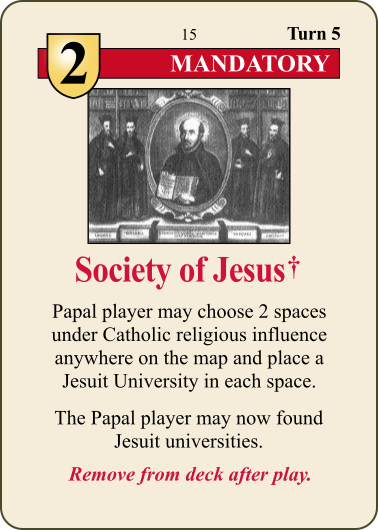
The Reformation continues: as a result of Henry VIII's marriage to Anne Boleyn last turn, the English Reformation is now on. The reformer Cranmer appears in London, flipping it Protestant and giving England their first Protestant Home Spaces VP, for a total of 14. Cranmer also joins the game as a debater, along with Coverdale and Latimer. The papal ranks are reinforced by Carafa and Pole, and a total of ten new cards are added to the deck, including the mandatory event Society of Jesus, Copernicus and the Spanish Inquisition.

Before dealing cards, we work out New World riches for the Habsburgs and French. The Spanish roll a seven for their colony in Cuba, which ends up as a result of 8 due to Plantations, so they get a card, and another card from their Aztec conquests; the French get a card from Charlesbourg Royal.

So the total cards everyone starts the turn with are as follows:

Ottomans: dealt 5, kept 2, total 8
Hapsburgs: 7, 2, 10
English: 4, 1, 6
French: 6, 1, 8
Papacy: 5, 1, 8
Protestants: 5, 1, 7

**

And then it's time for the diplomacy phase. The negotiation segment had to be extended when one player's laptop screen broke, but eventually, after some exchanges of diplomatic missives, I got things started by announcing an Ottoman alliance with France. The Habsburgs also announce an alliance with France, and grant them a card draw! England then announces an alliance with France, because of course they do, at the price of one French mercenary unit transferred to their control, as well as an alliance with the Protestants.

For their part, the French confirm the Ottoman and Habsburg alliances, as well as the Habsburg card draw, and announce an alliance with the Vatican! France loans the Genoan naval squadron and Andrea Doria, and transfers four units of mercenaries, all to the Papacy, and in exchange the Pope cedes Florence to the French. The alliance with England is declined. The Vatican confirm the agreement, and the Protestants confirm their alliance with England. France now leads with 22 VP!


The Habsburgs decline to sue for peace with England, and declare war on the Ottomans; the French cap off a very succesful diplomacy phase by declaring war on the English. We're running out of diplomatic counters!


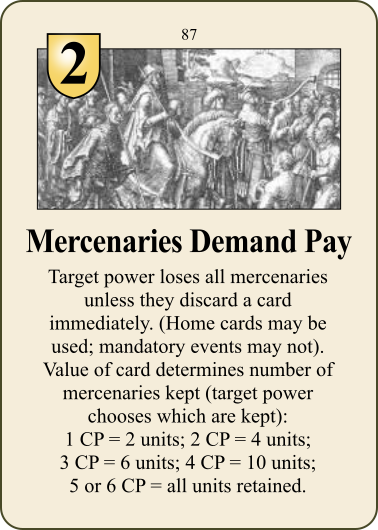
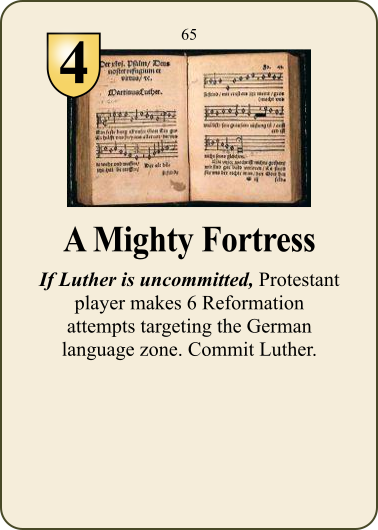
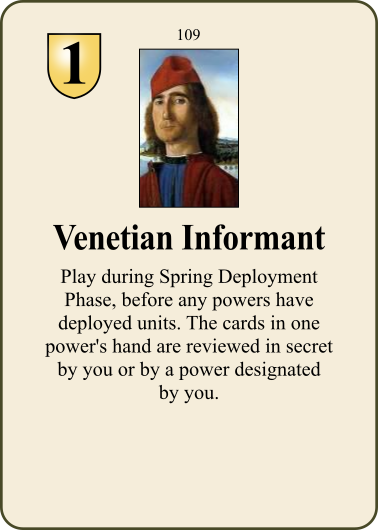
The Habsburgs pay for their declaration of war with Mercenaries Demand Pay, and France with A Mighty Fortress. The French then play Venetian Informant for the third time in the game, this time looking at the English hand.

I spring deploy Suleiman and three Ottoman regulars to Buda, and the Habsburgs decline to deploy. Henry VIII travels to Calais with three mercenaries and two regulars, and the French deploy Francis, Montmorency, four regulars and four mercenaries to Boulogne. The Papacy finishes spring deployment by sending four mercenaries to Ancona.

**

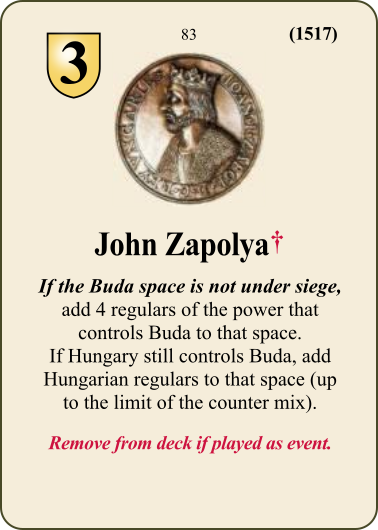
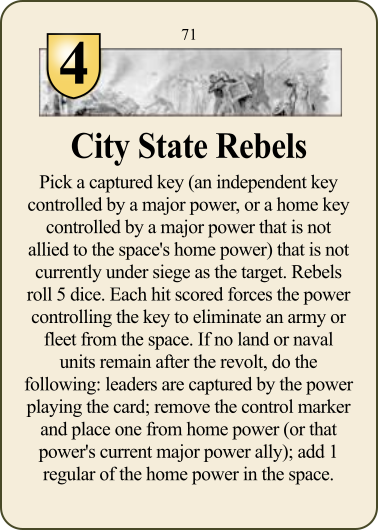
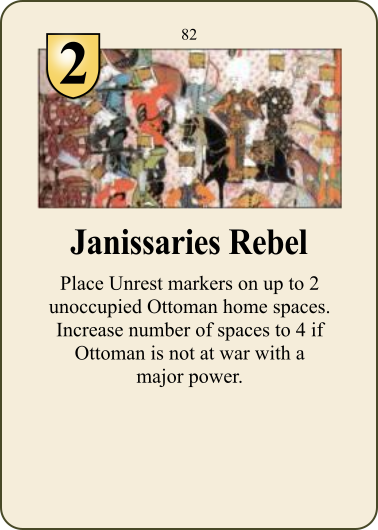
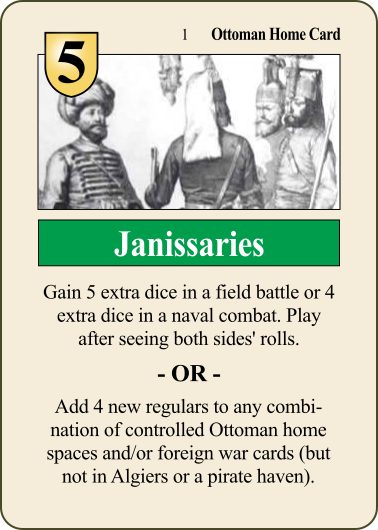
The Ottomans start the action phase with John Zápolya, meaning I now have an army of eleven regulars at Buda. The Habsburgs retaliate by recruiting two regulars at Vienna with City State Rebels, and England plays Janissaries Rebel for command points to deploy their fleet: two squadrons from Bristol to the Irish Sea, two squadrons from Calais to the Channel and a squadron from London to the North Sea. Following this, Brandon and his army march from Antwerp to Calais.

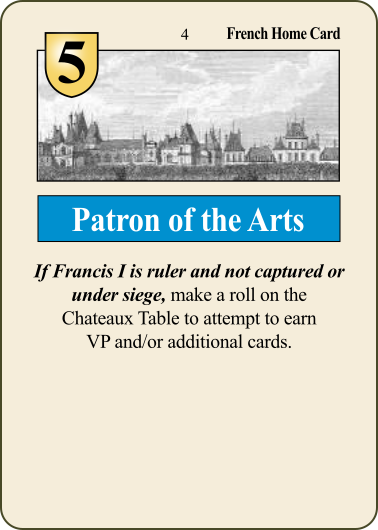
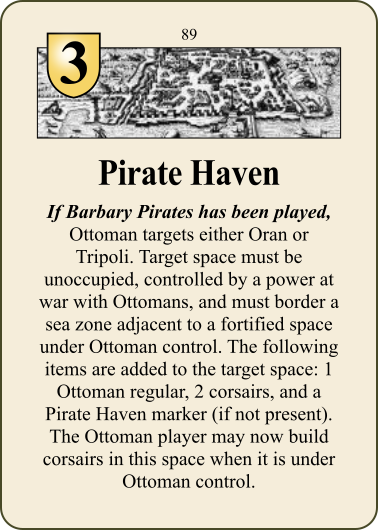
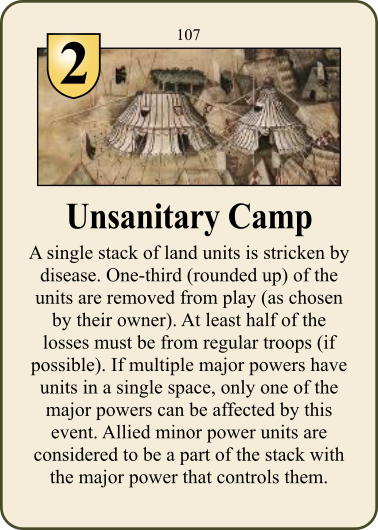
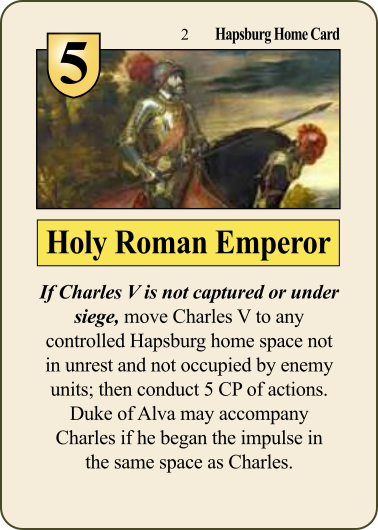
France plays their home card and rolls on the château table with maximum bonuses, but rolls a 2, so they draw one card and go up to 23 VP. The Papacy plays Pirate Haven for 3 CP, deploying their fleets from Venice and Rome and burning books in German. Utilizing Tetzel's bonus to add 1 CP to the St. Peter's track, the Vatican returns Strasbourg to Catholicism but strikes out in Münster. The Protestants play Unsanitary Camp as an event in Vienna, causing the Habsburgs to lose four regulars.


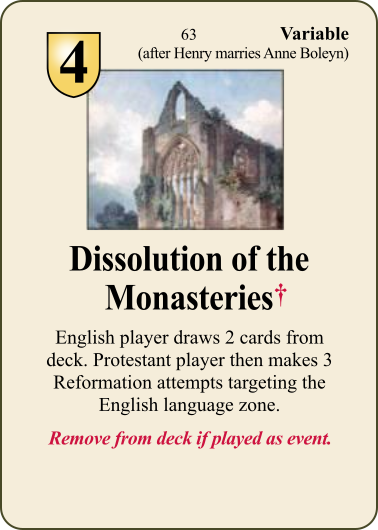
As the Ottomans, I play Dissolution of the Monasteries for command points. My fleet in Coron moves to the Aegean and Barbarossa's navy in Corfu deploys into the Ionian Sea. The papal fleet in the Adriatic Sea successfully intercepts; in the ensuing combat, I roll 11 dice and score 3 hits, sinking one Venetian squadron, and the Papal fleet gets five hits with six dice, destroying both my squadrons and a corsair. Barbarossa withdraws into the Aegean, and I use the remaining command points to build my last fleet at Coron and take control of Szegedin.

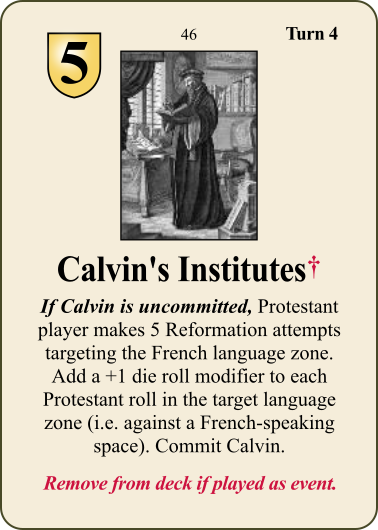
The Habsburgs play Calvin's Institutes for command points, building a regular in Prague and Innsbrück, as well as a mercenary in Vienna. England play their home card, Six Wives of Henry VIII, and the roll on the marriage chart is a 5: Edward is born sickly, and England gets 5 VP, catapulting them to a total of 19. Further, since Edward's mother was Anne of Cleves, both the English and the Protestants draw a card.

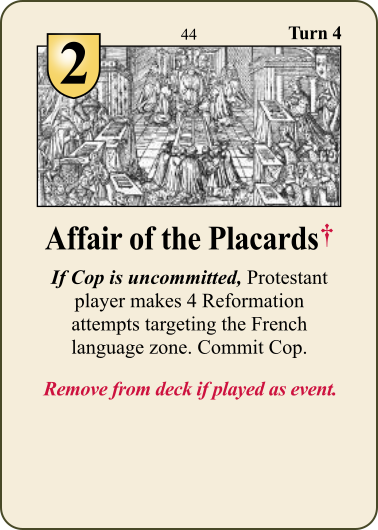
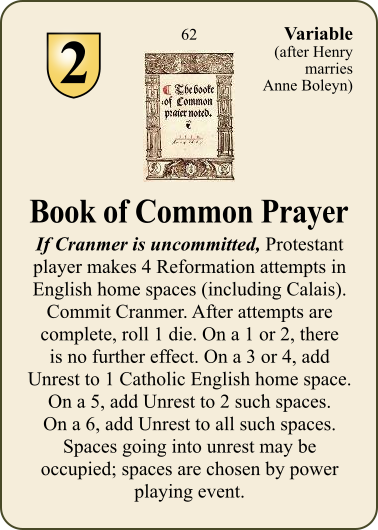
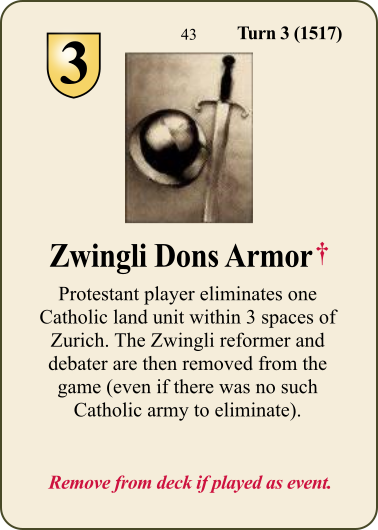
The French play Affair of the Placards for command points, moving their fleet in Marseille to sea and marching the two regulars in Genoa to Florence. The Vatican plays Book of Common Prayer, moving their fleet in Ancona to the Adriatic and building St. Peter's. The Protestants play Zwingli Dons Armour for command points: Philip of Hesse besieges the electorate of Trier, the Protestant regular in Brandenburg marches to Wittenberg, and Tyndale finishes translating the New Testament into English, generating six reformation attempts in the English language zone. Staggeringly, every single one of them succeeds, equalizing the Protestants and the Papacy at 17 VP each and taking England to 22!


On my impulse, I play Erasmus for command points, and engage the Venetian fleet in the Ionian Sea again. This time, after failed papal interception and avoid battle attempts, we're victorious, but only sink one of the two enemy fleets; the survivors retreat to the Adriatic. Barbarossa pursues them, and we finally destroy the rest of the Venetian navy for the loss of another corsair. A third naval move regroups my fleet in the Ionian.


The Habsburgs play Pilgrimage of Grace for command points, continuing an impressive streak of religious events not played as events, to recruit a mercenary in Innsbruck and send an explorer to the New World. England plays the mandatory event Imperial Coronation, which has no effect as Charles V is in Vienna, and marches their army from Calais to Boulogne. The French choose to avoid battle and retreat to Boulogne, but they fail. In the field battle, both armies manage to score a grand total of three hits, which means both sides lose three mercenaries, the French defenders win, and the English retreat back to Calais. They use their other command point to recruit a mercenary there.

For their part, the French play War in Persia for CP, withdrawing their army from Boulogne to Paris, sending Montmorency and two mercenaries to Rouen, and recruiting a Scottish regular in Glasgow. The pope plays Unpaid Mercenaries and uses the command points to build St. Peter's, which gets them their fourth St. Peter's victory point for a total of 18 VP. The Protestants retaliate with Mercenaries Bribed, starting a debate in German against the only committed Papal debater, Tetzel. The Protestant debater is Melanchton, and he absolutely destroys his opponent: the Protestants win by four hits to none, meaning Tetzel is disgraced and four German-speaking locations convert to Protestantism. The Protestants flip Regensburg, Salzburg, Innsbrück and Linz, and all this swings the victory points their way: the Papacy now has 16 VP and the Protestants 20.


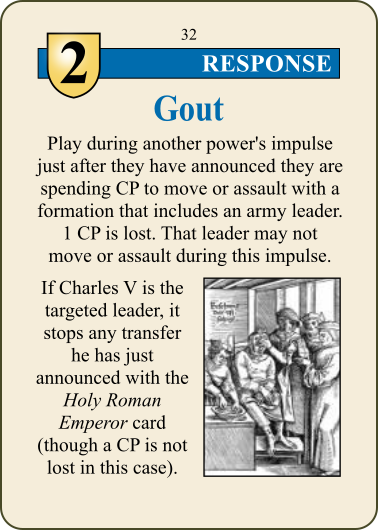
The Ottomans play Gout for command points, attempting piracy in the Ionian Sea. We score one hit, and the Habsburgs award us a piracy VP, for a total of 21 VP. On the Habsburg impulse, it turns out that none of us were expecting the Spanish Inquisition.


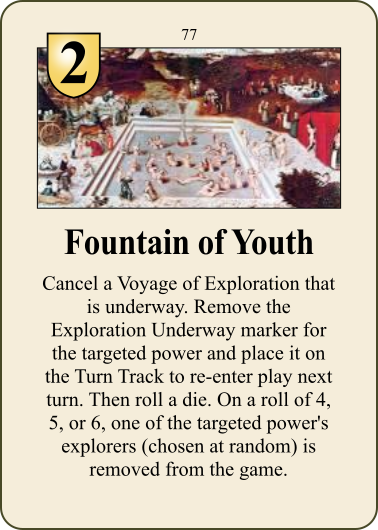
There are no Protestant Spanish-language spaces (are there ever?), but the Habsburgs make the English discard Fountain of Youth and draw a card for themselves. The debate ends up being Carafa against Luther himself, and the Catholics win it by one hit, converting Worms. This again changes the victory points, putting the Papacy at 17 and the Protestants at 19. Incensed at losing a card, the English play Shipbuilding for command points, recruiting a mercenary at Calais and then marching their entire army in Calais to Brussels; the Habsburg garrison withdraws into the fortifications.

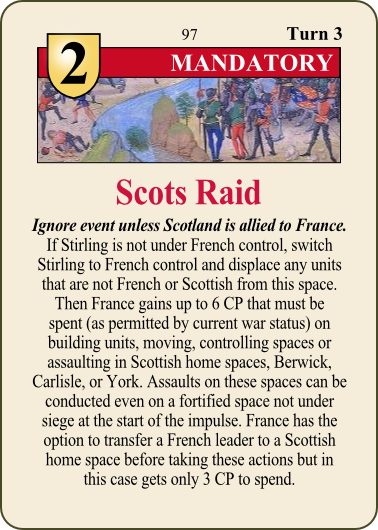
At this point France plays Swiss Mercenaries as a response, placing one in Florence and three in Carlisle, followed by Scots Raid.


France builds a Scottish regular in Glasgow, and marches the stack of five units there to Carlisle. The English decline to intercept, so the Scots march on to York and launch their assault. Neither side scores any hits, so now the siege is on. They then use the command points from the event to send an explorer to the New World.

The Papacy plays Leipzig Debate, nominating Eck as their attacker and targeting an uncommitted German debater. It ends up being Eck versus Karlstadt again, and the hits are 3-0 to the Papal side. That means Karlstadt is burned at the stake! The Papacy flips Nürnberg, Regensburg and Leipzig; they gain 1 VP from this and 1 VP from Karlstadt, going up to 19 VP, while the Protestants drop to 18.

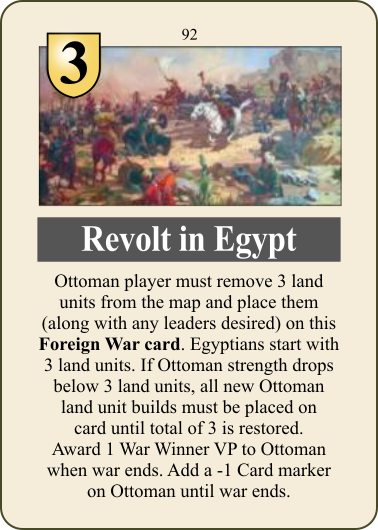
For their part, the Protestants play Master of Italy. Since France controls Milan, Florence and Genoa, they go up to 24 VP! The Protestants use the command points to storm Trier, unsuccesfully, and move a regular from Augsburg to Worms. I play Revolt in Egypt for command points, move Barbarossa's fleet to the Adriatic and piratize the Papacy there. We score one hit, netting one piracy VP for a total of 22.

Meanwhile, the Habsburgs go on the offensive! They play Gabelle Revolt for one CP and march Charles, the Duke of Alva and their entire stack in Vienna to Pressburg. Suleiman attempts an intercept with the Ottoman stack in Buda and succeeds. The battle of Pressburg is a tremendous slaughter, with the Ottomans losing five regulars and the Habsburgs seven units. The Habsburg survivors retreat to Vienna.


The English play Machiavelli: the Prince for command points, and storm Brussels: both sides lose one mercenary and the siege continues. They also send one of their regulars from Edinburgh to besiege Stirling, and the French mercenary at Glasgow fails to intercept them. This cuts the French line of communication to York. The other English regular at Edinburgh then attacks the French mercenaries at Glasgow, but neither side scores any hits and the English retreat back to Edinburgh. France then plays Treachery! and conquers York! The French now have 26 victory points, which means the game will end this turn unless someone drops them back below 25.


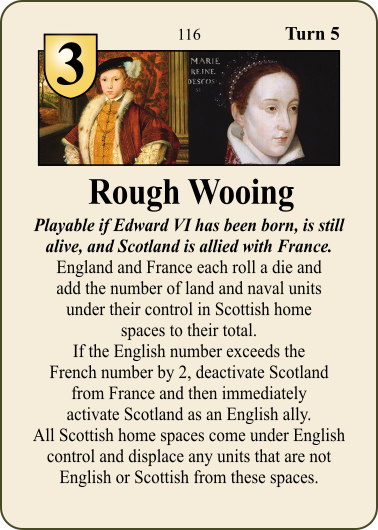
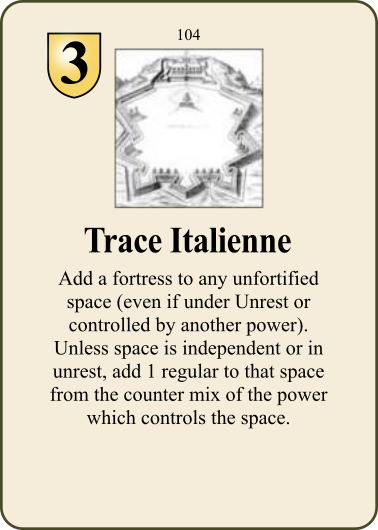
The Pope plays Rough Wooing for command points, sending Andrea Doria and the Genoan fleet into the Barbary Coast and building St. Peter's for two CP. The Protestants play Trace Italienne to initiate a debate in the German language zone. The matchup ends up being Büllinger versus Eck, so the Protestants swap in Luther and draw a card with Here I Stand. The first round ends in a tie, and in the second round, Campeggio beats Oekolampedius by two hits, flipping Kassel and Lübeck.

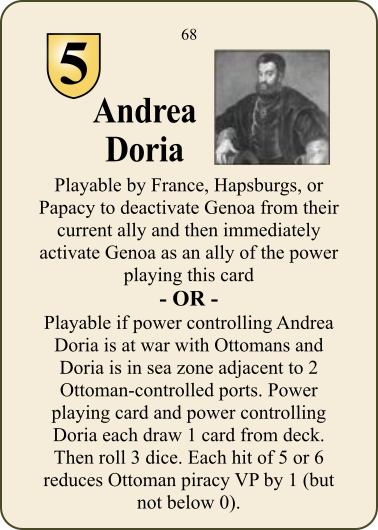
For my part, I play my home card to place four regulars in Istanbul. With France past the victory threshold, there's not a lot I can do except hope that there's a next turn and I can have a shot at winning this. On that note, the Habsburgs play Andrea Doria as an event: both they and the Papacy draw a card, but luckily I lose none of my piracy VPs.


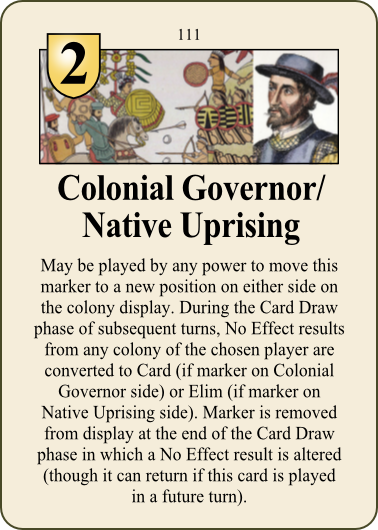
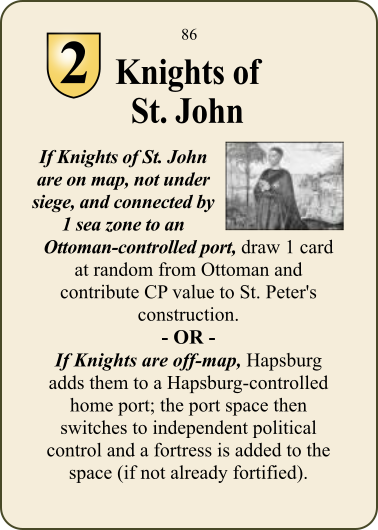
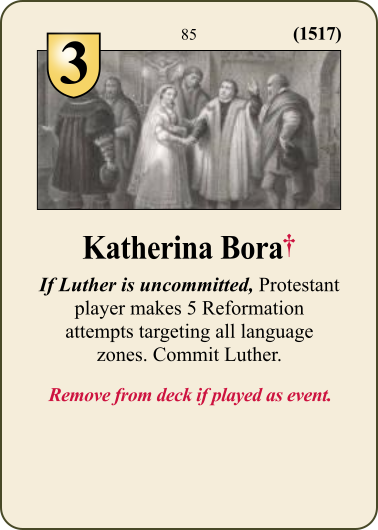
With only one card left, there's nothing England can do to evict the French from York, and they skip their impulse. France plays Colonial Governor / Native Uprising for command points, recruiting a mercenary in St. Dizier and returning their ships in the Gulf of Lion to Marseille. The Pope plays Knights of St. John for command points to finish building St. Peter's, taking them to 20 VP. The Protestants play Katherine Bora to start translating the New Testament into French.

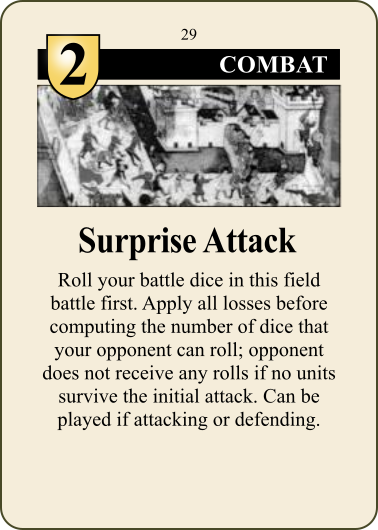
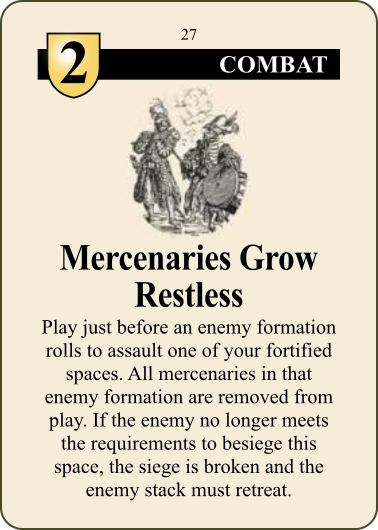
As the Ottomans, the French victory seems inevitable at this point, so I pass. The Habsburgs play Philip of Hesse's Bigamy as an event, forcing the Protestants to either discard a random card or remove the bigamist from play. They discard Surprise Attack. England skips their impulse, and so does France. The Papacy plays Papal Bull, excommunicating Zwingli and choosing to debate an uncommitted Protestant in German. Aleander faces Oecolampadius, and wins by one hit to none. With Aleander's special ability, that means Salzburg and Kassel flip Catholic. The Protestants and Ottomans skip their impulses, and the Habsburgs play their home card for command points. They recruit four mercenaries in Vienna, and Charles again leads his forces to Pressburg. In the ensuing battle, all four mercenaries are lost for three Ottoman casualties, and the Habsburgs withdraw back to Vienna. England and France skip their impulses, and the Papacy plays Mercenaries Grow Restless to recruit a regular in Rome. Then everyone skips, ending the action phase.

Because it was obvious the game would end this turn, we skipped the winter phase and went straight on to the New World. The Habsburg and French explorers ended up being Roberval and Magellan, and while Roberval returned empty-handed, Magellan completed a succesful circumnavigation! This earned the Habsburgs 1 VP for the Pacific Straits and 3 for the circumnavigation, catapulting them into second place. It's not enough to change the outcome, though, and the game ends in a French victory.

Here's the final score:

Protestants 17
England 20
Papacy 21
Ottomans 22
Hapsburgs 23
France 26


**

We got Turn 5 started on May 14th 2021, and the diplomacy phase ended on June 22nd. The action phase kicked off on July 20th, and ran for the rest of the year and then some. Prince Edward was born on August 30th, and Tyndale published his New Testament on September 22nd. Karlstadt was burned on December 20th, and York fell on the first of February 2022. By the time Zwingli was excommunicated, the turn had taken a full year. The action phase and the game ended on Monday, the 11th of July: two years, three months and some days since Luther's 95 Theses hit the table on March 22nd 2020.

**

Well, that was certainly an epic experience in the proper sense of the word. As one of our players put it to me, the delay between sending out your "orders" and finding out what happened made for a real feeling of grand strategy. I'm delighted we performed this experiment, and want to thank everyone who participated.

I have to say I still have mixed feelings about this last turn. I'm not taking anything away from the French player: they saw a shot at a win, and combined some very skilful diplomacy with getting everything out of the cards they were dealt to take it. So I consider this an absolutely deserved win. It did involve running some considerable risks, though. There were several cards that could have derailed the French win completely: any of the cards affecting mercenaries would have been difficult for the thinly stretched French to deal with, and something like Diplomatic Marriage, City State Rebels or Andrea Doria could have knocked out a key, leaving them short of the 25 VP needed for the win.

The thing is, nearly all of those cards were in play this turn, and none of them were used against the French, even when it became clear that they were winning. We've played Munchkin, where as soon as someone starts pulling ahead, everybody piles on them; this was somehow exactly the opposite experience. With my cards and board position, there was very little I could do except hope there would be a sixth turn, where I think all of us would have had a shot at the win. Several players could have done something to stop the French. The Habsburgs could have dropped France below 25 VP and put themselves in a position to win with a successful circumnavigation - which, we know with hindsight, they would have got. The play of Andrea Doria against my Ottomans, as opposed to deactivating Genoa, amounted to throwing the game to the French. I still don't quite know how I feel about that.

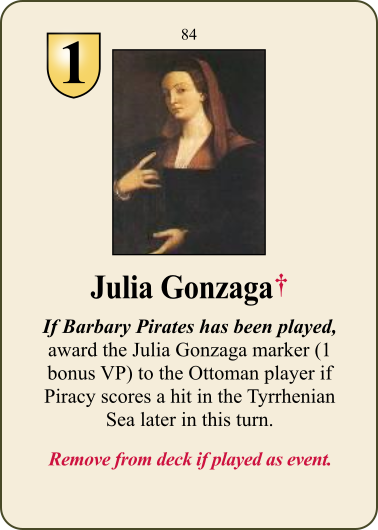
Having said that, I'm reasonably happy with my strategy. My experience in our first game was that if the Ottomans come out swinging, everyone else will mobilize against them, and I wanted to avoid that. What's perhaps slightly boring about the Ottomans, purely in an abstract strategy game sense, is that you've got very few options other than fighting the Habsburgs. I tried fighting the Papacy, and I don't mind telling you I was unpleasantly surprised by Venetian Alliance! I was unlucky on some key naval combat rolls, otherwise I think I might have done better in the Mediterranean. I was also quite lucky on my piracy rolls, and managed to grab Julia Gonzaga as well. I feel that if there had been one more turn, I'd have had a pretty good shot at winning, but it wasn't to be.

**

So, now that that's done, I've put in a P500 order for Virgin Queen. Again, I want to thank everyone who took part; we'll be back.